 Share
Share 


The ATP is set for two 500 level events this week as the China Open and the Japan Open Tennis Championships are set to begin. Be sure to check out our tennis match trends page for daily odds, trends and insights on each match.
Up to $1,500 in Bonus Bets if Your First Bet Doesn't Win*
*Bonus Bets Expire in 7 Days. One New Customer Offer Only. Add’l terms. 21+. Gambling Problem? Call 1-800-GAMBLER or 1-800-MY-RESET
Up to $1,500 in Bonus Bets if Your First Bet Doesn't Win*
*Bonus Bets Expire in 7 Days. One New Customer Offer Only. Add’l terms. 21+. Gambling Problem? Call 1-800-GAMBLER or 1-800-MY-RESET
ATP China Open
Favorite to Win: Alexander Zverev +185
Sleeper Pick: Alex de Minaur +1100
ATP China Open Information
- Dates: September 30–October 6, 2026
- Location: Beijing, China
- Surface: Hard (outdoor)
- Tier: 500
- Defending Champion: Jannik Sinner
ATP China Open Odds to Win
| Seed | Country | Player | Odds to Win |
|---|---|---|---|
| 1 | 🇩🇪 | Alexander Zverev | +185 |
| 2 | 🇨🇦 | Felix Auger-Aliassime | +800 |
| 6 | 🇷🇸 | Novak Djokovic | +900 |
| 3 | Daniil Medvedev | +900 | |
| 5 | 🇦🇺 | Alex de Minaur | +1100 |
| 7 | 🇺🇸 | Learner Tien | +1400 |
| 8 | 🇨🇿 | Jakub Mensik | +1500 |
| Andrey Rublev | +2000 | ||
| 4 | 🇮🇹 | Flavio Cobolli | +2200 |
| Karen Khachanov | +3000 | ||
| 🇵🇱 | Hubert Hurkacz | +3000 | |
| 🇰🇿 | Alexander Bublik | +3500 | |
| Roman Safiullin | +4000 | ||
| 🇦🇷 | Francisco Cerundolo | +4000 | |
| 🇨🇳 | Yunchaokete Bu | +5000 | |
| 🇫🇷 | Quentin Halys | +5000 | |
| 🇵🇹 | Nuno Borges | +5000 | |
| 🇨🇳 | Juncheng Shang | +5000 | |
| 🇬🇧 | Cameron Norrie | +5000 | |
| 🇫🇷 | Arthur Rinderknech | +5000 | |
| 🇳🇱 | Tallon Griekspoor | +6000 | |
| 🇦🇷 | Juan Manuel Cerundolo | +6000 | |
| 🇫🇷 | Arthur Gea | +6500 | |
| 🇳🇱 | Botic van de Zandschulp | +6500 | |
| 🇦🇷 | Thiago Agustin Tirante | +8000 | |
| 🇵🇪 | Ignacio Buse | +10000 | |
| 🇸🇰 | Alex Molcan | +12000 | |
| 🇨🇳 | Zhizhen Zhang | +13000 | |
| 🇩🇪 | Jan-Lennard Struff | +13000 | |
| 🇦🇷 | Mariano Navone | +15000 | |
| 🇪🇸 | Pablo Carreno Busta | +15000 | |
| 🇦🇷 | Sebastian Baez | +20000 |
ATP China Open Draw
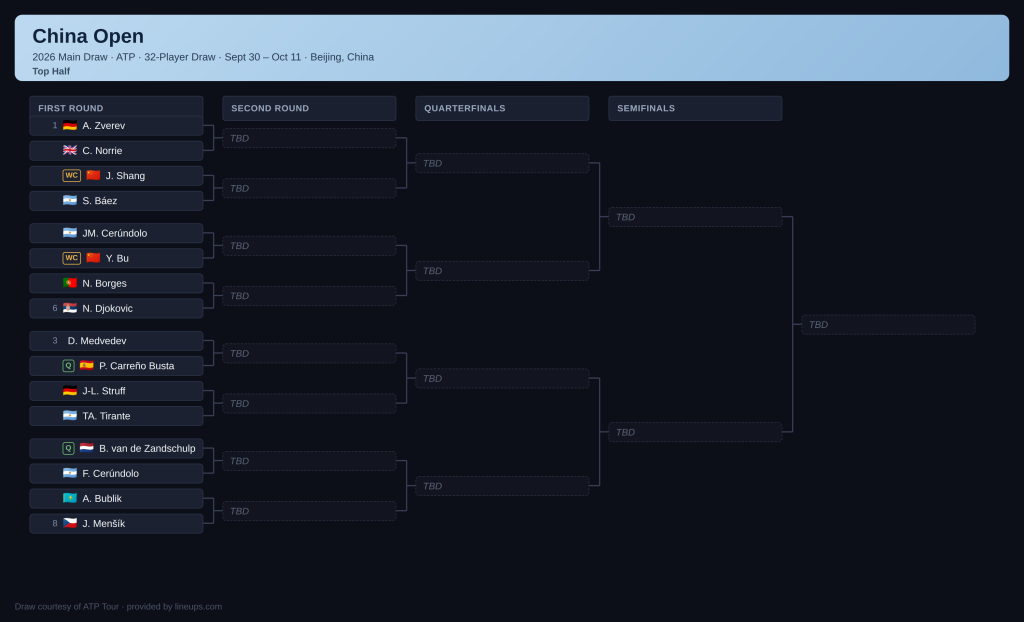
Top Half
Alexander Zverev anchors the top half as the No. 1 seed, but he’s got no shortage of landmines to clear. Novak Djokovic (6) looms as a projected quarterfinal opponent, and the six-time Beijing champion has history on his side here. Daniil Medvedev is arguably the most dangerous floater in the draw, sitting in a section with qualifier Pablo Carreño Busta and countryman Jan-Lennard Struff. Wildcards Juncheng Shang and Yunchaokete Bu give the home crowd two players to rally behind early, though Shang draws a tough opener against Cam Norrie. Jakub Menšík (8) headlines the bottom quarter of this half but will have to get through Alexander Bublik first, never a given.
Bottom Half
Felix Auger-Aliassime (2) is the highest seed in the bottom half and a favorite to reach the semifinals, but Karen Khachanov — unseeded, dangerous, and unafraid of big stages — sits right in his path. Alex de Minaur (5) and Flavio Cobolli (4) round out the seeded contingent, while Andrey Rublev, without a seed for the first time in years, is the biggest threat lurking outside the top eight. Learner Tien carries real momentum as the 7/WC entry, and Roman Safiullin’s special-exempt status hints at a player still working his ranking back. Keep an eye on Hubert Hurkacz too — a big server capable of stealing a set or two off anyone in this section.
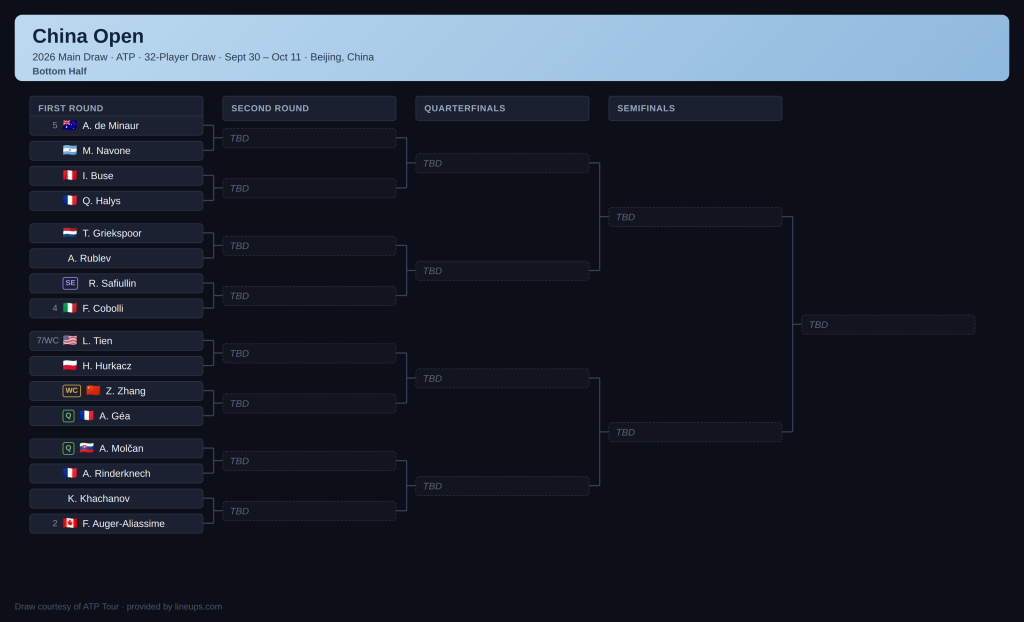
ATP China Open Bracket Analysis
Quarter 1 – Deciding Factor
Zverev’s Perfect Record vs. Shang’s Wildcard Danger
Zverev doesn’t have to worry about the head-to-head in his likely second-round matchup: he’s beaten Cameron Norrie eight straight times, including twice already in 2026 (Australian Open and Cincinnati), and Norrie has never taken a set off him in three of those meetings. The bigger threat in this section is wildcard Shang Juncheng, who enters ranked all the way down at No. 228 after a foot surgery layoff but is still dangerous — he beat world No. 10 Karen Khachanov as a wildcard at last year’s Shanghai Masters. Sebastián Báez is the wild card of the seeding, not the entry list, capable of grinding out a long match against either. On paper this is Zverev’s to lose, but Shang is exactly the kind of unranked floater who’s already proven he can take down a top-10 player in this country.
Djokovic’s Beijing Fortress vs. His 2026 Collapse
No player has a record like Djokovic’s in Beijing: 29-0, six titles (2009, 2010, 2012-2015), the last coming over Nadal in the 2015 final. That history is the entire case for him advancing. Everything else about his 2026 season argues against it — he was bageled out of Cincinnati by Thiago Agustin Tirante, then suffered his first-ever first-round loss at the US Open, a five-set collapse to Mariano Navone that included vomiting, cramping, and shoulder pain. It was his earliest Grand Slam exit since 2006. He opens against Nuno Borges, a manageable draw, but the deciding factor in this section isn’t tactical — it’s whether his body holds up long enough for Beijing’s ghosts to matter again.
Quarter 2 – Deciding Factor
Medvedev’s Indian Wells Proof vs. Tirante’s Cincinnati Breakthrough
Medvedev arrives in this section playing the best tennis of anyone left in the draw. He’s up to world No. 6 after winning his third title of the season in Hangzhou this week — beating a red-hot Andrey Rublev 7-5, 6-4 in the final — to go with titles in Brisbane and Dubai and a runner-up finish at Indian Wells, where he beat Alcaraz in the semis before losing to Sinner. He’s 38-16 on the season with 27 hard-court wins, and Beijing specifically has been a happy hunting ground: a finalist here in 2023, with back-to-back semifinal runs in 2024 and 2025.
The complication is Thiago Agustin Tirante sitting in the same section: the Argentine, ranked No. 50, just had the best week of his career in Cincinnati, upsetting a physically compromised Djokovic 2-6, 6-4, 6-4 in the second round and then beating Martin Landaluce to reach his first-ever Masters 1000 last-16. Jan-Lennard Struff and qualifier Pablo Carreño Busta round out the section, but neither changes the math — Medvedev should be heavily favored to escape this half of the quarter, with Tirante as the live wire who’s already proven he beats players he shouldn’t.
Bublik and Menšík’s Collision Course vs. Van de Zandschulp’s Slam-Killer Résumé
The other half of this quarter is a legitimate toss-up before it even reaches the Quarterfinal round. Alexander Bublik, now No. 16 and fresh off becoming the first Kazakh man ever ranked inside the Top 10 after his Hong Kong title over Musetti, draws No. 8 seed Jakub Menšík — who’s arguably even hotter, having just knocked off world No. 2 Sinner in Doha and won Auckland earlier this year. Menšík leads their head-to-head 2-1, but Bublik’s lone win came in a five-set Wimbledon classic, so there’s no real form edge either way; whoever survives that opener becomes the section’s presumptive favorite.
That’s exactly why Botic van de Zandschulp is the pick here despite sitting at No. 40 unseeded — his résumé against exactly this level of danger is absurd: he ended Alcaraz’s 15-match Grand Slam win streak at the 2024 US Open, beat a top-10 Djokovic at Indian Wells last year, and took down de Minaur at this year’s US Open before finally losing to Zverev in the quarterfinals after two straight five-setters. He opens against Francisco Cerúndolo, a far gentler draw than Bublik or Menšík get each other, and if his big-match habit holds, he’s built for exactly this kind of section.
Quarter 3 – Deciding Factor
De Minaur’s Soft Section vs. His Own Recent Slip-Ups
De Minaur is the seed here (No. 5) but not actually the higher-ranked player in the quarter anymore — Cobolli has passed him — which makes the draw around him matter more than usual. His most dangerous potential opponent is Mariano Navone, who just delivered the biggest win of his career at the US Open, grinding out a five-set comeback over a physically compromised Djokovic (7-6(5), 5-7, 4-6, 6-2, 6-1).
That’s a real scalp, but Navone remains a clay-built counterpuncher without de Minaur’s hard-court pedigree, and Ignacio Buse and Quentin Halys behind him aren’t the kind of names that change a draw. It’s worth noting de Minaur has stumbled against exactly this caliber of player elsewhere in 2026 — he lost to Cobolli at Wimbledon and to Menšík at the French Open — so this isn’t a case of him being unbeatable. It’s that nothing in his immediate section looks capable of beating him before he has to find out.
Rublev’s Uneven Season vs. His Hangzhou Statement
Cobolli’s half of the quarter still carries more risk than his seed number suggests, but the picture on Rublev just shifted. Yes, he fell out of the Top 20 for the first time in six years earlier this year on the back of shaky losses to players like Van Assche, Borges, and Safiullin (who’s literally in this same section). But he just reached his third final of the 2026 season in Hangzhou — beating Kyrian Jacquet 7-6(0), 6-1 in the semi for his 400th tour-level win before running into a red-hot Medvedev in the final, 7-5, 6-4. That’s a player arriving in Beijing with real match rhythm, not one in free fall. Add Tallon Griekspoor, who’s already beaten Bublik and world No. 3 Zverev this year, and Cobolli’s route to the quarterfinal looks genuinely live-wire, even before accounting for his own French Open-finalist form.
Quarter 4 – Deciding Factor
Tien’s Slam-Toppling Breakout vs. Hurkacz’s Chengdu Redemption
Tien arrives in this section as arguably the form player left in the bottom half. He’s up to a career-high world No. 12 after a spring and summer that included a maiden major quarterfinal at the Australian Open — where he beat fifth seed Daniil Medvedev in straight sets, taking one set 6-0, the first time all year Medvedev had lost a set that way at a major — a fourth-round run at the Italian Open for his best Masters result on clay, and a second tour title in Geneva over Mariano Navone. Hurkacz is playing catch-up on confidence more than ranking: he just reached his first final in over a year at Chengdu, his 13th career final, before falling to Alejandro Davidovich Fokina 6-4, 7-6(7). The three days between that final and this opener could matter as much as either man’s résumé.
Géa’s Cinderella Run vs. Zhang’s Home Crowd
Arthur Géa has been one of the more unlikely stories on tour in 2026 — a Los Cabos title over defending champion Denis Shapovalov, a lucky-loser run to the fourth round at the US Open with wins over Juan Manuel Cerúndolo, Zachary Svajda, and Michael Zheng, and an Australian Open second round secured by upsetting 17th seed Jiří Lehečka as a qualifier. He’s now a career-high No. 82 and playing with nothing to lose. Zhizhen Zhang gets a wildcard and a home crowd in Beijing to counter that momentum, but has nothing on his 2026 ledger that matches Géa’s run.
Auger-Aliassime’s Career-High Surge vs. Khachanov’s Familiar Foe
Auger-Aliassime is the highest seed in the section outside the top four in the draw, riding a career-high No. 4 ranking after becoming the first Canadian man to reach the quarterfinals at all four majors this year — punctuated by a five-set opening-round escape against Daniel Altmaier at Roland Garros before a quarterfinal loss to eventual finalist Flavio Cobolli. Khachanov already has a thread running through this section’s other storyline: he beat Géa at Roland Garros this year, and will be looking to play spoiler again against the section’s headline name.
Up to $1,500 in Bonus Bets if Your First Bet Doesn't Win*
*Bonus Bets Expire in 7 Days. One New Customer Offer Only. Add’l terms. 21+. Gambling Problem? Call 1-800-GAMBLER or 1-800-MY-RESET
Up to $1,500 in Bonus Bets if Your First Bet Doesn't Win*
*Bonus Bets Expire in 7 Days. One New Customer Offer Only. Add’l terms. 21+. Gambling Problem? Call 1-800-GAMBLER or 1-800-MY-RESET
ATP Japan Open Tennis Championships
Favorite to Win: Carlos Alcaraz -125
Sleeper Pick: Brandon Nakashima +1600
ATP Japan Open Information
- Dates: September 30–October 6, 2026
- Location: Tokyo, Japan
- Surface: Hard (outdoor)
- Tier: 500
- Defending Champion: Carlos Alcaraz
ATP Japan Open Odds to Win
| Seed | Country | Player | Odds to Win |
|---|---|---|---|
| 1 | 🇪🇸 | Carlos Alcaraz | −125 |
| 🇫🇷 | Arthur Fils | +700 | |
| 3 | 🇺🇸 | Taylor Fritz | +750 |
| 2 | 🇺🇸 | Frances Tiafoe | +1000 |
| 4 | 🇪🇸 | Rafael Jódar | +1200 |
| 5 | 🇺🇸 | Brandon Nakashima | +1600 |
| 7 | 🇺🇸 | Tommy Paul | +2000 |
| 🇨🇿 | Jiri Lehecka | +2200 | |
| 6 | 🇳🇴 | Casper Ruud | +2500 |
| 8 | 🇲🇨 | Valentin Vacherot | +2800 |
| 🇺🇸 | Alex Michelsen | +2800 | |
| 🇪🇸 | Alejandro Davidovich Fokina | +2800 | |
| 🇬🇷 | Stefanos Tsitsipas | +3500 | |
| 🇮🇹 | Lorenzo Musetti | +3500 | |
| 🇨🇦 | Denis Shapovalov | +3500 | |
| 🇮🇹 | Matteo Berrettini | +4000 | |
| 🇩🇰 | Holger Rune | +4000 | |
| 🇧🇪 | Alexander Blockx | +5000 | |
| 🇨🇱 | Alejandro Tabilo | +5000 | |
| 🇫🇷 | Ugo Humbert | +6500 | |
| 🇧🇪 | Zizou Bergs | +8000 | |
| 🇦🇷 | Tomas Martin Etcheverry | +8000 | |
| 🇯🇵 | Rei Sakamoto | +8000 | |
| 🇮🇹 | Matteo Arnaldi | +8000 | |
| 🇫🇷 | Luca Van Assche | +8000 | |
| 🇫🇷 | Kyrian Jacquet | +8000 | |
| 🇯🇵 | Kei Nishikori | +8000 | |
| 🇪🇸 | Jaume Munar | +10000 | |
| 🇮🇹 | Luciano Darderi | +10000 | |
| 🇬🇧 | Arthur Fery | +10000 | |
| 🇵🇾 | Adolfo Daniel Vallejo | +15000 | |
| 🇯🇵 | Sho Shimabukuro | +25000 |
ATP Japan Open Draw
Top Half
Carlos Alcaraz is the class of this half and the tournament’s top seed, but Tokyo’s crowd will have plenty to cheer with two Japanese wildcards in his quarter — Rei Sakamoto and Sho Shimabukuro both get a shot on home soil, though Shimabukuro opens against Denis Shapovalov. Tommy Paul (7) rounds out that group as the only other seed. The bottom quarter is stacked: Taylor Fritz (3) and Casper Ruud (6) bookend a section that includes Lorenzo Musetti and a return for Holger Rune, back in on protected ranking after his injury layoff. Kyrian Jacquet enters as a special exempt, an unusual add worth watching. Alcaraz projects to meet Fritz or Ruud for a semifinal spot, but Sakamoto’s home support could make his second-round test a genuine banana peel.
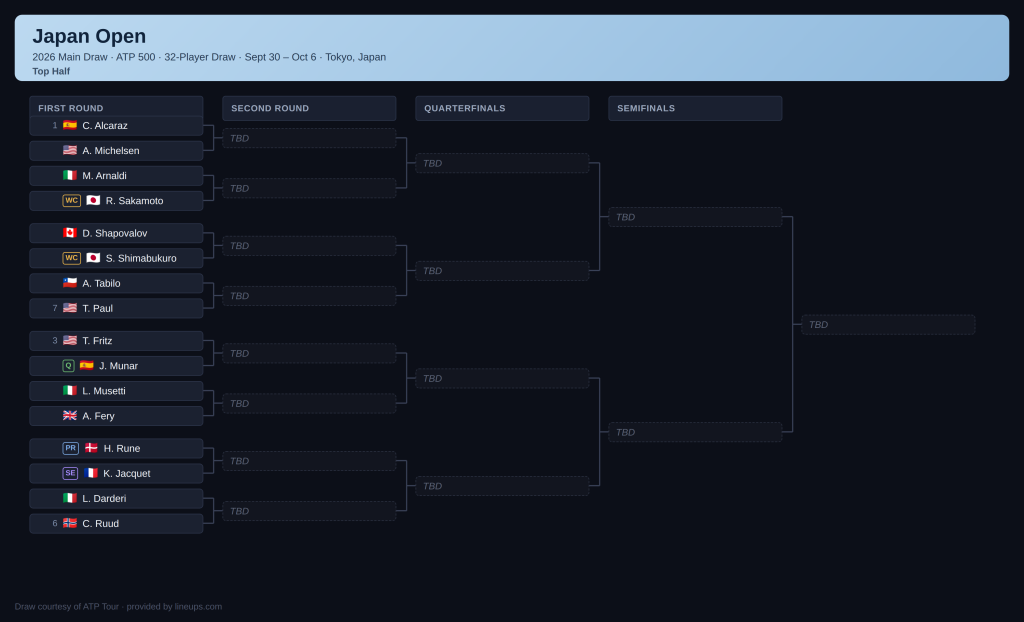
Bottom Half
Frances Tiafoe (2) headlines, but this half’s real story is how many big names had to come through qualifying to get here — Stefanos Tsitsipas and Arthur Fils both enter as Q, a reminder of how unforgiving the rankings crunch has been lately. Kei Nishikori’s wildcard is the sentimental pick, giving the Japanese crowd a home favorite in Tiafoe’s opening section. Brandon Nakashima (5) and Rafael Jódar (4) lead the top quarter, with Adolfo Daniel Vallejo sneaking through qualifying as well. Valentin Vacherot (8) anchors the bottom quarter opposite Tsitsipas’s group, setting up a potential all-underdog clash before the section even reaches its seeded players. Expect early fireworks — this half is deeper than its seeding suggests.
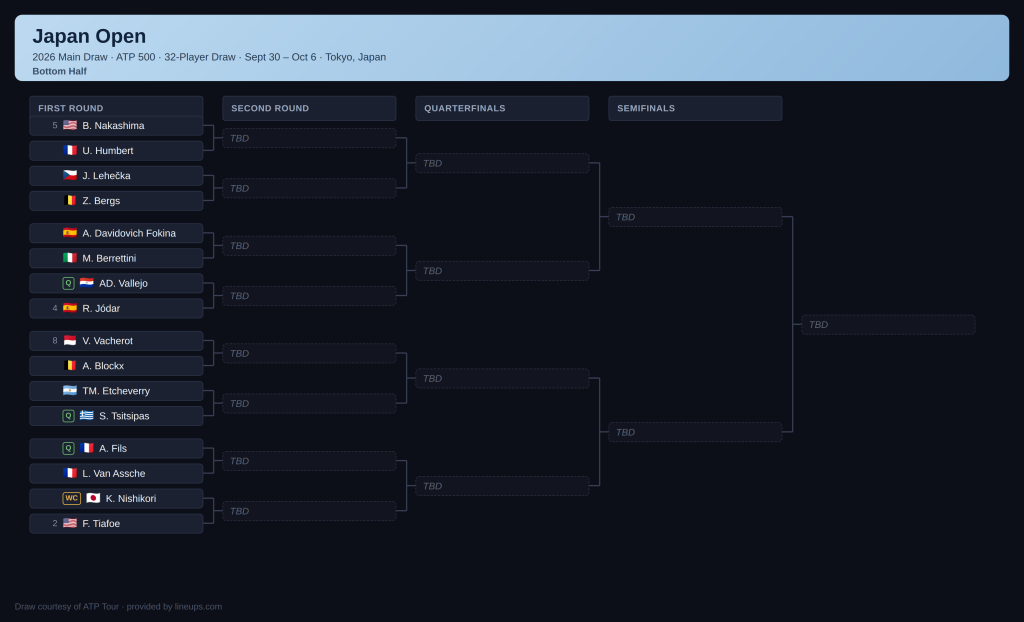
ATP Japan Open Bracket Analysis
Quarter 1 – Deciding Factor
Alcaraz’s Comeback Trail vs. Paul’s Clay-to-Hard Question Mark
Alcaraz is still finding his footing after a five-month absence with a wrist injury (tenosynovitis) that cost him Roland Garros and Wimbledon as defending champion. His return at the US Open produced a straight-sets win over Safiullin, but the reality check came in the quarterfinal, where Ben Shelton beat him 8-6, 6-7, 6-6, 7-10 in the latest-ever finish in tournament history.
He still has to get through Michelsen and the Arnaldi/Sakamoto winner to set up this section’s decisive match, and how his match sharpness holds up over three rounds is the open question. Paul, on the other side, opens against Tabilo and arrives off a clay-heavy season — a title at the U.S. Men’s Clay Court Championships in April and a runner-up finish in Hamburg in May — with far less evidence of what he does on a hard court right now. Head-to-head, Alcaraz leads 5-2, and won their most recent meeting comfortably, 6-0, 6-1, 6-4 in last year’s French Open quarterfinal.
Quarter 2 – Deciding Factor
Fritz’s Shaky Slam Finish vs. Ruud’s Battered Back
Fritz’s own résumé here isn’t spotless — he blew a two-set lead in the fourth round at the US Open and lost in five to Francisco Cerúndolo, so the “easy” path still has to be walked through Munar and a likely Musetti test in round two. But the section’s presumed 6-seed roadblock, Ruud, carries far more risk: he retired mid-match in Cincinnati with a back injury in August, then withdrew from the US Open before his first match, and enters Tokyo at No. 21 off a 28-22 season that’s been defined by that injury as much as results. His opener against Darderi — fresh off a clay-court run in Santiago that tells you little about his hard-court readiness — isn’t the concern; his back holding up over multiple rounds is.
Rune’s Rust vs. the Rest of the Bottom Section
The other floater worth watching is Rune, who returned this month after 335 days out with an Achilles injury — his only competitive tennis since being two Davis Cup wins, over Radulov and a grittier three-setter over Dimitrov. He’s currently No. 144 and, by his own team’s framing, still measuring progress in “healthy matches played” rather than results, which makes him a live danger in a single match but a long shot to string together the two or three wins needed to actually threaten Fritz in this section.
Quarter 3 – Deciding Factor
Nakashima’s Montreal Breakthrough vs. Humbert’s Opening Test
Nakashima enters off the best result of his career — his maiden Masters 1000 title in Montreal, where he beat both Darderi and Jódar back-to-back on the way to the trophy. That’s not just form, it’s a direct answer to the question of what happens if he sees Jódar again: he’s already done it, recently, under pressure. His own path here isn’t a total walkover — Humbert in round one is a capable ball-striker — but the presumed round-two test out of Lehečka/Bergs is a lower bar than what’s lurking on Jódar’s side.
Jódar’s Career-Best Season vs. a Red-Hot Davidovich Fokina Lying in Wait
Jódar’s 2026 has been a genuine breakout — a maiden title in Morocco, a Roland Garros quarterfinal built on a comeback from two sets down against Carreño Busta, and a Rome quarterfinal that made him the first teenager to get that far since Djokovic in 2007. He’s at a career-high No. 13, higher-ranked than Nakashima. But his path here is the harder one: an opener against Vallejo should be routine, but the round-two threat is Davidovich Fokina, who just won Chengdu — his second title of the year — returning from three and a half months out with injury, beating Juan Manuel Cerúndolo, Alexandre Muller, Basilashvili, and Hurkacz along the way. Walking into that in round two, rather than round three like Nakashima’s equivalent test, is the gap the pick comes down to.
Quarter 4 – Deciding Factor
Fils’ Case Despite the Qualifying Slot vs. His Own Comeback Year
Fils is the talent play here even though he’s coming through qualifying — a status owed to a scheduling mishap, not form: he and his team missed the entry deadline while deciding how to open the Asian swing, and didn’t get one of the three wildcards. On the court he’s been excellent, winning the Cincinnati Masters 1000 this year and sitting at No. 11, currently seventh in the race to Turin. The complicating factor is his own 2026: a back stress fracture kept him out from August 2025 through February, so there’s still some rust-versus-readiness question even with the Cincinnati title on the résumé. He opens against countryman Van Assche.
Tiafoe’s US Open Semifinal Run vs. Nishikori’s Farewell Tour
Tiafoe is the real threat to that plan. He put together the biggest Grand Slam comeback of his career at the US Open, beating Vacherot in the fourth round and Michelsen in a wild quarterfinal before finally losing in the semifinal — that’s a two-seed playing his best tennis of the season, not a name on paper. He has to get through Nishikori first, though, and that’s its own story: Nishikori has announced he’s retiring at the end of 2026, has battled injuries most of the year, and gets a home Tokyo crowd for what’s likely one of his last tournaments on Japanese soil. Sentiment aside, if Tiafoe handles that emotional test, he’s the one player in this section playing well enough right now to beat Fils for the quarter.
Photo Credit: REUTERS