
 Share


The Daniel Jones era in Indianapolis came to an abrupt, brutal end on Friday. One day after a 26-3 blowout loss to the Texans on Thursday Night Football — a game in which Jones was benched in the fourth quarter after going 12-of-27 for 144 yards and an interception — head coach Shane Steichen announced the Colts had released their quarterback and would turn the offense over to Anthony Richardson Sr. the rest of the way. It’s a stunning reversal for a player who was the engine behind an 8-2 start in 2025 before a fibula fracture and, later, a torn Achilles unraveled his season, and who the Colts had just paid franchise-quarterback money to keep.
The Financial Fallout
Jones signed a two-year, $88 million extension with Indianapolis in March 2026 — a deal that came together fast, with the Colts using the transition tag on him on March 3 before locking him into the new contract just nine days later. It was, by some cap accountings, the most expensive two-year contract in NFL history on a per-year basis. The deal paid him close to $50 million to start all 11 games this season, numbers that looked rough in hindsight: 205-of-351 passing (58.4%) for 1,974 yards, seven touchdowns and 13 interceptions, with his completion percentage and passer rating both ranking near the bottom of the league among qualified starters.
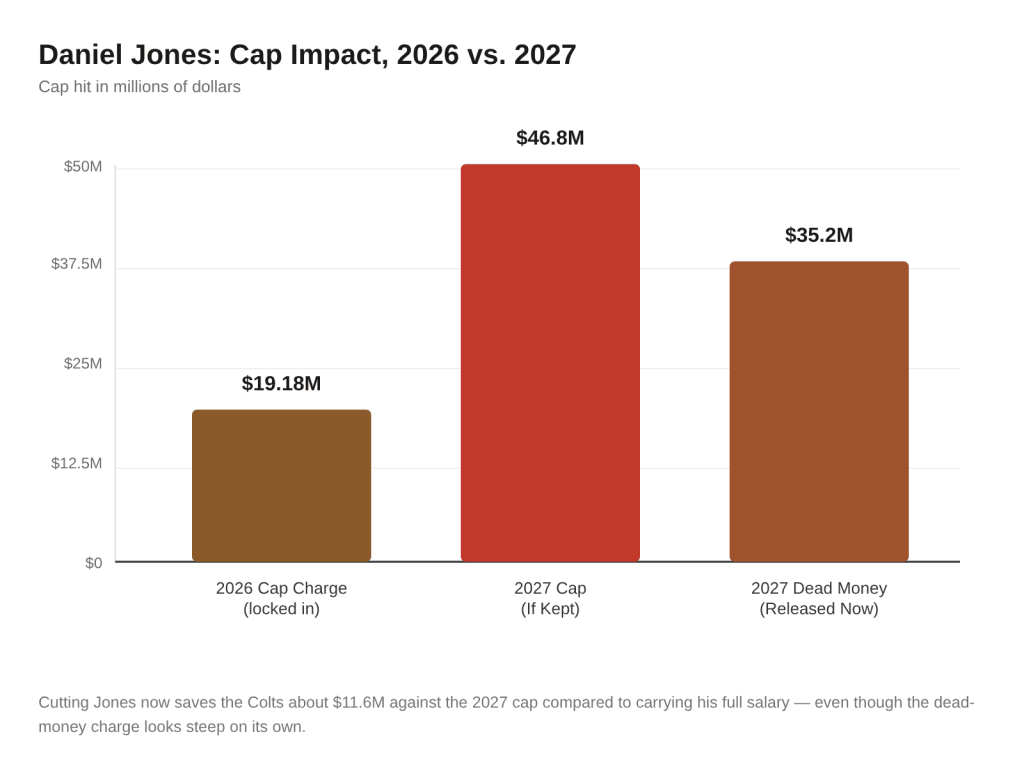
The move away from him wasn’t cheap, but it also wasn’t as devastating to Indianapolis’ books as the raw dead-money number suggests. Jones’ 2026 cap charge ($19.18 million) was already baked in and doesn’t change. The real number to watch is 2027: had the Colts kept him, his cap hit would have jumped to roughly $46.8 million (a $33.49 million base salary, a $4 million roster bonus and $8.8 million in signing-bonus proration). By cutting him now, Indianapolis instead absorbs an estimated $35.2 million in dead money against the 2027 cap — the remaining proration from his signing bonus, which was already paid out in prior years and simply has to be recognized for cap purposes — while saving about $11.6 million relative to carrying his full 2027 number. Crucially, only about $10.5 million of his 2027 salary was guaranteed, and only for injury, with that guarantee not fully vesting until March. Because Jones was released now, in November, and not due to injury, the Colts don’t owe him that money going forward — the dead cap charge is an accounting hit from money already spent, not a fresh check they have to cut him.
One other detail worth clearing up: despite some wire reports suggesting Jones would need to clear waivers before signing elsewhere, that shouldn’t apply here. Jones has seven accrued NFL seasons under his belt, which makes him a vested veteran under the league’s collective bargaining agreement — a status that exempts him from the in-season waiver process entirely. Waivers are for players with fewer than four accrued seasons; a vested veteran released during the season becomes an unconditional free agent the moment the move is officially processed, free to sign with any of the 32 teams immediately, with no waiting period and no draft-pick compensation owed to Indianapolis.
Anthony Richardson Takes Over
The job now belongs to Anthony Richardson Sr., the No. 4 overall pick in the 2023 draft, who will make his first start since Week 16 of the 2024 season when the Colts host the Giants in Week 12. It’s been a star-crossed three-plus years for Richardson, who has appeared in just 19 career games (15 starts) and completed only 50.6% of his throws (179-of-354) for 2,408 yards with 11 touchdowns and 13 interceptions, though his rushing upside remains real — 640 yards and 10 touchdowns on 118 career carries. He’s logged only mop-up duty in two appearances this season, including Thursday’s loss to Houston, where he entered with roughly seven minutes left and didn’t complete either of his two pass attempts.
Indianapolis’ remaining schedule gives Richardson a runway to show what he’s got: at home against the Giants on Nov. 29, a Week 13 bye, then road trips to Philadelphia (Dec. 13) and Tennessee (Dec. 20), before closing with a home game against Cincinnati, a trip to Cleveland on Jan. 3, and a home finale against Jacksonville. At 3-8 and already looking toward a rebuild after trading away Quenton Nelson and DeForest Buckner at the deadline, Indy has every incentive to let Richardson play through mistakes and find out, once and for all, what they have in him.
Where Could Jones Land?
As an immediate free agent with no waiting period, Jones should have options — and a few teams missing a starting quarterback stand out as logical fits.
The Arizona Cardinals are the most obvious: Kyler Murray is done for the season with a foot injury, and after benching Jacoby Brissett in favor of Gardner Minshew and then trading Brissett to Baltimore entirely, Arizona’s depth behind Minshew is a rookie in Carson Beck. A proven, if inconsistent, veteran arm like Jones would give them a real bridge option.
The Miami Dolphins are in a similar spot — with Tua Tagovailoa no longer on the roster and Malik Willis sidelined on injured reserve with a groin injury, rookie Kyle McCord has been thrust into the starting job, and Miami could use a veteran safety net behind him.
Photo Credit: REUTERS