
 Share
Share 


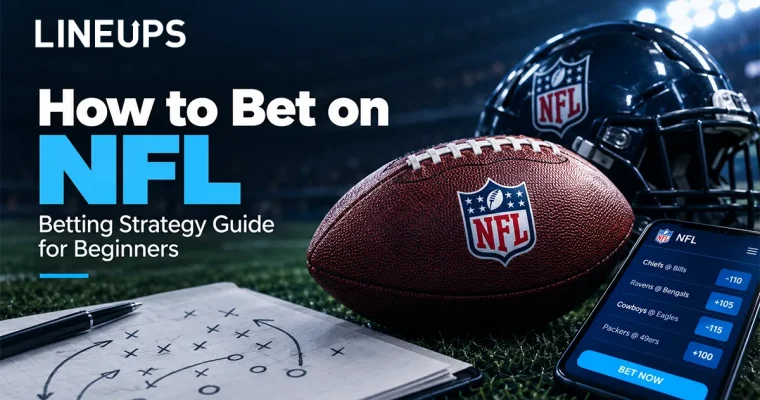
Here’s how to bet on NFL games: choose a game or player market, select an outcome, and decide how much to risk at the odds offered. A moneyline bet asks you to pick the winner. A point spread asks whether a team will cover a scoring margin. An over/under asks whether the combined score will finish above or below a set number.
Sounds simple enough, right? The part that catches new bettors out is that picking the winning team and winning your bet are not always the same thing. The number you take, the price you pay, and the amount you risk all matter.
This NFL betting guide walks through the basics with one running example, then covers the NFL betting strategies you can use to make better-informed decisions. Every line, score, and payout below is hypothetical, so you can follow along without placing a bet.
All matchups, lines, scores, and payouts in the examples below are hypothetical. They are here to explain how betting works, not to recommend a wager or show current odds. Payout examples use cash stakes and exclude promotional adjustments.
How Does NFL Betting Work?
Every bet has a few moving parts. The market tells you what you’re betting on. The selection is the outcome you choose. Your stake is the money you risk, and the odds determine the profit if your bet wins. Once the result is official, the sportsbook settles the bet under its rules.
If you’re learning how to bet on football for beginners, those four parts are the whole picture. Everything after that is detail.
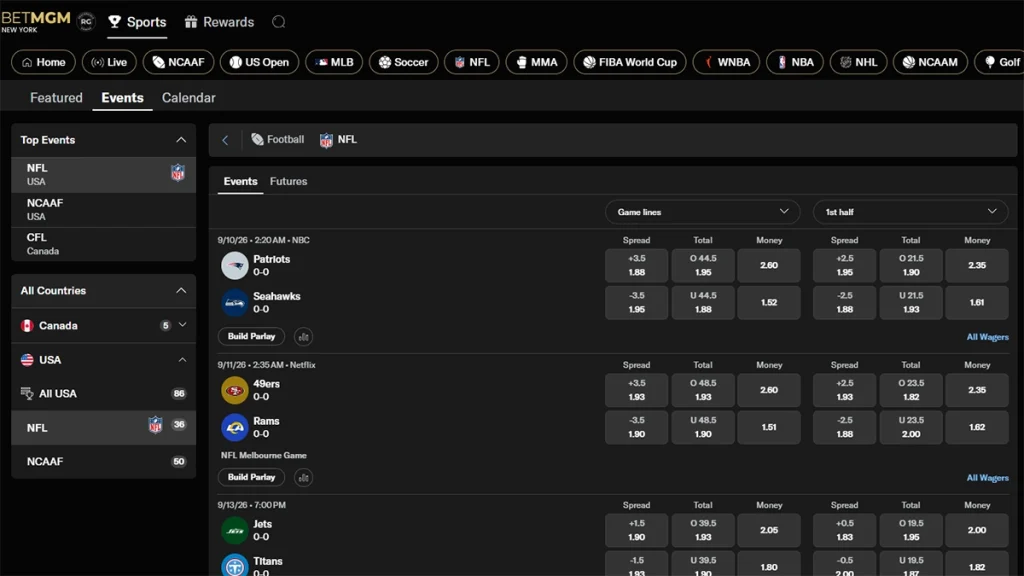
Let’s say New England is playing Miami. Here is the board we’ll use throughout this guide:
| Team | Moneyline | Point spread | Game total |
|---|---|---|---|
| New England Patriots | -180 | -3.5 (-110) | Over 44.5 (-110) |
| Miami Dolphins | +155 | +3.5 (-110) | Under 44.5 (-110) |
New England is the favorite, while Miami is the underdog. But you don’t have to bet the favorite, and you don’t have to pick a team at all. You could bet on the total instead. Each column represents a different question about the same game.
That is NFL betting explained at its simplest: one question, one price, one settlement.
NFL Bet Types Explained with Examples
Moneyline: Pick the Winner of the Game
A moneyline bet is a bet on which team wins the game outright. The margin doesn’t matter. If you take New England and it wins by one point, your bet wins just as it would if New England won by 20.
Here’s the catch: the favorite costs more to back. At -180, a $10 bet on New England wins about $5.56 in profit. At +155, a $10 bet on Miami wins $15.50 in profit. A bigger potential payout comes with a different price, not a promise that the underdog is a better bet.
We’ll break down that math in the section on reading the odds below.
Point Spread: Winning the Game Isn’t Always Enough
The point spread gives the favorite a scoring handicap. In our example, New England is -3.5. The Patriots must win by at least four points for that spread bet to win. Miami +3.5 wins if the Dolphins win outright, tie, or lose by three points or fewer.
Let’s say New England wins 24-21. Patriots fans are happy, but anyone who took New England -3.5 loses the bet. Miami +3.5 covers because the Dolphins lost by only three. Your team can win the game and still lose against the spread.
Also notice the two different numbers in -3.5 (-110). The -3.5 is the handicap; the -110 is the price. Don’t confuse how many points a team needs to cover with how much a winning bet pays.
Over/Under: Bet on the Combined Score
An over/under, also called a total, asks how many points the teams will score between them. At 44.5, the over wins with 45 or more combined points. The under wins with 44 or fewer. It doesn’t matter which team wins.
That same 24-21 Patriots win produces 45 points, so over 44.5 wins. If the final score were 24-20, the total would be 44 and the under would win. The half-point means the score cannot land exactly on the line.
NFL Player Props and Futures Explained
A player prop focuses on an individual result, such as passing yards, rushing yards, receptions, or a touchdown scorer. If a quarterback’s passing total is 249.5 yards, over wins at 250 or more and under wins at 249 or fewer, provided the bet has action under the sportsbook’s participation rules.
Futures cover outcomes decided later, such as a division winner, season win total, or Super Bowl champion. Suppose you bet $10 on a team at +2000 to win the Super Bowl. If it wins, you receive $200 in profit plus your $10 stake. The bet is settled at the price you accepted, even if the odds change afterward. Remember that your money may be tied up for months.
Parlays, Same-Game Parlays, and Teasers
A parlay combines two or more selections, called legs, into one bet. All active legs must win for the ticket to win. Get three right and one wrong, and the whole parlay loses. Pushes and voided legs are handled under the sportsbook’s rules.
A same-game parlay combines selections from one game. New England to win and its quarterback to throw multiple touchdowns could be related outcomes, so you cannot assume their prices simply multiply together. The sportsbook accounts for those relationships when pricing the ticket.
A teaser lets you move eligible spreads or totals in your favor while combining selections at a quoted price. In a hypothetical six-point teaser, -8 becomes -2 and +2 becomes +8. Easier-looking lines do not make the whole ticket safe. Check the payout and how ties are treated before confirming.
There is no universal payout for a four-leg parlay or a two-team teaser. Look at the actual odds on your bet slip. For beginners, single bets are easier to follow because one result settles one wager.
Live NFL Betting: Placing Bets After Kickoff
Live betting means betting after kickoff. Lines change with the score, clock, possession, and other developments. A team falling behind may get a bigger moneyline price, but that alone doesn’t make it good value. Broadcasts can be delayed, markets can pause, and prices can change before a bet is accepted. You don’t need to bet during the game to follow the action.
How to Bet on NFL Games: Step by Step
- Check eligibility. Confirm the legal age, location, and sportsbook licensing requirements where you are. Our guide to where sports betting is legal explains the state-by-state picture.
- Choose a sportsbook and set a budget. Use our page to compare NFL betting sites and apps for the features you need. Complete the required identity and location checks, and only set aside money you can afford to lose.
- Find the game and choose the market. Make sure you’re looking at the right matchup, date, and period. A full-game total and a first-half total are different bets.
- Compare the line and the price. Compare current NFL odds before selecting a wager, and confirm the sportsbook still offers that number. Prices can move.
- Read the bet slip. Check your selection, odds, stake, potential profit, and applicable rules. In our example, Miami +3.5 (-110) with a $10 stake should show roughly $9.09 in potential profit.
- Confirm and keep the receipt. Check that the bet was accepted and record the final line and price. A selection sitting in your bet slip is not yet a placed bet.
If you use an offer, read its qualifying conditions and expiry date. Bonus bets may return winnings without returning the bonus stake, so their payouts can differ from the cash examples above. Compare current NFL sportsbook promos separately; an offer should not push you into staking more than you planned.
Up to $1,500 in Bonus Bets if Your First Bet Doesn't Win*
*Bonus Bets Expire in 7 Days. One New Customer Offer Only. Add’l terms. 21+. Gambling Problem? Call 1-800-GAMBLER or 1-800-MY-RESET
Up to $1,500 in Bonus Bets if Your First Bet Doesn't Win*
*Bonus Bets Expire in 7 Days. One New Customer Offer Only. Add’l terms. 21+. Gambling Problem? Call 1-800-GAMBLER or 1-800-MY-RESET
Get $250 in Bonus Bets When You Wager $5 for 5 Days ($50 Bonus Bets Per Day)
Available on Desktop, Android & iOS
Easy Deposits, Fast Withdrawals
Get $250 in Bonus Bets When You Wager $5 for 5 Days ($50 Bonus Bets Per Day)
Available on Desktop, Android & iOS
Easy Deposits, Fast Withdrawals
Get a 100% Bet Match up to $100 in FanCash for 10 Days
Earn FanCash & Spend it on Team Swag or More Bets
Daily Odds & Profit Boosts on Select Games
Get a 100% Bet Match up to $100 in FanCash for 10 Days
Earn FanCash & Spend it on Team Swag or More Bets
Daily Odds & Profit Boosts on Select Games
Spend $5+ Get $150 in Bonus Bets Over 14 Days
Plus Get up to $1,000 Deposit Bonus
Bet on All Your Favorite Sports With America's Top-Rated Sportsbook
Spend $5+ Get $150 in Bonus Bets Over 14 Days
Plus Get up to $1,000 Deposit Bonus
Bet on All Your Favorite Sports With America's Top-Rated Sportsbook
Bet $10 Get $200 in Bonus Bets Win or Lose
30% Extra on Same Game Parlay Profit
T&Cs Apply. Gambling Problem? Call 1-800-GAMBLER or 1-800-MY-RESET (AZ, CO, IL, IN, KS, KY, LA, MD, MI, MO, NC, NJ, OH, PA, TN, VA, WV) or 1-800-BETS OFF (IA). 21+ only. Please gamble responsibly. Must be present in AZ/CO/IA/IL/IN/KS/KY/LA(select parishes) /MD/MI/MO/NC/NJ/OH/PA/TN/VA/WV.
Bet $10 Get $200 in Bonus Bets Win or Lose
30% Extra on Same Game Parlay Profit
T&Cs Apply. Gambling Problem? Call 1-800-GAMBLER or 1-800-MY-RESET (AZ, CO, IL, IN, KS, KY, LA, MD, MI, MO, NC, NJ, OH, PA, TN, VA, WV) or 1-800-BETS OFF (IA). 21+ only. Please gamble responsibly. Must be present in AZ/CO/IA/IL/IN/KS/KY/LA(select parishes) /MD/MI/MO/NC/NJ/OH/PA/TN/VA/WV.
How to Read NFL Odds and Calculate Payouts
American odds use plus and minus numbers. Negative odds show how much you must risk to win $100 in profit. Positive odds show the profit on a $100 stake. You don’t have to bet $100; the amounts scale with your stake.
| Selection | Stake | Profit if it wins | Total returned |
|---|---|---|---|
| New England moneyline -180 | $10 | $5.56 | $15.56 |
| Miami moneyline +155 | $10 | $15.50 | $25.50 |
| Miami +3.5 at -110 | $10 | $9.09 | $19.09 |
For negative odds, calculate stake × 100 ÷ the odds number without the minus sign. For positive odds, calculate stake × the odds number ÷ 100. So a $60 bet at -160 wins $37.50 in profit and returns $97.50 in total. “To win” and “total payout” are not interchangeable.
What Does -110 Mean, and What Is the Vig?
At -110, you risk $110 to win $100. When both sides are offered at that price, the sportsbook has built a margin into the market. You’ll hear this called the vig or juice. That is why winning half your bets is not enough to break even at -110.
With equal stakes at -110, you need to win about 52.38% of settled win-or-loss bets to break even, excluding pushes. That is calculated as 110 ÷ (110 + 100). It is a break-even rate implied by the price, not proof that a selection has that chance of winning.
For example, a +155 moneyline has an implied probability of about 39.22%, calculated as 100 ÷ (155 + 100). Deciding whether the real chance is higher is the difficult part. For unfamiliar terms as you go, keep our sports betting glossary handy.
NFL Betting Strategies for Beginners
Once you understand the board, you can work on your process. An NFL betting strategy is not a system that guarantees wins; it is a set of checks you run before every bet. The most useful beginner strategies are all things you can verify in a minute or two. None removes the risk of losing, but each helps you avoid a common mistake.
1. Line Shopping: Compare Prices on the Same Bet
Suppose one sportsbook offers Miami +3.5 at -110 and another offers the same +3.5 at -105. With a $10 stake, the first wins about $9.09 in profit; the second wins about $9.52. You’re betting the same outcome, but one price pays more.
That is line shopping. Compare the same game, market, period, and settlement conditions. A better payout on Miami +3 is not a straight price comparison with Miami +3.5, because the result needed to win has changed.
2. Understand NFL Key Numbers Like 3 and 7
Football scoring makes certain margins especially worth watching, including three and seven: a field goal is worth three points, and a touchdown followed by a successful extra point is worth seven. You’ll hear these margins called key numbers.
Go back to our 24-21 example. Miami +3.5 wins, but Miami +3 pushes and refunds the cash stake. On the other side, New England -3.5 loses while New England -3 pushes. That half-point can change the settlement of your bet.
It does not follow that you should buy every extra half-point. The sportsbook may charge a worse price for it. Compare both the number and the cost.
3. Separate the Better Team from the Better Price
“New England is the better team” is an opinion about the matchup. “New England is worth betting at this price” is an opinion about value. They are different judgments. A strong favorite can still be overpriced, and a large underdog payout can still be too small for the risk.
The same goes for popular betting shortcuts. Automatically betting favorites, fading the public, or backing a team after a loss does not establish an edge. Ask what your evidence adds and whether the available price already reflects it.
4. Watch Line Movement Without Trying to Predict Every Move
An opening line is the first price offered; the closing line is the price near the start of the game. News, betting activity, and changes across the market can move both the spread and the odds attached to it. Sportsbooks do not have to receive equal money on both sides of every game.
If Miami moves from +3.5 to +2.5, waiting has cost an underdog bettor a point. But the move could have gone the other way. Betting early can secure a number; waiting can give you more information about injuries and conditions. Neither timing rule works automatically every week.
5. Bankroll: Keep Your Bet Size Under Control
Your bankroll is a separate entertainment budget you can afford to lose. Set money and time limits before you begin. A unit is simply a way to describe your usual stake: for illustration, 1% of a $100 bankroll is $1. Even small bets can add up if you place too many of them.
Now imagine losing two $20 bets from that $100 budget. Putting the remaining $60 on a favorite at -160 would risk everything left to win only $37.50. Even a win would not recover the earlier $40 loss. A loss would empty the bankroll. This is why chasing losses is such a costly mistake.
Keep a record of your stakes, prices, and results, and don’t raise your stake just to get even. Our NFL bankroll management guide goes into more detail. A staking system cannot turn an unfavorable price into a favorable one.
How to Research an NFL Game Before Betting
“Do your homework” sounds useful until you’re staring at 20 tabs and still don’t know where to start. Here is a simple order to follow, with a reason for each check.
Start with the Matchup and the Schedule
Use the NFL matchup breakdowns to orient yourself to the teams, then check the NFL schedule for rest days, bye weeks, and travel. A short week or a long trip is context to investigate, not an automatic reason to bet against a team.
Look beyond the final score of the last game. Ask whether the performance came against a strong opponent, whether turnovers changed the result, and whether the same circumstances are likely to apply again.
Check Injuries and the Players Behind the Starters
Read the latest NFL injury reports, then use the NFL depth charts to see who could take over. A quarterback change can alter how an offense plays. Several missing offensive linemen or defensive backs can also change a matchup, even when no single name grabs the headlines.
If you’re unfamiliar with a replacement, the NFL team rosters help you identify the player and position. Don’t assume a listed starter is guaranteed a full workload, or that an injury designation tells you exactly how many snaps someone will play.
Use Snap Counts to Check a Player’s Opportunity
Before considering a player prop, check NFL snap counts and snap shares. They show how much a player has been on the field. A big box score on a small number of snaps can tell a different story from steady production with a consistent role.
Suppose a Miami receiver’s teammate is unavailable. You might expect more opportunities, but first check who actually took the extra snaps when that teammate missed time. More snaps do not guarantee more targets, catches, or yards. Compare several games where possible, and account for whether the team was chasing the score.
Consider Weather and Matchup Conditions
For an outdoor game, check the forecast near kickoff, particularly wind, and confirm the stadium’s roof situation. Wind can affect passing and kicking, but bad weather is not an automatic under bet. The total may already have moved, and both offenses still matter.
Think about the units facing each other, too: an offensive line against the opposing pass rush, or receivers against the available defensive backs. Rankings can provide background, but a ranking alone does not tell you what price to accept.
Bring the Research Back to the Price
Now put those checks together. Say you notice an injury, confirm the likely replacement, and find evidence of a changed workload. Look at the current line again. Has the market already adjusted? Is your evidence strong enough to estimate the effect? If you can’t explain why the price is worth the risk, passing is a reasonable decision.
Our NFL teams, stats and resources hub brings the wider research tools together. You do not need to use every statistic or bet every game. You need to understand the wager you are considering.
NFL Betting Rules: Pushes, Overtime, and Voided Bets
The number on your ticket decides what has to happen, while the market rules decide how the bet is settled. Read those rules before placing it. An ordinary full-game cash bet, a player prop, and a promotional wager can have different conditions.
What Happens When an NFL Bet Pushes?
A push happens when a result lands exactly on a whole-number spread or total in a standard two-way market. If you bet Miami +3 and New England wins 24-21, the spread pushes. If you bet over 45 and the final score is 24-21, that total also pushes. Your cash stake is returned with no profit.
A half-point line cannot push on an integer score. In a parlay, a pushed leg may be removed and the payout recalculated, but check the rules for that specific product. Teasers and same-game parlays can be handled differently.
Does Overtime Count in NFL Betting?
Standard full-game NFL spreads, moneylines, and totals generally include overtime unless stated otherwise. Markets labeled “regulation time” or “excluding overtime” do not. Don’t assume that a quarter or half market follows the same rule as a full-game bet.
If a game finishes tied, a standard two-way moneyline is commonly refunded, while a three-way market with a draw selection is settled differently. Check your sportsbook’s rules for the exact market you chose.
What If a Player Doesn’t Play or a Game Is Postponed?
Player props have participation requirements. A player who never enters the game can be treated differently from one who plays and then leaves injured. An early injury does not automatically mean a refund; any injury-protection offer has its own conditions. For example, DraftKings describes eligibility separately in its Early Exit terms.
Postponed, suspended, and canceled games also have settlement conditions. Don’t assume a delay voids the bet immediately. Check the event rules, the rescheduling window, and any market-specific exceptions. Operator rulebooks, such as bet365’s American football rules, are the place to check; use the version that applies to your sportsbook and location.
Common NFL Betting Mistakes to Avoid
- Confusing a spread with a moneyline. Picking New England to win is different from asking it to cover -3.5.
- Confusing profit with total payout. Your returned stake is your own money, not extra winnings.
- Adding parlay legs just for a bigger payout. Every additional active leg adds another condition that must be met.
- Chasing a loss with a larger bet. The next game does not owe you the money lost on the previous one.
- Treating one good game as a trend. Check workload, opponents, and the size of the sample.
- Ignoring the current price. A bet that looked appealing at +3.5 may be a different proposition at +2.5.
- Betting because you support the team. Separate what you want to happen from what the evidence supports.
Your Pre-Bet NFL Betting Checklist
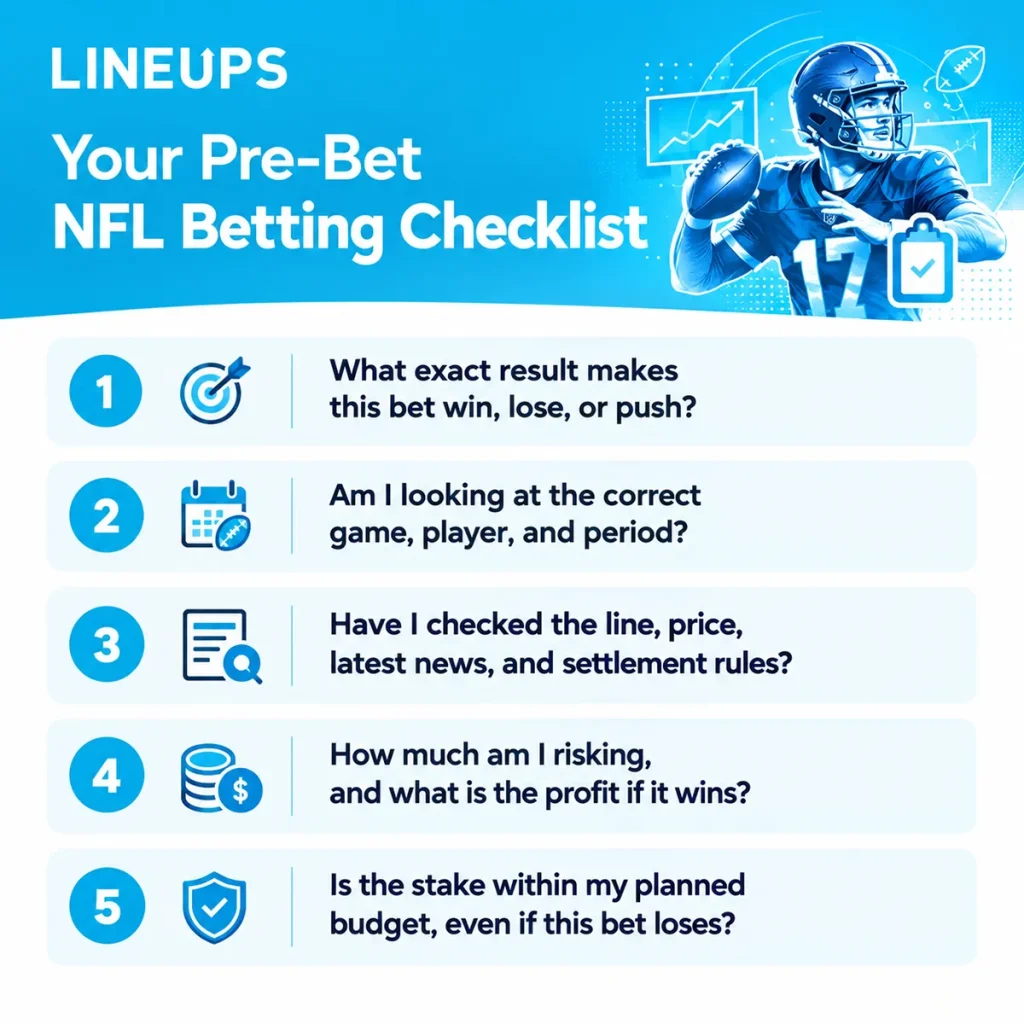
Before confirming, make sure you can answer these five questions:
- What exact result makes this bet win, lose, or push?
- Am I looking at the correct game, player, and period?
- Have I checked the line, price, latest news, and settlement rules?
- How much am I risking, and what is the profit if it wins?
- Is the stake within my planned budget, even if this bet loses?
Let’s finish the example. You placed one $10 cash bet on Miami +3.5 (-110), and New England wins 24-21. Here is how that ticket compares with two other possible bets on the same game:
| Possible $10 cash bet | Result at 24-21 | Profit or loss | Total returned |
|---|---|---|---|
| Miami +3.5 (-110) | Win: Miami loses by 3 | +$9.09 | $19.09 |
| New England -3.5 (-110) | Loss: New England wins by only 3 | -$10.00 | $0.00 |
| Over 44.5 (-110) | Win: 45 combined points | +$9.09 | $19.09 |
That is the habit to build: knowing how to bet on NFL games is mostly about understanding the ticket before you put money on it. If you’re feeling pressure to chase losses, stop and take a break. Use deposit, loss, and time limits where available.
NFL Betting FAQs
What is the simplest NFL bet for a beginner?
A moneyline is usually the simplest because you pick the winner without a scoring handicap. Simple does not mean risk-free or good value. A heavy favorite can lose, and its payout may be small relative to the stake.
Can my team win the game but lose my bet?
Yes. If you take New England -3.5 and it wins by three, the team wins but your spread bet loses. A New England moneyline bet would win in the same game. Always check which market is on your ticket.
What is the best NFL betting strategy for beginners?
Start with a repeatable process: understand the market, compare prices, check relevant team news, and keep stakes within a fixed budget. There is no single best bet type or system that guarantees a profit. You can also practice reading and settling hypothetical bets without risking money.
Can I lose more than my stake on an NFL bet?
On a standard fixed-odds sportsbook bet, the amount you can lose on that ticket is the stake you placed. For example, a losing $10 bet at -180 loses $10, not $180. Other products can work differently, so make sure you know what you’re using.
Do NFL betting systems guarantee a profit?
No. Changing stake sizes, doubling after losses, or always backing a particular type of team cannot guarantee a profit. Keep the focus on the price, the evidence, and the amount you can afford to lose. Skipping a game is always an option.