
 Share
Share 


Be sure to check out our tennis match trends page for daily odds, trends and insights on each match.
Up to $1,500 in Bonus Bets if Your First Bet Doesn't Win*
*Bonus Bets Expire in 7 Days. One New Customer Offer Only. Add’l terms. 21+. Gambling Problem? Call 1-800-GAMBLER or 1-800-MY-RESET
Up to $1,500 in Bonus Bets if Your First Bet Doesn't Win*
*Bonus Bets Expire in 7 Days. One New Customer Offer Only. Add’l terms. 21+. Gambling Problem? Call 1-800-GAMBLER or 1-800-MY-RESET
ATP Almaty Open
Favorite to Win: Daniil Medvedev +260
Sleeper Pick: Stefanos Tsitsipas +600
ATP Almaty Open Information
- Dates: October 19–25, 2026
- Location: Almaty, Kazakhstan
- Surface: Hard
- Tier: 250
- Defending Champion:
ATP Almaty Open Odds to Win
| Seed | Country | Player | Odds to Win |
|---|---|---|---|
| 1 | Daniil Medvedev | +260 | |
| 4 | Andrey Rublev | +450 | |
| 3 | 🇰🇿 | Alexander Bublik | +450 |
| 7 | 🇬🇷 | Stefanos Tsitsipas | +600 |
| 5 | Karen Khachanov | +700 | |
| 2 | 🇮🇹 | Luciano Darderi | +1200 |
| 🇭🇷 | Marin Cilic | +2200 | |
| 🇫🇷 | Adrian Mannarino | +2500 | |
| 🇫🇷 | Terence Atmane | +2800 | |
| 8 | 🇦🇷 | Thiago Agustín Tirante | +3000 |
| 🇦🇺 | Rinky Hijikata | +3000 | |
| 🇭🇺 | Fabian Marozsán | +3000 | |
| 🇨🇿 | Tomáš Macháč | +4000 | |
| 🇷🇸 | Miomir Kecmanović | +4000 | |
| 6 | 🇦🇷 | Tomás Martín Etcheverry | +4000 |
| 🇮🇹 | Mattia Bellucci | +5000 | |
| 🇰🇿 | Mikhail Kukushkin | +6000 | |
| 🇦🇺 | James Duckworth | +8000 | |
| 🇦🇺 | Aleksandar Vukic | +8000 | |
| 🇦🇷 | Facundo Díaz Acosta | +10000 | |
| 🇺🇸 | Aleksandar Kovacevic | +10000 | |
| 🇯🇵 | Sho Shimabukuro | +15000 | |
| 🇰🇿 | Zangar Nurlanuly | +25000 | |
| 🇰🇿 | Timofey Skatov | +25000 |
ATP Almaty Open Draw
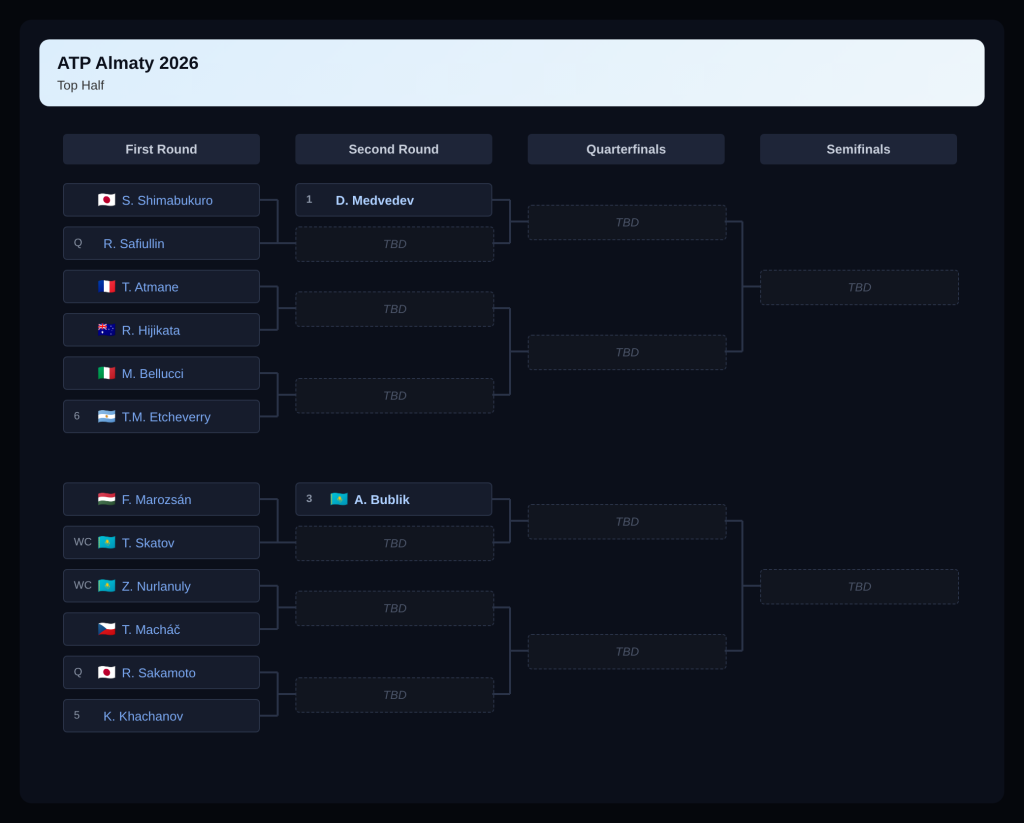
Top Half (Quarters 1 & 2)
Top seed Daniil Medvedev headlines, awaiting the winner of a section featuring Sho Shimabukuro and Terence Atmane. 3rd seed Alexander Bublik anchors the other side, drawing a group that includes Fabian Marozsán and two Kazakh wild cards, Timofey Skatov and Zangar Nurlanuly, playing in front of a home crowd.
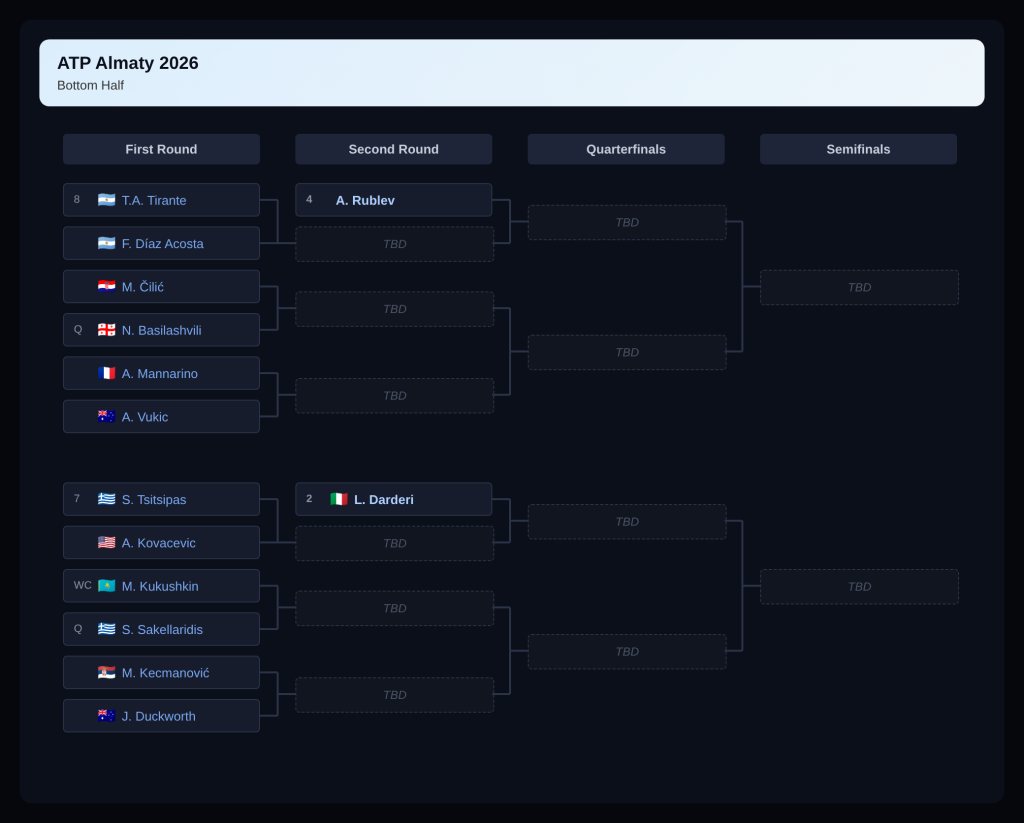
Top Half (Quarters 3 & 4)
4th seed Andrey Rublev opens this half, sitting across from a section led by Marin Čilić and 8th seed Tomás Martín Etcheverry. 2nd seed Luciano Darderi rounds out the bottom, facing the survivor of a loaded group featuring 7th seed Stefanos Tsitsipas and Miomir Kecmanović.
ATP Almaty Open Bracket Analysis
Quarter 1 – Deciding Factors
Daniil Medvedev’s Shanghai Surge vs. Roman Safiullin’s First-Strike Serve-Forehand Game
Medvedev is the clear favorite in this section, and his data backs it up without much argument. He won the Brisbane title in January, reached the Indian Wells final without dropping a set before losing to Jannik Sinner, made the Italian Open semifinals, and just reached the Shanghai Masters quarterfinals on October 14, beating Stefanos Tsitsipas 6-4, 7-5 without facing a single break point. That’s a top-10 player playing his best hard-court tennis of the season at exactly the right moment, with a bye waiting for him in the opening round here.
Safiullin’s sleeper case is built on a genuine first-strike game: a right-hander whose serve and forehand are his primary weapons, backed by a career 72% first-serve-points-won rate and a hard-court skill rating roughly 250 points above his clay rating — he’s built for exactly this surface. His 2026 season includes a five-set upset of 13th-seeded Andrey Rublev at Wimbledon, a run to the semifinals at the Hangzhou Open, and, most relevantly, a first-round win over Rinky Hijikata at the Shanghai Masters this month — meaning he’s already beaten one of the two players on the other side of this very quarter within the last few weeks. He still has to win through qualifying to get his shot, and he’s currently done exactly that, beating Ilya Ivashka as the No. 1 qualifying seed. If he closes out qualifying and his serve holds up the way it has on hard courts all year, he’s a live threat to make this section competitive; against Medvedev specifically, his first-strike game gives him the tools to make it uncomfortable, even if Medvedev’s season-long résumé makes him the heavy favorite to win the quarter regardless.
Terence Atmane’s Dominant Service Games vs. Rinky Hijikata’s Bigger Scalp
The stats lean toward Atmane on serve. His 2026 numbers show an 81.3% hold rate and 0.092 aces per service point, both well ahead of Hijikata’s 77.0% hold rate and 0.058 aces per service point, and his first-serve percentage (61.6%) is also higher than Hijikata’s (59.3%). Atmane has also banked quality wins this season, beating Felix Auger-Aliassime at the Miami Open and Frances Tiafoe at the Washington Open, both at the round-of-32 stage. On a surface and in a format where holding serve efficiently matters most, his numbers are the better of the two.
Hijikata, meanwhile, carries the higher ranking (No. 85 to Atmane’s No. 99) and a slightly better overall 2026 win rate (44% to 42%), and his best win this year outranks anything on Atmane’s resume — he upset second-seeded Jiří Lehečka at the HSBC Championships to reach the quarterfinals, and also knocked out Gael Monfils at the Cincinnati Open. Both players arrive off losing skids: Atmane has dropped three straight, most recently to João Faria at the Hangzhou Open, while Hijikata has lost two straight, including a first-round defeat to Safiullin at the Shanghai Masters. If the match comes down to who’s serving better on the day, Atmane’s numbers give him the edge; if it comes down to who’s beaten the better player under pressure this year, Hijikata’s win over a seeded top-50 player in Lehečka is the stronger data point.
Quarter 2 – Deciding Factors
Alexander Bublik’s Home-Soil Serve vs. Karen Khachanov’s US Open Semifinal Surge
Bublik brings a serve that should travel well on home soil in Almaty. He’s 29-18 this season (62% win rate) with a title, and his 2026 serve numbers are elite for the tour: 65.5% first serves in, an 88.4% service-game hold rate, and 0.148 aces per service point. He’s also beaten Tomáš Macháč directly this month, winning their Shanghai Masters first-round meeting before losing to Alexander Zverev in the round of 16. Playing in front of a Kazakh crowd with a serve that already ranks among the tour’s best holders, Bublik has the tools to make this section very difficult from the baseline out.
Khachanov, meanwhile, arrives with the more significant recent peak of anyone in this quarter — a US Open semifinal run this year, where he beat Learner Tien in five sets, advanced past Alexander Blockx by retirement in the quarterfinal, and lost to Zverev in the final four. He’s currently on a two-match winning streak (W2), having just beaten Adrian Mannarino in the Shanghai Masters second round before a scheduled meeting with Alex de Minaur. His own serve numbers are solid if less explosive than Bublik’s — 63.8% first serves, 86.8% holds, 0.089 aces per point — and his ranking has climbed from outside the top 50 in early September to the mid-20s now. If this comes down to whose serve dictates more points, Bublik’s numbers are the better of the two; if it comes down to who’s proven they can win best-of-five rounds against elite opposition recently, Khachanov’s US Open run is the stronger data point.
Tomáš Macháč’s Dark-Horse Reputation vs. His Injury-Interrupted 2026
On name recognition and past form, Macháč fits the dark-horse profile — he’s shown in prior seasons he can trouble higher-ranked players on hard courts, and a run through a lighter section of this draw wouldn’t be unprecedented for him. But the 2026 data doesn’t support that case right now. He’s 15-14 on the season (52% win rate), his ranking has slipped to No. 75, and his year included a confirmed foot tear suffered against Zverev at Roland-Garros that ended his clay season and forced a recovery break, plus a separate foot-related absence of roughly 11 weeks that cost him most of the summer hard-court swing. His most recent result was a straight-forward round-of-64 loss to Bublik at the Shanghai Masters, and other 2026 results — a first-round US Open exit, a loss to Moutet in Miami, a quarterfinal loss to Rublev in Barcelona — point to a season of inconsistency layered on top of the injury disruption rather than the form that would typically make him a threat here.
Quarter 3 – Deciding Factors
Andrey Rublev’s Hangzhou Final Run vs. Thiago Tirante’s Top-10-Slaying Summer
Rublev is the right favorite here on the data. He’s 31-19 this season (62% win rate) at No. 23, with strong all-around serve numbers — 84.7% service games held, 66.4% of total service points won, and a serve rating in the 86th percentile of the tour. He just reached the Hangzhou Open final this month before losing to Medvedev 5-7, 4-6, and while his immediate form has cooled with back-to-back losses (most recently a Shanghai Masters round-of-64 exit to Rei Sakamoto), a deep final run at a tour event three weeks ago is a much stronger recent signal than either Argentinian waiting in his section can match, and he opens with a bye.
The Argentinians, meanwhile, split clearly in upset potential. Tirante is the one with real data behind him — he’s 25-15 (63% win rate), the best winning percentage of anyone in this entire quarter, built on a standout summer that included wins over Novak Djokovic and Jakub Menšík en route to the Cincinnati Open quarterfinals, plus a 7-5, 6-3 upset of 8th-ranked Taylor Fritz at the Montreal Masters — his third career win over a top-10 player. Diaz Acosta’s résumé looks superficially similar — five Challenger titles this year, more than anyone else on tour, and a return to the top 100 — but all of that success has come at the Challenger level; at actual ATP Tour events in 2026 he’s just 2-5 (29%), a sign his game hasn’t yet translated upward. If either Argentinian is going to trouble Rublev in this section, the data says it’s Tirante, whose top-10 scalps are real and recent; Diaz Acosta’s tour-level results give him much less of a case.
Nikoloz Basilashvili’s Chengdu Breakout vs. Marin Cilic’s Fading Form
Basilashvili’s dark-horse case rests on a genuinely strong month. Despite an ordinary season line (7-10, 41% win rate, ranked No. 124) and a two-match losing streak into this event, he put together a real run at the Chengdu Open in September — beating Miomir Kecmanović, Botic van de Zandschulp, and Jenson Brooksby back to back to reach the semifinal, where he lost to Alejandro Davidović Fokina. That’s three wins over legitimate tour-level opponents in the same week, and it’s also why he enters Almaty as the No. 5 seed in qualifying, where he’s already beaten Taro Daniel to advance. On recent signal rather than season-long record, that Chengdu week is the best evidence either player in this match has produced lately.
Cilic, meanwhile, is trending the wrong way at 37 years old — he’s 14-16 (47% win rate) at No. 80 and currently riding a three-match losing streak, including a first-round loss at the Shanghai Masters. His other recent results are a mixed bag: a win over Alexei Popyrin in Miami undercut by a loss to Zverev the very next match, a first-round exit at Wimbledon to Medvedev, and a split result at the Canadian Open (beating Shimabukuro, then losing to Tiafoe). If Basilashvili’s Chengdu form carries over, he looks like the more dangerous player heading into this section; Cilic’s case rests more on pedigree and experience than on anything in his recent match data.
Quarter 4 – Deciding Factors
Stefanos Tsitsipas’s Shanghai Surge vs. Luciano Darderi’s Season-Long Pedigree
Tsitsipas enters this section playing the best tennis of his season at the best possible time. After falling to No. 87 in late June — his lowest ranking since January 2018 — he’s climbed back behind a title at the Swiss Open in Gstaad in July that snapped a 16-month drought, and he just strung together three straight wins at the Shanghai Masters: over Kimmer Coppejans, then Darderi himself 6-3, 6-4 on October 10 (his 400th career tour-level win, a mark only eight other active players have reached), then 11th seed Taylor Fritz 3-6, 7-5, 6-3, before a competitive two-set loss to Daniil Medvedev in the round of 16. That’s a direct, recent head-to-head win over Darderi built into a broader hot streak, not an isolated result.
Darderi, meanwhile, carries the better season-long résumé by a clear margin — a title at the Chile Open, finals at the Argentina Open and Swedish Open, a win over Alexander Zverev at the Italian Open after saving four match points, and a career-high ranking of No. 16 against Tsitsipas’s current No. 43. He’s also 35-23 on the year to Tsitsipas’s 27-22. But his most recent form has dipped at exactly the wrong time: a loss to Jacquet in the Japan Open round of 16, followed immediately by that straight-sets loss to Tsitsipas in Shanghai. If Darderi’s season-long weapons reassert themselves, his ranking and results advantage make him the more complete player; but with Tsitsipas holding the fresher, more current data point — a head-to-head win just over a week ago, inside a genuine three-match hot streak — the form argument currently favors Tsitsipas if the two meet again in Almaty.
James Duckworth’s Soft Draw Slot vs. Miomir Kecmanovic’s Faded Early-Season Peak
Kecmanovic’s path through this section is about as favorable as a round of 32 gets — Duckworth carries no notable 2026 results that would make him a threat on paper, and a win there would set up a projected round of 16 against the loser’s side of Tsitsipas-Darderi rather than either of them directly.
The problem for Kecmanovic is what he’d be bringing into that match. His 2026 season peaked early with wins over Alexander Zverev and Tommy Paul, but his form since has fallen off a cliff: he’s 16-25 on the season with a 39% win rate, and his recent results read as a genuine slide — losses at Kitzbühel, Canada, Cincinnati, the US Open, Chengdu, and most recently a round-of-64 exit to Jakub Menšík at the Shanghai Masters. His ranking has dropped into the high 50s to low 60s from wherever those early wins had him. A favorable draw slot only matters if the player walking into it is still playing the tennis that made those results possible, and right now, the data says Kecmanovic isn’t.
ATP Lyon Open
Favorite to Win: Taylor Fritz +200, Brandon Nakashima +330
Sleeper Pick: Lorenzo Musetti +1600, Arthur Fery +2800
ATP Lyon Open Information
- Dates: October 19–25, 2026
- Location: Lyon, France
- Surface: Hard
- Tier: 250
- Defending Champion:
ATP Lyon Open Odds to Win
| Seed | Country | Player | Odds to Win |
|---|---|---|---|
| 2 | 🇺🇸 | Taylor Fritz | +200 |
| 4 | 🇺🇸 | Tommy Paul | +330 |
| 5 | 🇺🇸 | Brandon Nakashima | +330 |
| 1 | 🇮🇹 | Flavio Cobolli | +650 |
| 3 | 🇲🇨 | Valentin Vacherot | +700 |
| 6 | 🇮🇹 | Lorenzo Musetti | +1600 |
| 7 | 🇫🇷 | Ugo Humbert | +1800 |
| 8 | 🇬🇧 | Arthur Fery | +2800 |
| 🇮🇹 | Matteo Berrettini | +3500 | |
| 🇪🇸 | Martín Landaluce | +5000 | |
| 🇫🇷 | Luca Van Assche | +5000 | |
| 🇬🇧 | Cameron Norrie | +5000 | |
| 🇫🇷 | Titouan Droguet | +5000 | |
| 🇵🇹 | Jaime Faria | +5000 | |
| 🇦🇷 | Sebastian Baez | +6500 | |
| 🇫🇷 | Corentin Moutet | +6500 | |
| 🇷🇸 | Hamad Medjedovic | +8000 | |
| 🇩🇪 | Daniel Altmaier | +13000 | |
| 🇨🇭 | Stan Wawrinka | +15000 | |
| 🇮🇹 | Matteo Arnaldi | +15000 | |
| 🇮🇹 | Lorenzo Sonego | +20000 | |
| 🇫🇷 | Benjamin Bonzi | +20000 | |
| 🇫🇷 | Moïse Kouamé | +25000 | |
| 🇫🇷 | Felix Balshaw | +25000 |
ATP Lyon Open Draw
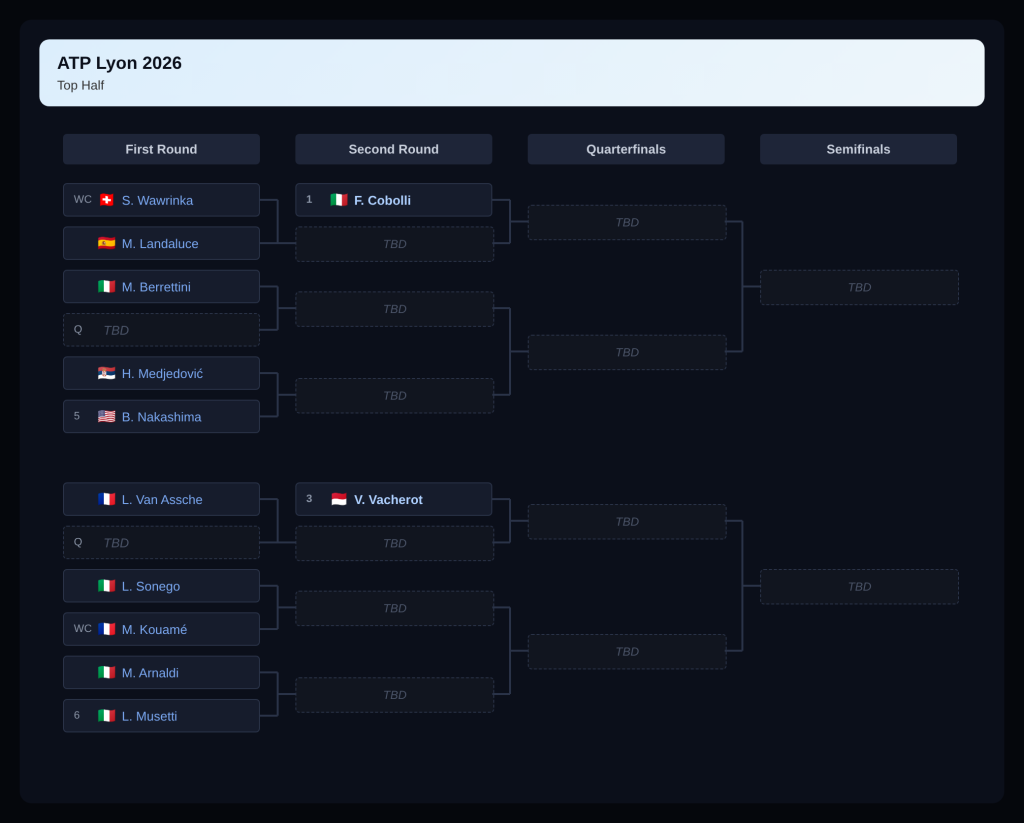
Top Half (Quarters 1 & 2)
Top seed Flavio Cobolli headlines, with the winner of a section featuring Stan Wawrinka and Matteo Berrettini awaiting him in round two. 3rd seed Valentin Vacherot anchors the other side, drawing the survivor of a deep Italian-French group that includes Lorenzo Musetti and Matteo Arnaldi.
Top Half (Quarters 3 & 4)
7th seed Ugo Humbert opens in front of a home crowd, sitting across an all-French-heavy section from 4th seed Tommy Paul. 8th seed Arthur Fery rounds out the bottom, with 2nd seed/wild card Taylor Fritz on the other side of a group featuring Sebastián Báez and Daniel Altmaier.
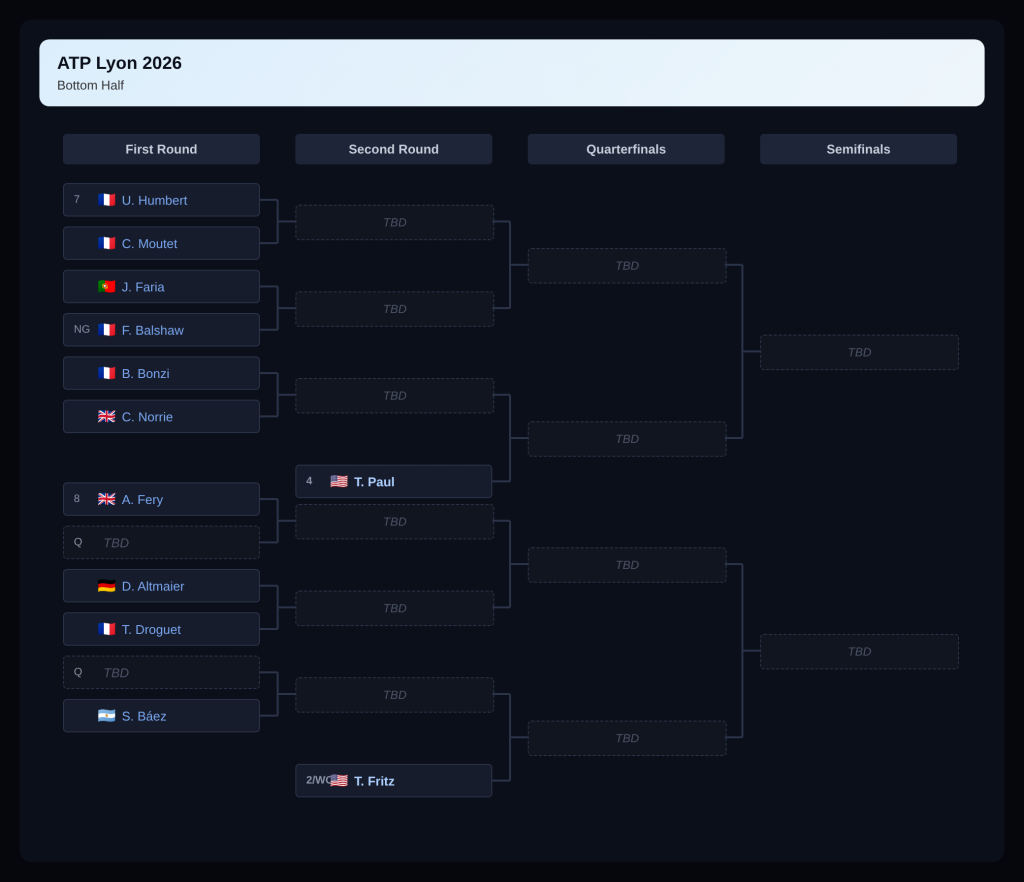
ATP Lyon Open Bracket Analysis
Quarter 1 – Deciding Factors
Flavio Cobolli’s Cincinnati Form vs. Martin Landaluce’s Three-Match Skid
Cobolli’s case for reaching the quarterfinals here is built on a strong recent peak more than overwhelming hard-court dominance. He’s 32-19 this season (63% win rate) with a Mexican Open title, but his hard-court record specifically sits at 14-10 (58%), clearly his least efficient surface compared to 14-7 on clay. The highlight is a Cincinnati Open run to the semifinal, where he beat Blockx, Jodar and Paul before losing to Fils — real, recent proof he can beat good players on hard courts. That said, his form has cooled since: a US Open loss to Alexander Blockx in which he was broken eight times, and a round-of-64 exit at the Shanghai Masters to Adrian Mannarino, leaving him on a two-match losing streak into Lyon.
Landaluce’s data doesn’t support a real upset case right now. He’s 12-14 (46% win rate) and arrives on a three-match losing streak of his own — losses to Jack Fearnley at the US Open, Mattia Bellucci at Winston-Salem, and Thiago Tirante at Cincinnati, the last two coming in the same stretch where Cobolli was playing his best tennis of the summer. He does have a recent scalp to his name, a win over Matteo Arnaldi at Cincinnati, so he’s not without any recent positives, but he still has to get past wildcard Stan Wawrinka before any Cobolli match happens at all. Between Cobolli’s cooling form and Landaluce’s active skid, the data doesn’t point to a real upset here — it points to two players both trying to find form, with Cobolli’s higher season-long level still the more reliable signal.
Brandon Nakashima’s Hard-Court Surge vs. Hamad Medjedović’s Mid-Tier Season
The form argument for Nakashima is about as clean as it gets in this draw. He’s 35-20 this season (64% win rate), with a hard-court-specific record of 24-12 (67%) — clearly his best surface — and serve numbers to match: 87.6% of service games held and a serve rating in the 91st percentile on tour. His last month includes wins over Daniil Medvedev and Taylor Fritz to reach the Cincinnati Open quarterfinals, and most recently a 7-6, 7-5 win over Matteo Berrettini in the second round of the Shanghai Masters on October 9 — a tight, high-level win just over a week before Lyon. That’s a player peaking at exactly the right moment on exactly the right surface.
Medjedović, by comparison, is a solid but clearly lesser threat on the data. He’s 18-14 (56% win rate) and enters off a one-match winning streak, having beaten Alejandro Davidovich Fokina at the Japan Open before losing to Nicolás Vallejo in the round of 16; he also lost to Alexander Kovačević in the first round at Shanghai. Nothing in his recent results approaches the level of Nakashima’s wins over Medvedev, Fritz, and Berrettini in the same stretch, which makes Nakashima the clear form-based pick in this section.
Matteo Berrettini’s Grand Slam Pedigree vs. His Sub-.500 2026 Season
Berrettini’s pedigree is real and shouldn’t be dismissed outright — a Wimbledon finalist and former world No. 6, he’s shown flashes of that game even this year, including a comeback win over Aleksandar Kovačević at Shanghai, 6-7(3), 6-1, 6-4, where he hit 23 aces and faced no break points. That serve, when it’s on, is still capable of carrying him through a short, low-pressure ATP 250 draw.
But the season-long data leans toward a fade. He’s 11-13 (46% win rate) at No. 78, well off his career-high ranking, and his results away from that one Kovačević flash have been largely negative — first-round-level losses to Trungelliti, Cerúndolo and Ofner, and, most tellingly, a loss to the very form-based pick in this section: Nakashima beat him 7-6, 7-5 just last week in Shanghai, needing two tiebreak-level sets to do it but still getting it done. A single good week doesn’t offset a season mostly spent below .500, which makes Berrettini a fade on current data even with the pedigree still on his resume.
Quarter 2 – Deciding Factors
Valentin Vacherot’s Japan Open Signature Wins vs. an Italian-Riddled Field
Vacherot’s recent form is real, even if his season-long record doesn’t scream dominance. He’s 20-17 (54% win rate) on the year, but the data behind that number is lumpy rather than weak — a semifinal run at the Japan Open that included wins over Stefanos Tsitsipas and Arthur Fils, two legitimate, in-form opponents, is about as strong a recent signal as anyone in this entire draw has produced. His serve backs it up: an 87th-percentile serve rating, 84.3% of service games held, and first serves averaging 205 km/h, among the biggest in the field. The dip since then — a round-of-16 loss to Lloyd Harris at Chengdu and a round-of-32 exit to Tommy Paul at Shanghai — keeps his overall record modest, but neither loss undoes what the Tsitsipas and Fils wins already proved about his ceiling right now.
The three Italians, meanwhile, present very different levels of threat, and the data backs your instinct on Musetti specifically. Musetti is 20-11 (65% win rate), the best mark of anyone in this section, with a hard-court-specific record of 14-7 (67%) built on a Cincinnati run past Altmaier, Zheng and Faria to the quarterfinals before losing to Tiafoe — that’s a player whose best surface numbers line up with Lyon’s hard courts. Arnaldi, by contrast, is 11-15 (42% win rate) and his best recent result is a competitive but ultimately straightforward round-of-16 loss to Carlos Alcaraz at the Japan Open, while Sonego sits at 12-16 (43% win rate) with no standout recent result on record at all. If any of the three Italians is positioned to make this section’s draw genuinely dangerous for Vacherot, the numbers say it’s Musetti — not Arnaldi, who he’ll face directly in the first round, and not Sonego, whose season simply doesn’t carry the same weight.
Quarter 3 – Deciding Factors
Jaime Faria’s Top-10-Beating Season vs. a Very Recent Blowout Loss
Faria’s case for being this section’s best stats-based pick is real on a season-long view. He’s up to a career-high No. 70-72 this year on the strength of some genuine signature wins: he beat Ben Shelton 6-4, 6-4 at the Cincinnati Open for his first career win over a top-10 player, then beat Jenson Brooksby in five sets at the US Open before pushing defending champion Carlos Alcaraz to four sets in the second round. He also beat Alexander Blockx at the Australian Open and reached the French Open third round, beating Denis Shapovalov and Jan-Lennard Struff before a five-set loss to Frances Tiafoe after leading two sets to love. That’s a player who has repeatedly shown he can hang with, and occasionally beat, far better-ranked opponents on hard courts specifically.
The complication is his most recent result: a 6-1, 6-1 blowout loss to Jaume Munar at the Japan Open on October 1, his last tour-level match before Lyon. That’s a significant, very current red flag that tempers the pedigree case above. Still, his first-round draw here is about as soft as it gets — unseeded wildcard-level opponent Felix Balshaw, ranked outside the top 190 — which gives Faria a real chance to shake off that Tokyo result before he’d face anything resembling the level of player he’s already beaten this year. The season-long data still makes him a sound pick on talent; the Munar result is the one piece of evidence working against him right now.
Corentin Moutet’s Stylistic Danger vs. His Season-Long Collapse
Moutet’s reputation as a tough first-round draw for Humbert is understandable given his awkward, high-variance lefty game, but the 2026 data doesn’t back up the “danger” label right now. He’s 9-20 on the season, a 31% win rate, and arrives on a two-match losing streak that ended with a retirement trailing 0-3 in the third set of his US Open opener against Dane Sweeny. His other recent results — losses to Brooksby, Jodar, Giron and Sinner, with his only notable win coming over Tomáš Macháč at the Miami Open — paint a picture of a player who has struggled for most of the year rather than one primed to spring a stylistic upset. Humbert should still be wary of the matchup itself, but the numbers suggest Moutet is a tough opponent by reputation more than by current form.
Tommy Paul’s Shanghai Quarterfinal Run vs. the Field Chasing Him
Paul is the clear data-driven favorite to win this section, and it isn’t especially close. He’s 41-19 this season (68% win rate), the best winning percentage of anyone across this entire quarter, with a hard-court record of 24-13 (65%) on the exact surface Lyon is played on. His serve numbers back it up — 84.9% of service games held and an 88th-percentile serve rating — and his most recent results show a player rounding into form at the right time: he beat Zizou Bergs in the Shanghai Masters round of 16 before losing a competitive quarterfinal to Medvedev, sandwiched around a US Open run to the fourth round where he lost to Alcaraz. A bye into the second round only adds to the case, letting him watch Humbert, Moutet, Faria, Norrie and the rest work through each other first.
The field chasing him, meanwhile, doesn’t have anyone whose season-long numbers approach his. Faria’s pedigree wins (Shelton, Brooksby) are real but came with a blowout loss to Munar just weeks ago; Norrie’s recent uptick is genuine but his overall win rate still sits in the low 50s; Humbert is below .500 on hard courts specifically. None of that is a knock on their sleeper or dark-horse cases individually — it’s simply that Paul’s combination of a 68% win rate, a deep run at a Masters event last week, and the softest remaining path (a bye plus the winner of two rounds of attrition among the others) makes him the pick to beat in this section on the data, not just on name recognition.
Quarter 4 – Deciding Factors
Arthur Fery’s Wimbledon Breakout vs. Taylor Fritz’s Superior but Cooling Numbers
Fery’s “sleeper darling” tag is backed by one of the most dramatic rises on tour this year. He finished 2024 at No. 483 and 2025 at No. 189, and is now up to No. 37 after a run to the Wimbledon semifinal, where he beat 10th-seeded Flavio Cobolli in the quarterfinal 6-4, 7-6, 6-0 before losing to Zverev. He’s 15-10 (60% win rate) on the season with a reached final at Winston-Salem, and his serve numbers back up the results: 80.2% of service games held and 69.6% of first-serve points won. That’s a legitimately proven big-match player now, not just a name climbing the rankings on volume.
Fritz, meanwhile, still carries the better overall season by most measures — 37-15 (71% win rate), a No. 12 ranking, and elite serve data (98th-percentile serve rating, 89.1% of service games held, 0.174 aces per serve point). But his most recent results have a few cracks in them: a loss to Tsitsipas at the Shanghai Masters, a defeat to qualifier Jaume Munar at the Japan Open, and a US Open third-round loss to Francisco Cerúndolo after leading two sets to none. None of those results is disastrous, but they show a player who hasn’t been untouchable lately, which is exactly the kind of opening a rapidly improving player like Fery could exploit if the two meet. On raw season-long numbers, Fritz remains the favorite; on recent vulnerability versus recent momentum, the gap between them is closer than the ranking difference suggests.
The Altmaier-Droguet Winner’s Shaky Form vs. Sebastián Báez’s Mixed Season as the Gatekeepers
Whoever has to get past the undercard matches in this section isn’t facing much resistance on the data. Daniel Altmaier is 16-25 (39% win rate) this season and enters off a mixed run of results — recent losses to Zachary Svajda, Lorenzo Musetti, Nakashima, Alex Molčan and Darderi, offset by wins over Vukić, Collignon, Coméşana and Wong. Titouan Droguet, his direct round-of-32 opponent, is actually the more positive story statistically at 10-9 (53% win rate), with wins over Van Assche and Faria earlier in the year, though he’s currently on a two-match losing streak, most recently to Berrettini at Cincinnati.
On the other side, Sebastián Báez sits at 22-22 (50% win rate) and will first need to get past a qualifier — his recent form includes a loss to Jenson Brooksby at Chengdu, a loss to Nakashima at the US Open, and a split Winston-Salem showing (a win over Grenier, then a retirement against Cerúndolo). None of the four players filling out this bottom section of the quarter has a season that would make them a threat to either Fery or Fritz on the data; this section looks like it exists mainly to decide who survives long enough to find out whether the breakout story or the proven favorite wins the quarter.
ATP European Open
Favorite to Win: Arthur Fils +200
Sleeper Pick: Alexander Blockx +1400, Botic Van De Zandschulp +2200
ATP European Open Information
- Dates: October 19–25, 2026
- Location: Brussels, Belgium
- Surface: Hard
- Tier: 250
- Defending Champion:
ATP European Open Odds to Win
| Seed | Country | Player | Odds to Win |
|---|---|---|---|
| 1 | 🇫🇷 | Arthur Fils | +200 |
| 2 | 🇨🇿 | Jiří Lehečka | +300 |
| 5 | 🇺🇸 | Alex Michelsen | +750 |
| 3 | 🇦🇷 | Francisco Cerúndolo | +800 |
| 6 | 🇧🇪 | Zizou Bergs | +1400 |
| 4 | 🇧🇪 | Alexander Blockx | +1400 |
| 🇭🇷 | Dino Prizmic | +2000 | |
| 7 | 🇳🇱 | Botic van de Zandschulp | +2200 |
| 🇳🇱 | Tallon Griekspoor | +2500 | |
| 🇩🇰 | Holger Rune | +2500 | |
| 🇪🇸 | Jaume Munar | +3000 | |
| 8 | 🇦🇷 | Mariano Navone | +3500 |
| 🇩🇪 | Yannick Hanfmann | +3500 | |
| 🇬🇧 | Jacob Fearnley | +3500 | |
| 🇵🇱 | Kamil Majchrzak | +4000 | |
| 🇩🇪 | Jan-Lennard Struff | +4000 | |
| 🇧🇪 | Raphaël Collignon | +5000 | |
| 🇺🇸 | Marcos Giron | +5000 | |
| 🇦🇷 | Juan Manuel Cerúndolo | +5000 | |
| 🇫🇷 | Hugo Gaston | +5000 | |
| 🇬🇧 | Toby Samuel | +6500 | |
| 🇧🇪 | David Goffin | +15000 | |
| 🇧🇦 | Damir Džumhur | +15000 | |
| 🇩🇪 | Max Schönhaus | +25000 |
ATP European Open Draw
Top Half (Quarters 1 & 2)
Seventh seed Arthur Fils headlines a quarter that’s wide open on paper, with three qualifying spots still unresolved alongside Jaume Munar and home favorite David Goffin — Fils will fancy his chances of a straightforward path to the quarters. The second quarter is the one to watch, where Belgian home hope Alexander Blockx (6) draws a tricky opener and faces a jam-packed section including Jan-Lennard Struff, Marc-Andrea Hüsler-type floaters in Dušan Lajović’s old slot via Dino Prižmić and Damir Džumhur, plus Zsombor Piros… — in short, a gauntlet before any seed reaches the last eight, and a big opportunity for a home-soil run from Blockx or Zizou Bergs if they navigate it.
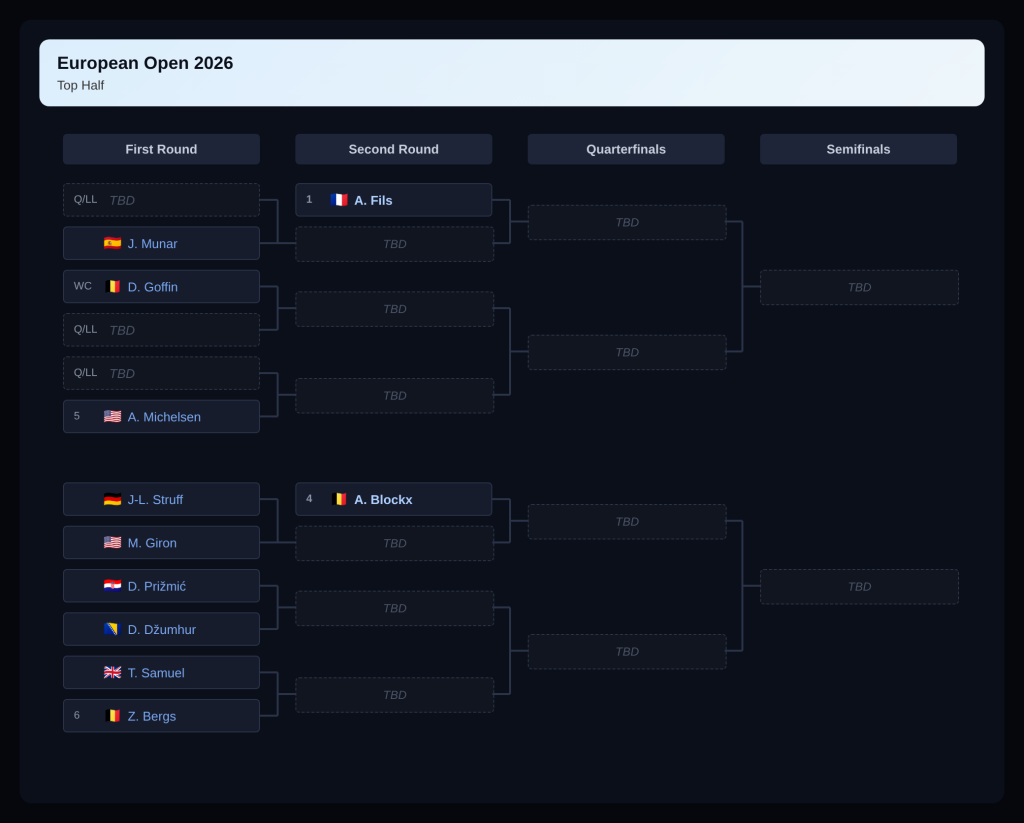
Top Half (Quarters 3 & 4)
Botic van de Zandschulp (7) opens as the top seed in the third quarter but shares the section with two unresolved qualifying slots, Jacob Fearnley, Hugo Gaston and Yannick Hanfmann — a group with no shortage of dangerous floaters before Francisco Cerúndolo (3) arrives fresh off his bye to likely meet the winner. The bottom quarter is stacked with intrigue: Mariano Navone (8) opens against his own brother-in-arms countryman Juan Manuel Cerúndolo in an all-Argentine first-rounder, while Tallon Griekspoor faces wildcard Max Schönhaus and another wildcard, Holger Rune, takes on Raphaël Collignon in a section loaded with big names before second seed Jiří Lehečka enters via his bye — arguably the highest-profile single quarter in the draw given Rune’s pedigree.
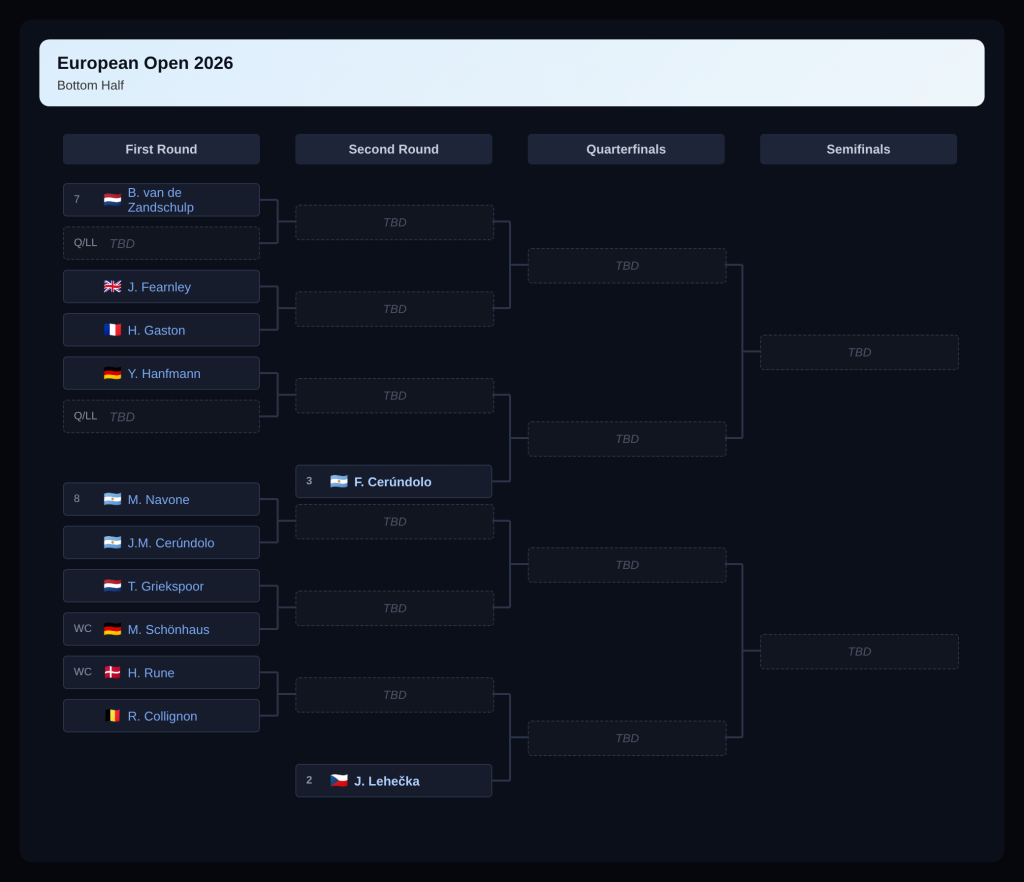
ATP European Open Bracket Analysis
Quarter 1 – Deciding Factors
Arthur Fils’s Top-10 Resume vs. Jaume Munar’s Tokyo Breakout
Arthur Fils arrives in Brussels as the new top seed after Félix Auger-Aliassime’s and Casper Ruud’s late withdrawals from the draw, and the ranking underneath him backs up the status: he’s currently No. 10 with 3,275 points, sitting on a 35-13 record in 2026 with titles already banked in Barcelona and Cincinnati. His serve has been the foundation all year — 63.2% first serves in, 74.6% of those points won, 86.2% of service games held — and he owns this matchup on paper, having beaten Jaume Munar in both of their previous meetings, a five-set epic at the 2025 French Open (7-6(3), 7-6(4), 2-6, 0-6, 6-4) and a three-setter in Hamburg in 2024. The catch is that both of those wins came on clay, and Fils is not walking into Brussels on a hot streak; he dropped his last match in straight sets to Botic van de Zandschulp in the Shanghai Masters round of 32 (5-7, 4-6) on October 12, part of a stretch in which he’s gone just 3-2 across his last five main-draw matches, including an October 4 loss to Valentin Vacherot in Tokyo sandwiched between wins over Pavel Kotov and Frances Tiafoe.
Munar, meanwhile, had to come through qualifying just to get into last week’s Japan Open and still turned it into the best fortnight of his season, climbing from as low as No. 68 in mid-September back to his current No. 49 by beating Taylor Fritz in three sets (6-7(7), 6-4, 6-3), then Jaime Faria, then Kyrian Jacquet in the quarterfinal, before finally running into Carlos Alcaraz in the semifinal (5-7, 6-3, 6-1) on October 5. That run was built on the return game, not the serve: Munar’s return points won sits in the 93rd percentile on tour, with break points converted at 38.7%, while his own service games held (80.3%) lags well behind Fils’s. He landed only 61.1% of first serves across his 2026 matches and won just 50.8% of his second-serve points, numbers that make him vulnerable against a server of Fils’s quality on a quick Brussels hard court rather than the clay where their two prior meetings were played. If Munar’s break-point conversion translates away from clay and he can weather Fils’s first two shots the way he weathered Fritz’s, the Spaniard — fresh off beating a top-10 player on his way to an ATP 500 semifinal — has a real path to his first career win over Fils and an opening-match upset of the new top seed.
Arthur Fils’s Clear Path vs. Alex Michelsen’s Three-Match Skid
Assuming Fils clears the Munar test, the draw sets up a projected quarterfinal against No. 5 seed Alex Michelsen, who opens against a qualifier or lucky loser of his own — the two have never actually played each other, with a long-rumored 2024 Australian Open meeting never materializing (Fils beat Jiri Vesely and Michelsen beat James McCabe that day in separate matches), so this would be a first career meeting. Fils’s season-long numbers are the headline act here: 35-13, two titles, a top-10 ranking and a serve that’s held at an 86.2% clip in 2026, giving him a wide margin for error even while working through his current form dip. The French Open and Hamburg wins over Munar already show he can grind through five-set battles when his level dips, which is exactly the profile of player this section is built to reward with Auger-Aliassime and Ruud both out.
Michelsen, meanwhile, is sliding in the wrong direction at the worst time, losing three straight main-draw matches — a five-set collapse from two sets up against Frances Tiafoe at the US Open on September 8, a competitive but ultimately straight-forward loss to Alcaraz at the Japan Open on October 1 (6-7(1), 6-4, 1-6), and a round-of-64 exit to Botic van de Zandschulp at the Shanghai Masters on October 10. His No. 35 ranking and 27-20 record still reflect a quality ball-striker — his first-serve-points-won rate (72.8%) is nearly identical to Fils’s own — but his break-point conversion (37.2%) and current L3 streak suggest a player leaking the moments that decide close matches rather than one in indoor-hard-court form. If Michelsen’s serve holds up the way it has on paper and he can finally snap the skid before Brussels, he has the raw tools to make this an actual contest; but until he does, Fils looks like the clear-cut favorite to reach the semifinals out of this section.
Quarter 2 – Deciding Factors
Alexander Blockx’s Home-Court Surge vs. a Struff-Giron Winner in Freefall
Alexander Blockx is the No. 4 seed and the leading dark-horse case in this section, and the underlying numbers back up the hype even if his overall 2026 record (19-14) looks modest on the surface. The 21-year-old Belgian reached his career-high ranking of No. 27 on September 14 off the back of a breakout season that included an ATP Masters 1000 semifinal in Madrid and a run to the Estoril Open final, where he rallied from the brink of defeat to beat Luciano Darderi 5-7, 7-6(1), 7-6(5) in just under three hours — the kind of match-toughness profile that plays well in a home-soil draw with every home crowd advantage in Brussels. His first real test arrives in the second round against the winner of Jan-Lennard Struff and Marcos Giron, and neither man arrives in form: Struff is No. 59 and 15-18 on the season, having gone just 2-3 in his last five matches including a loss to Daniil Medvedev in Shanghai, while Giron has cratered to No. 88 and is riding a five-match losing streak dating back to Cincinnati in August, with his 2026 record now down to 11-20.
The Struff-Giron winner, meanwhile, is essentially guaranteed to be carrying real baggage into that second-round match regardless of which man comes through, since both are a combined 13-41 in main-draw matches this season and neither has won consecutive matches since the summer. That’s a sharp contrast with Blockx, who is 21 and still building, but whose two biggest results this year (Madrid, Estoril) both came against clearly superior competition than anything in this section outside of Bergs. If Blockx’s serve holds up the way it did across three tiebreak sets against Darderi in Estoril, the supposed “tough second round” is a far softer landing spot than the names suggest, and he has every reason to be favored into the quarterfinal.
Zizou Bergs’s Alcaraz-Beating Form vs. Blockx’s Biggest Test of the Section
Zizou Bergs is the clear biggest threat in this quarter, and the case is built on more than just reputation: the No. 6 seed is fresh off beating Carlos Alcaraz 7-5, 7-6(4) at the Shanghai Masters on October 12, part of a three-match winning streak through Shanghai that also included wins over Vit Kopriva and Ignacio Buse before Tommy Paul finally stopped him in the next round (6-7(5), 4-6) on October 14. That gives Bergs a 3-1 record in his last four matches against a signature, ranking-defying win mixed in, even though his season-long mark sits at an unremarkable 19-19 with one title, at Eastbourne. His path to Blockx runs through Thomas Samuel in the first round and then the winner of Dino Prizmic and Damir Dzumhur, giving him a more straightforward road to the section final than Blockx faces against the Struff-Giron winner.
Blockx, meanwhile, would be taking on a player who has already shown he can beat the best player in the world this month, which is a materially different proposition than grinding past a faded Struff or Giron. Blockx’s resume this year — the Madrid semifinal, the Estoril final — shows he can win long, tight matches against ranked opposition, and his home crowd in Brussels is a real factor working in his favor that Bergs, also Belgian, will have to share rather than own outright. If Blockx’s tiebreak composure from Estoril travels with him into a projected quarterfinal, he has a path to beating the man playing the best tennis in this section; if it doesn’t, Bergs’s recent win over Alcaraz makes him the more dangerous pick to emerge from this quarter and the biggest threat to the field as a whole.
Quarter 3 – Deciding Factors
Francisco Cerundolo’s Complete Season vs. Botic van de Zandschulp’s Shanghai Spike
The data lines up clearly behind Cerundolo as the pick out of this section. The No. 3 seed is ranked No. 20, sitting on a 33-19 record with two titles this season and a bye straight into the second round, and he’s been one of the more consistent pros on tour all year — his recent form is 3-2 over his last five main-draw matches, with his only losses in that stretch coming to Jakub Mensik in the Shanghai Masters round of 32 (Oct. 11) and to Daniil Medvedev at the China Open (Oct. 4). More relevant than either of those: Cerundolo has already beaten van de Zandschulp this month, winning 5-7, 6-4, 6-3 at the China Open on October 1, just over two weeks before this draw. That head-to-head result is as fresh and as directly applicable as data gets.
Van de Zandschulp, meanwhile, is the only real threat the data supports, but it’s a spike rather than a sustained level. After that loss to Cerundolo at the China Open, he caught fire in Shanghai, beating Alex Michelsen 6-4, 6-4 in the round of 64 and then eighth-seeded Arthur Fils 7-5, 6-4 in the round of 32 — his third top-20 win of the season and the best Masters 1000 result of his career — before the run ended with a three-set loss to Rafael Jódar in the next round. He’s currently No. 41, well below his career-high of No. 22, and his season record of 28-21 is solid but not in the same class as Cerundolo’s. If van de Zandschulp’s Shanghai form carries over and he can avoid the kind of late-match letdown that ended that run against Jódar, he has a real shot at flipping the recent script; but with Cerundolo holding both the ranking edge and the head-to-head win from two weeks ago, he’s the data-backed favorite to win this section.
Quarter 4 – Deciding Factors
Jiri Lehecka’s Top-16 Floor vs. Raphael Collignon’s Home-Crowd Pedigree
Lehecka is rightly the clear favorite on paper here. The No. 2 seed sits at No. 16 in the world (career-high No. 12, reached this past May), has a bye straight into the second round, and carries a 31-19 record for the season. His recent form is a respectable 3-2 over his last five matches, including wins over Valentin Vacherot (6-4, 6-2) and Adolfo Daniel Vallejo (6-1, 6-1) at the Japan Open in early October, with his only blemishes in that stretch coming against Carlos Alcaraz (Japan Open) and Rafael Jódar in a tight three-setter at the Shanghai Masters (6-4, 6-7(2), 4-6) on October 12. That’s a far more battle-tested, higher-ceiling resume than anything left in the bottom half of this section now that Rune is out.
Collignon, meanwhile, is a legitimate home-crowd threat even with the circumstances working in his favor — he reached the semifinal of this exact tournament a year ago and is currently No. 50, up 15 spots over the past six months, with a best career ranking of No. 37. But his tour-level form right now is a real question mark: his last five recorded ATP main-draw results are all losses, stretching from a three-set defeat to Daniel Altmaier in Kitzbühel (July 21) through a five-set, match-point-saving loss to Sebastian Gorzny at the US Open (August 30), and he hasn’t recorded an ATP main-draw match since. His 2026 tour-level record sits at a modest 13-15. If the walkover into the second round gives him a free match to find his footing in front of a home crowd that’s carried him deep here before, Collignon has a path to another run in Brussels; but with no tour-level win in two and a half months, he looks like the clear underdog against a healthier, more in-form Lehecka.
Mariano Navone’s Signature Upset vs. Tallon Griekspoor’s All-or-Nothing Form
The other half of this section pits Mariano Navone against the winner of Tallon Griekspoor and wild card Max Schoenhaus, and Navone’s case is anchored by the single best result of his season: a stunning 7-6(5), 5-7, 4-6, 6-2, 6-1 upset of Novak Djokovic in the first round of the US Open on August 31. He followed that by beating Matteo Berrettini 3-6, 6-3, 6-4, 7-6(4) two days later to reach the third round, pushing his 2026 record to 23-23 with one title (the Tiriac Open). Since that US Open run, though, Navone has dropped three straight — to Tomás Martín Etcheverry at the US Open, Alex de Minaur at the China Open, and Pablo Carreño Busta in the Shanghai Masters round of 128 — so the form line isn’t pointing straight up, but the ceiling he showed against Djokovic is real.
Griekspoor, meanwhile, is the definition of streaky that the question points to: he’s currently No. 58, a steep drop from his career-high of No. 21, and sitting on a 12-19 record with a five-match losing streak that includes defeats to Pavel Kotov, Andrey Rublev, Denis Shapovalov, Ben Shelton and Daniel Merida dating back to early August — but three of those five losses went the distance or came in tight two-setters (Kotov 4-6, 6-7(4); Shapovalov 4-6, 6-7(3); Rublev 4-6, 7-5, 6-7(6)), which shows a player who’s competitive but can’t close rather than one who’s been blown off the court. He first has to get past Schoenhaus just to reach Navone. If Navone’s US Open ceiling is closer to his real level than his recent three-match skid suggests, he has the look of the second-most dangerous player in this section behind Lehecka; Griekspoor would need to snap a five-match losing streak against the tougher of his two possible section matches to prove the data wrong.
Photo Credit: REUTERS