
 Share
Share 


The WTA has two events to play out this week, the first a 500-level event in China while the other is a 250-level event in Osaka. Let’s go through the Ningbo Open and the Japan Open with betting odds, draw analysis, picks and deciding factors for the week ahead.
Be sure to check out our tennis match trends page for daily odds, trends and insights on each match.
Up to $1,500 in Bonus Bets if Your First Bet Doesn't Win*
*Bonus Bets Expire in 7 Days. One New Customer Offer Only. Add’l terms. 21+. Gambling Problem? Call 1-800-GAMBLER or 1-800-MY-RESET
Up to $1,500 in Bonus Bets if Your First Bet Doesn't Win*
*Bonus Bets Expire in 7 Days. One New Customer Offer Only. Add’l terms. 21+. Gambling Problem? Call 1-800-GAMBLER or 1-800-MY-RESET
WTA Ningbo Open
Favorite to Win: Elena Rybakina +250, Iva Jovic +600
Sleeper Pick: Ekaterina Alexandrova +3000
WTA Ningbo Open Information
- Dates: October 19–25, 2026
- Location: Ningbo, China
- Surface: Hard
- Tier: 500
- Defending Champion: Elena Rybakina
WTA Ningbo Open Odds to Win
| Seed | Country | Player | Odds to Win |
|---|---|---|---|
| 1 | 🇰🇿 | Elena Rybakina | +250 |
| 2 | 🇵🇱 | Iga Świątek | +350 |
| 4 | 🇺🇸 | Iva Jovic | +600 |
| 6 | Diana Shnaider | +1400 | |
| 🇵🇭 | Alexandra Eala | +2000 | |
| 🇵🇱 | Maja Chwalińska | +2200 | |
| 7 | 🇧🇪 | Elise Mertens | +2200 |
| 🇨🇿 | Sára Bejlek | +2500 | |
| 🇨🇿 | Marie Bouzková | +2500 | |
| 🇱🇻 | Jelena Ostapenko | +2800 | |
| 🇮🇹 | Jasmine Paolini | +2800 | |
| 5 | 🇨🇭 | Belinda Bencic | +2800 |
| 8 | 🇷🇴 | Sorana Cîrstea | +3000 |
| Ekaterina Alexandrova | +3000 | ||
| 🇨🇦 | Leylah Fernandez | +3500 | |
| 🇦🇺 | Daria Kasatkina | +4000 | |
| 🇨🇳 | Xiyu Wang | +5000 | |
| Aliaksandra Sasnovich | +5000 | ||
| 🇺🇿 | Kamilla Rakhimova | +6500 | |
| 🇪🇸 | Cristina Bucșa | +8000 | |
| 🇵🇱 | Katarzyna Kawa | +10000 | |
| 🇺🇦 | Anhelina Kalinina | +10000 | |
| 🇰🇿 | Yulia Putintseva | +13000 | |
| 🇫🇷 | Diane Parry | +15000 | |
| 🇺🇿 | Polina Kudermetova | +20000 | |
| 🇨🇳 | Hanyu Guo | +25000 | |
| 🇨🇳 | Han Shi | +25000 |
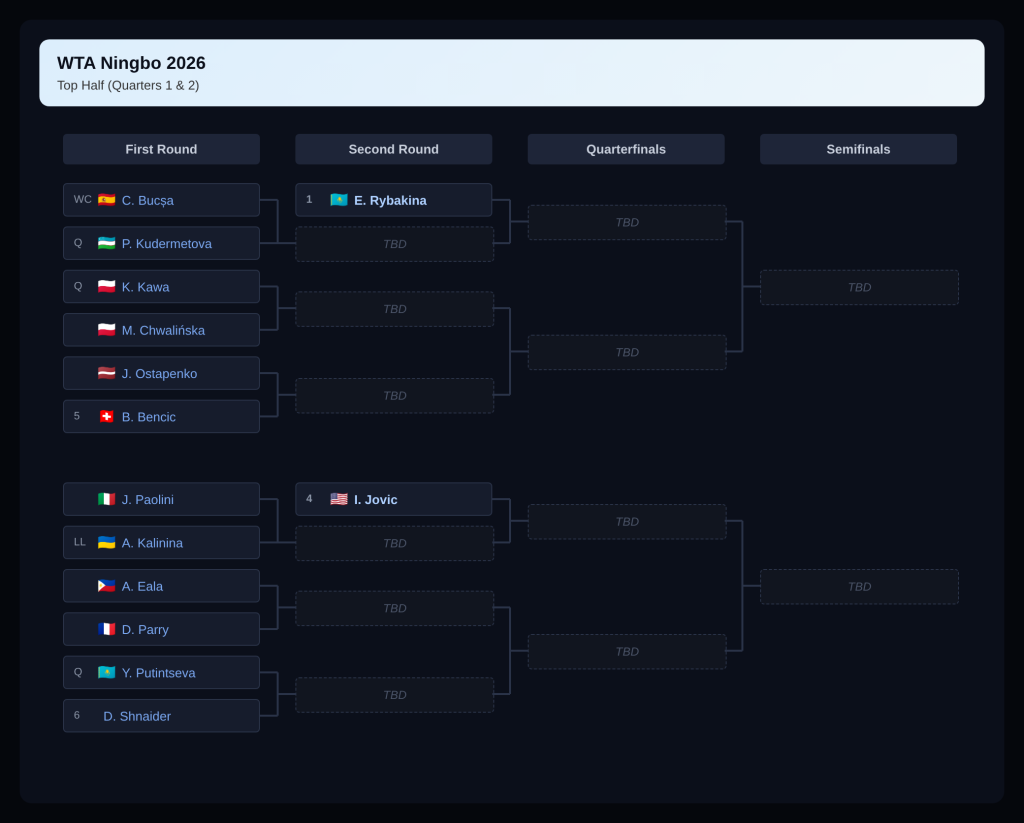
WTA Ningbo Open Draw
Top Half (Quarters 1 & 2)
Top seed Elena Rybakina headlines, with the winner of a crowded Q1 section — Jelena Ostapenko and 5th seed Belinda Bencic among them — awaiting her in the second round. 4th seed Iva Jovic anchors the other side, drawing the survivor of a brutal six-way group that includes Jasmine Paolini, Anhelina Kalinina and 6th seed Diana Shnaider.
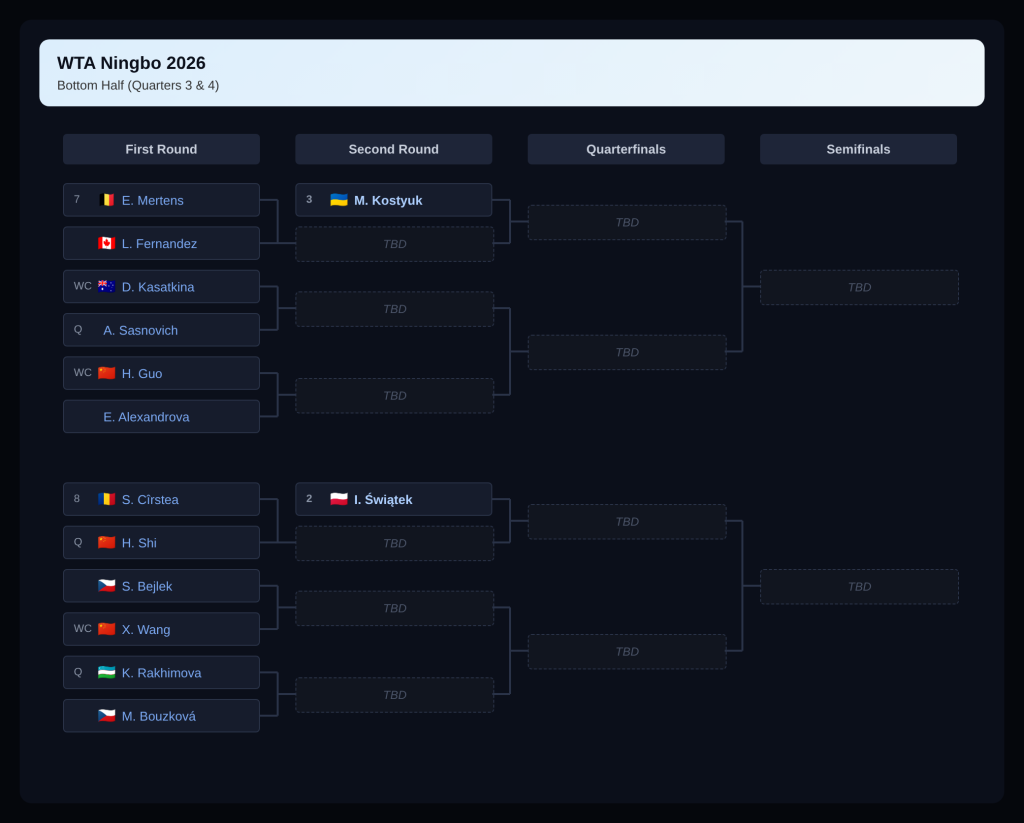
Bottom Half (Quarters 3 & 4)
3rd seed Marta Kostyuk opens this half, sitting across from a section led by 7th seed Elise Mertens, with Leylah Fernandez and Daria Kasatkina also in the mix. 2nd seed Iga Świątek rounds out the bottom, facing the winner of a group fronted by 8th seed Sorana Cîrstea, Xiyu Wang and Kamilla Rakhimova — a path that looks relatively clear for the Pole on paper.
WTA Ningbo Open Bracket Analysis
Quarter 1 – Deciding Factors
Elena Rybakina’s Generous Draw vs. Her Lingering Foot Injury
On paper, nobody in this tournament has it easier through two rounds than the top seed. Rybakina’s bye sends her straight into the Round of 16 against the winner of Cristina Bucsa and Polina Kudermetova, neither of whom has beaten a top-20 player all season, and her quarter’s other half has to survive three rounds of attrition before it even produces a quarterfinal opponent. That’s the version of this draw that has Rybakina cruising to the semifinals on talent alone, especially with the pedigree of a reigning US Open champion who beat Aryna Sabalenka for the title and the No. 1 ranking just six weeks ago.
Rybakina’s own body, meanwhile, is the bigger variable than anything on the other side of the net. She retired from her Cincinnati quarterfinal against Iga Świątek in August with a lower-leg/foot issue, admitted before the US Open that she “couldn’t even walk” a few weeks earlier, then made her first appearance as World No. 1 in Beijing and lost 3-6, 6-4, 6-3 to world No. 118 Alina Charaeva — saying afterward she “didn’t get a lot of chances to sleep and recover” and felt the foot again late in the third set. She withdrew from Wuhan entirely to rest it and is walking into Ningbo, where she’s the defending champion, without a clear public update on whether it has actually healed. If the foot is sound, the soft draw makes her the heavy favorite to reach the final four; if it flares again the way it did in Beijing, a bye and an easy second round won’t matter.
Jelena Ostapenko’s Wuhan Breakout vs. Elena Rybakina’s 4-0 Head-to-Head Hold
If health isn’t the deciding issue, the quality player standing between Rybakina and the semifinal is Jelena Ostapenko, and she’s arriving in the form of her life. Ostapenko just put together her best week in months at the Wuhan 1000: a 6-1, 6-1 demolition of Daria Kasatkina, a three-set win over Jessica Pegula, another three-setter over Leylah Fernandez, and a straight-sets win over No. 6 seed Diana Shnaider, before finally losing to eventual champion Sonay Kartal in the semifinal. That’s four wins over quality opposition in five days, including a seed, and it’s the kind of run that typically buys a player real confidence heading into the next event.
Rybakina, meanwhile, has simply owned this matchup regardless of either player’s form. She leads the all-time series 4-0, including wins on both hard courts she’s faced Ostapenko on (Cincinnati 2023, Australian Open 2023) and a 6-2, 6-2 beatdown as recently as the 2025 French Open — their most recent meeting. Ostapenko’s power game has given plenty of other top players trouble, but it’s a style Rybakina’s own ball-striking has matched and overwhelmed every time they’ve played. If Ostapenko gets there, the Wuhan hot streak runs into a head-to-head that says she’s 0-4 for a reason; Rybakina should extend that run if her health allows her to take the court at full strength.
Jelena Ostapenko’s Current Form vs. Belinda Bencic’s First-Match Wuhan Collapse
Before Ostapenko can even get a crack at Rybakina, she has to get past No. 5 seed Belinda Bencic in the Round of 32, and the recent form gap between the two is stark. Beyond the Wuhan run detailed above, Ostapenko has looked sharp and aggressive off both wings all month, with her serve and return numbers trending up through four rounds against increasingly good competition.
Bencic, meanwhile, was blown off the court in her very first match at Wuhan, losing 6-0, 7-5 to Kartal after getting a bye past a Zhang Shuai withdrawal — a lopsided first set that doesn’t square with a top-10-caliber player. Bencic does actually lead the all-time head-to-head with Ostapenko 2-1, with her most recent win coming at the 2025 Australian Open, so there’s a track record of her finding a way to disrupt Ostapenko’s power. But a 6-0 opening set in her last outing is a troubling form signal, and if that version of Bencic shows up again, Ostapenko should move through to a date with Rybakina without much resistance.
Maja Chwalinska’s Breakthrough Title vs. The Physical Toll of Winning It
Chwalinska is the wild card of this entire quarter after the biggest week of her career. She beat Maria Sakkari in a three-set Wuhan quarterfinal (6-0, 3-6, 7-5), ended an injured Świątek’s run in the semifinal, and rallied from a set down to beat Sonay Kartal 2-6, 6-4, 6-2 in a 2-hour, 43-minute final to claim her first WTA title — a WTA 1000, no less, and clearly her best form since reaching the French Open final. That kind of title run, against that level of competition, says she belongs in the conversation for this entire section, not just her first-round match.
The turnaround, meanwhile, is brutal. Chwalinska won a three-set quarterfinal, played a semifinal, and grinded through a nearly three-hour final all in the same week, then has to travel and open Ningbo almost immediately against Katarzyna Kawa — a modest, unseeded opponent on paper, but one who only has to show up focused while Chwalinska’s body processes a physical week most players need days to recover from. Title hangovers like this are a well-worn trend on tour; if the legs are heavy at all, Kawa has a real chance to catch her flat in round one, and even if Chwalinska survives, the fatigue could easily resurface by the time a second-week opponent is waiting.
Quarter 2 – Deciding Factors
Anhelina Kalinina’s Fight vs. Jasmine Paolini’s Chronic Foot Injury
Kalinina enters this one having already shown she can hang with the hottest player in China. In her Wuhan opener, she fell behind by a double break in the first set to Sonay Kartal — the eventual finalist who would go on to blow past Svitolina, Paolini, and Ostapenko later that week — and clawed all the way back before finally losing 7-5, 6-3 in an hour and 32 minutes. That’s a competitive, fighting loss to a player who proceeded to run the table on the rest of the draw, and it suggests Kalinina’s level is higher than her name recognition in this matchup would indicate.
Paolini, meanwhile, has spent 2026 managing a foot injury that has repeatedly derailed her season: she missed Cincinnati, withdrew from both Washington and Toronto, and announced a break in July specifically to “give my foot more rest time.” When she did return to action in Wuhan, she reached the third round without dropping a set before Kartal exposed her physically, routing her 6-2, 6-0 in just 64 minutes while she committed 24 unforced errors. If that version of Paolini — error-prone and without her usual movement — shows up again in Ningbo, Kalinina’s recent form against objectively better competition gives her a real path to the second round.
Diane Parry’s Career-Best Run vs. Alexandra Eala’s Three-Tournament Slide
Parry is not the opponent her unseeded status suggests. She’s riding a career-high ranking of No. 31 after going 21-8 since May — a complete turnaround from her 9-11 start to the season — highlighted by her maiden WTA title at the Abierto GNP Seguros in Monterrey, a WTA 500 event, as an unseeded player. In that stretch she’s picked up seven wins over Top 30 opponents, two of them in Monterrey alone, more than she had in her entire career before this run began. A player trending like that is a live danger to anyone on the other side of the net right now.
Eala, meanwhile, is in the worst form of her breakout season. The world No. 19 has lost three straight: a Round of 16 exit at Singapore to Tatiana Prozorova (6-4, 5-7, 3-6), a semifinal loss at the Asian Games to Wang Xiyu that limited her to bronze, and a Wuhan first-round defeat to 217th-ranked qualifier Shi Han (6-4, 3-6, 3-6) after leading by a set and 3-2 in the second. Her uncle Noli Eala called it a case of being “simply outplayed” and said she lacked her usual energy. If that slump carries into Ningbo, Parry’s surging game gives her a legitimate chance to end Eala’s tournament before she ever gets a look at Diana Shnaider.
Iva Jovic’s Clean Hard-Court Hitting vs. a Compromised Second-Round Test
Jovic has looked like the best player in this section when she’s on. Her Wuhan second-round win over Dayana Yastremska was a 6-4, 6-1 rout in which she won 6 of her 16 break-point chances and never faced one in the second set, and she’s already beaten Paolini once this year, a 6-2, 7-6(3) upset of the then-seventh-seeded Italian at the Australian Open. Yes, she ran into a red-hot Maja Chwalinska in her very next match and lost 4-6, 1-6 while committing 31 unforced errors — but that loss came against the player who went on to win the entire tournament, so it says little about where Jovic’s game actually stands against the players left in her own quarter.
Whoever survives Paolini and Kalinina, meanwhile, arrives banged up. Paolini is working through a foot injury that’s already cost her three tournaments and produced a 6-2, 6-0 blowout loss in her last match, and Kalinina’s own path required clawing back from a double-break deficit just to make a three-set match of it against Kartal. If Jovic’s level in Ningbo looks anything like the Yastremska rout rather than the Chwalinska letdown, neither likely second-round opponent has shown the form this month to make her sweat.
Quarter 3 – Deciding Factors
Leylah Fernandez’s Complete Wuhan Week vs. Elise Mertens’ Beijing Hangover
Fernandez is playing the more complete tennis of this pair right now. At Wuhan she beat Ekaterina Alexandrova in a gritty three-set opener (6-4, 3-6, 6-3), then survived a scare against Shi Han by winning the final five games of the match (6-3, 6-4), and only lost in the third round to a red-hot Jelena Ostapenko. That’s three real matches of competitive, winning tennis, not one signature scalp propping up an otherwise shaky week — and it comes on the heels of her sixth career WTA title, won last month in Singapore.
Mertens, meanwhile, had a genuinely spectacular Beijing — she beat Iga Świątek in straight sets and knocked off Coco Gauff to reach the China Open semifinal, described as “one of the weeks of her life.” But it evidently emptied the tank: she was bounced in her very next event, losing in the Wuhan first round to 42nd-ranked Daria Snigur, 6-4, 7-5. If that letdown carries into Ningbo, Fernandez’s steadier, more complete two-tournament sample gives her the better chance of being the one to reach Kostyuk in the Round of 16.
A Battle-Tested Round of 16 Opponent vs. Marta Kostyuk’s First-Match Rust
Whoever survives Mertens-Fernandez will arrive at this match with real rhythm — live sets against quality opposition, not a week off. That matters because Kostyuk’s own recent pattern is the thing working against her here: she gets a bye into this match, same as she did as the 8 seed at Wuhan, where that bye set up an immediate straight-sets loss to unseeded Maria Sakkari in her tournament opener.
Kostyuk, meanwhile, hasn’t shown she can shake off that specific trap. Two tournaments in a row now, a first-round bye has meant she’s cold for her first real match of the week while her opponent already has rhythm — and it bit her against Sakkari just five days ago. If that repeats, whoever comes out of Mertens-Fernandez, battle-tested and already playing with match rhythm, has a real chance to end Kostyuk’s tournament before it even starts — which is exactly what makes this the hardest section of the draw to call.
Ekaterina Alexandrova’s Across-the-Board Form vs. Hanyu Guo’s Emotional Wildcard Run
Alexandrova is playing quality tennis right now. In Beijing she beat Linda Noskova 6-2, 6-2 to reach the China Open quarterfinal and pushed Mirra Andreeva to two tiebreaks, 7-6(4), 7-6(3), before finally losing. Then at Wuhan, even in defeat, she took a set off Leylah Fernandez and forced a third-set decider, 6-4, 3-6, 6-3 — against an opponent who was herself playing well enough that week to go three competitive rounds before running into Ostapenko. Two tournaments, two tight battles with quality opposition: that’s a player swinging freely and hitting her spots, not one who’s cooling off.
Guo, meanwhile, is pure emotional momentum and home-crowd variance. The 240th-ranked Chinese wildcard has played just four tournaments since her father’s hospitalization this summer, and last week she produced one of the gutsiest runs of the Asian swing — saving three match points and climbing back from a set and 4-0 down to upset 12th seed Sorana Cîrstea, before finally falling to Elina Svitolina. That kind of adrenaline and crowd backing is real, especially with Ningbo giving her another Chinese stage. If Alexandrova’s level holds the way it has for two straight weeks, her ball-striking and experience should be enough to get through — but Guo’s house-money run gives her a genuine puncher’s chance at another home upset.
Quarter 4 – Deciding Factors
Sorana Cîrstea’s Career-Best Season vs. Han Shi’s Fearless Underdog Run
On paper, Cîrstea should be a real threat in this section. 2026 has been the best start to a season of her entire career — she reached 20 tour-level wins faster than ever before, going 20-6 through mid-April, and won her fourth career WTA title (and first on home soil) in Cluj-Napoca in February. She’s also playing with the extra motivation of a farewell tour, having announced 2026 as her last season.
Han Shi, meanwhile, is playing with house money and real belief after the week she just had. The 217th-ranked Chinese qualifier upset 13th-seeded Alexandra Eala in the Wuhan first round before falling to Fernandez, and that same fearless-underdog energy is exactly what bit Cîrstea last week — she was the one on the wrong end of a historic upset at Wuhan, blowing a big lead to lose 1-6, 7-6(6), 7-5 to 240th-ranked wild card Hanyu Guo after nearly closing it out. If that vulnerability to an underdog with nothing to lose shows up again, Shi’s recent scalp over a seeded player says she’s fully capable of delivering a second one.
Kamilla Rakhimova’s Recent Form vs. Marie Bouzkova’s Shaky Finish
Rakhimova is 6-4 over her last 10 matches and carried real form into Wuhan, breezing through qualifying with a 6-0, 6-3 win over Sofia Kenin before advancing into the main draw. That’s a player trending in the right direction heading into Ningbo, not one just surviving on the schedule.
Bouzkova, meanwhile, needed a retirement from Clara Tauson just to escape her Wuhan opener, advancing while up 6-1, 2-0 when Tauson pulled out. When she finally got a real test, against Maja Chwalinska, she won the first set 6-1 and then completely came apart, losing the next two sets 6-1, 6-1 as Chwalinska launched the run that carried her to the title. That’s a concerning pattern for someone projected to win two rounds and reach Świątek. If Rakhimova’s level holds, the assumption that Bouzkova is next in line looks a lot shakier than the bracket suggests.
Wang Xiyu’s Asian Games Gold vs. Sara Bejlek’s Two Straight Losses
Wang enters this stretch with as much momentum as anyone in the draw. She won Asian Games gold — beating Eala in the semifinal and Zhang Shuai in the final for an Olympic berth — then carried it straight into Wuhan, demolishing countrywoman Xinyu Wang 6-2, 6-0 before finally being outlasted in a 2-hour, 55-minute three-setter by Mia Pohankova. That’s a player who is dangerous on confidence alone right now.
Bejlek, meanwhile, carries the better season-long résumé — an Abu Dhabi title, a win over World No. 1 Aryna Sabalenka at Cincinnati, and her first WTA 1000 semifinal — but she’s lost her last two matches: a tight 7-6(4), 6-4 defeat to Naomi Osaka in the Beijing third round, then a more comfortable 6-3, 6-4 loss to Jasmine Paolini in the Wuhan first round. If that mini-slide carries into Ningbo, Wang’s gold-medal momentum makes her exactly the kind of sleeper worth watching out of this section, pedigree or not.
Up to $1,500 in Bonus Bets if Your First Bet Doesn't Win*
*Bonus Bets Expire in 7 Days. One New Customer Offer Only. Add’l terms. 21+. Gambling Problem? Call 1-800-GAMBLER or 1-800-MY-RESET
Up to $1,500 in Bonus Bets if Your First Bet Doesn't Win*
*Bonus Bets Expire in 7 Days. One New Customer Offer Only. Add’l terms. 21+. Gambling Problem? Call 1-800-GAMBLER or 1-800-MY-RESET
WTA Japan Open
Favorite to Win: waiting on odds
Sleeper Pick: waiting on odds
WTA Japan Open Information
- Dates: October 19–25, 2026
- Location: Osaka, Japan
- Surface: Hard
- Tier: 250
- Defending Champion: Leylah Ferndandez
WTA Japan Open Odds to Win
- TBD (waiting on sportsbooks to release odds)
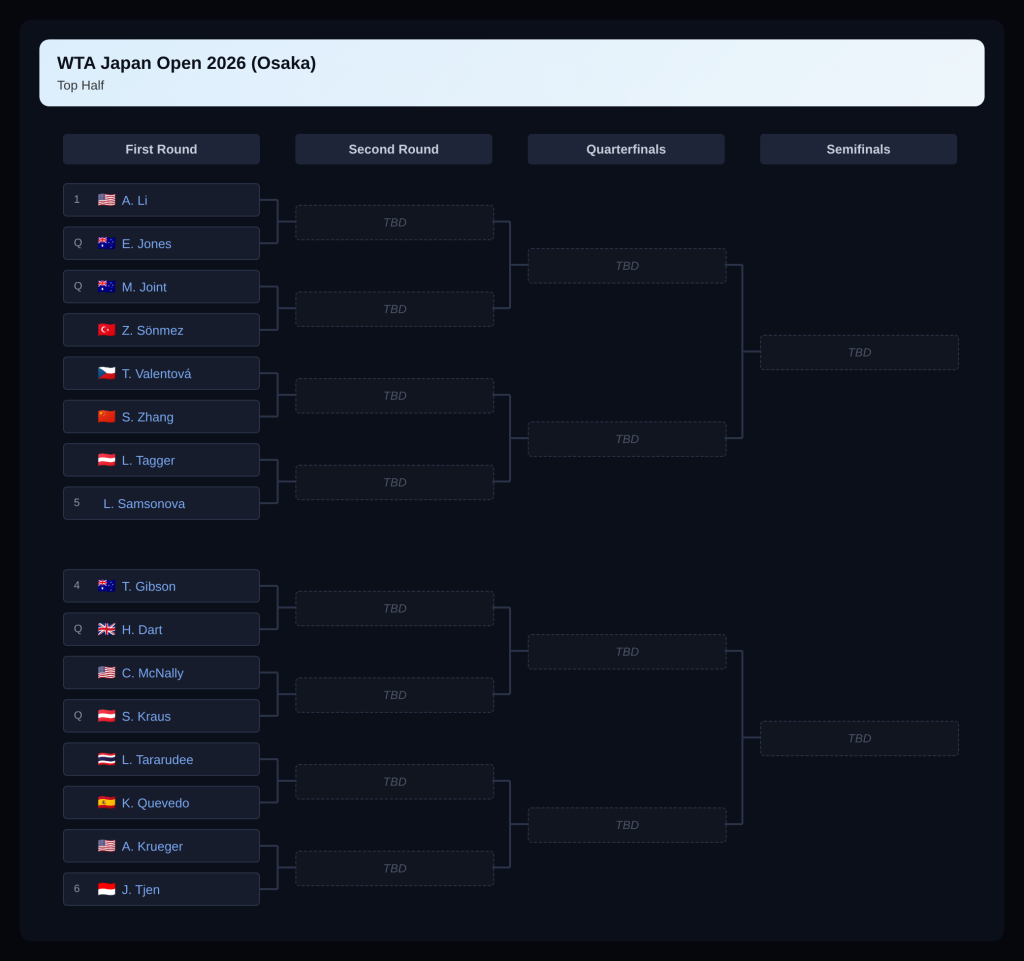
WTA Japan Open Draw
Top Half (Quarters 1 & 2)
Top seed Ann Li leads the way, with the winner of a tricky all-qualifier opener (Emerson Jones vs. Maya Joint) potentially waiting in round two. 4th seed Talia Gibson anchors the bottom of this half, drawing a section that includes Harriet Dart, Caty McNally and 6th seed Janice Tjen.
Top Half (Quarters 3 & 4)
8th seed Katie Boulter opens against a section full of Japanese wild cards (Himeno Sakatsume, Mai Hontama) before a potential run-in with 3rd seed Kimberly Birrell. 2nd seed Peyton Stearns rounds out the bottom, facing a group led by 7th seed Oleksandra Oliynykova and a home-crowd-heavy draw featuring Moyuka Uchijima and Ena Shibahara.
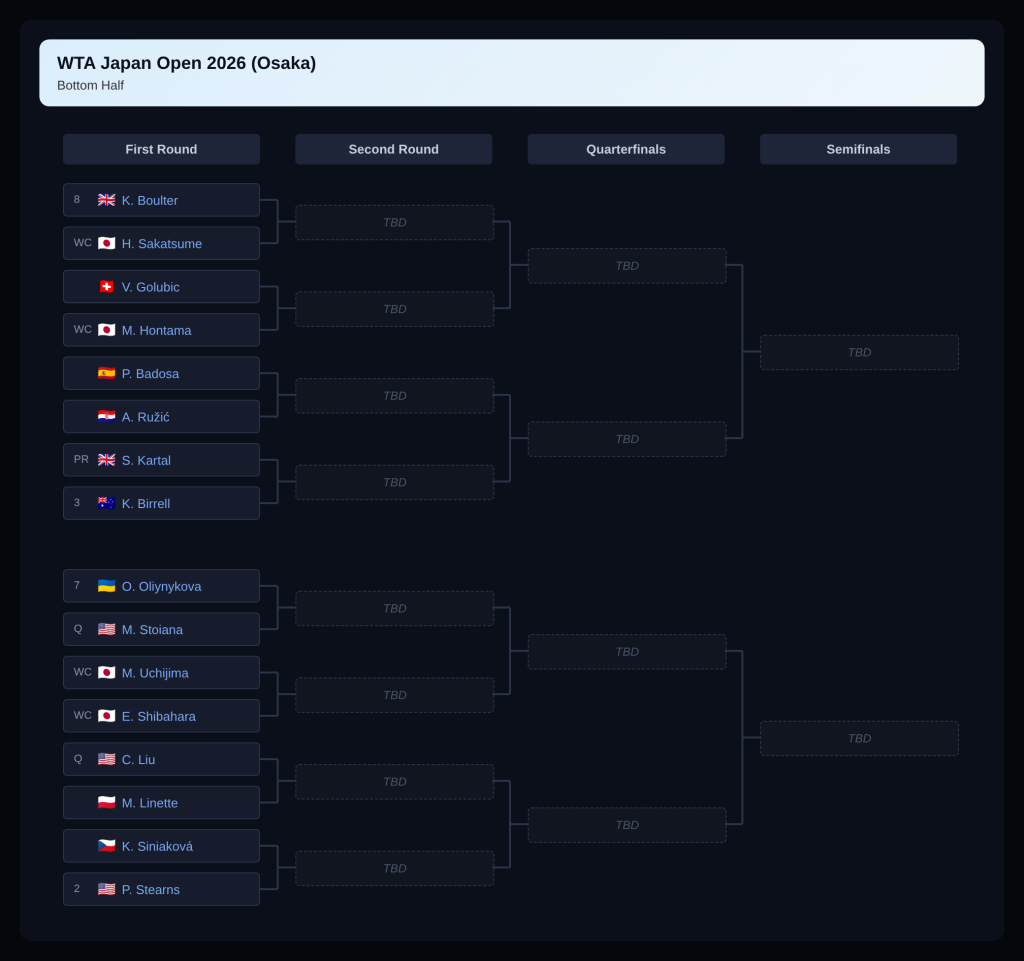
WTA Japan Open Bracket Analysis
Quarter 1 – Deciding Factors
Ann Li’s Statement Upset Over Sabalenka vs. an Unproven Field Around Her
Li enters as the No. 1 seed off the best week of her season. In the Wuhan Round of 32, she knocked off top seed and three-time Wuhan champion Aryna Sabalenka in a genuine statement win, 3-6, 6-4, 7-6(5) — down a set and facing a player who’d won more total points in the match, Li closed it out by serving 8 aces to Sabalenka’s 2 and out-aggressing her on the return. She carried that into a maiden Wuhan quarterfinal before Świątek finally stopped her, 6-4, 6-1. That’s a player who just beat the biggest name in the draw on the biggest stage available to her.
Nothing left in this section, meanwhile, has shown anywhere near that level right now. Her own path opens against a qualifier, and whoever she’d face in the next two rounds is either an unproven qualifying survivor, a 595th-ranked veteran running on fumes, or two players (Tagger and Samsonova) whose 2026 seasons have been defined by inconsistency rather than sustained form. On the numbers, the data clearly backs Li to be playing in the quarterfinal.
Tereza Valentova’s Osaka Pedigree vs. Liudmila Samsonova’s Shaky Fall Form
Valentova arrives with both rising form and specific history at this event. She reached the final of the WTA 125 in Saint-Malo in May — routing Sloane Stephens and Claire Liu before dropping just six games against Blinkova — and she’s actually been to an Osaka final before, reaching it as a qualifier last year before losing to Leylah Fernandez. A 19-year-old with that trajectory and course history is a real threat in this section.
Samsonova, meanwhile, carries the No. 5 seed and the power game but a genuinely bumpy season to match — 21-23 on the year with a 4-6 mark over her last 10 matches, and she’s coming off a Wuhan second-round exit to Svitolina just last week. Her best recent result, upsetting top seed Marta Kostyuk to reach the Guadalajara semifinal last month, shows the talent is there, but it hasn’t been consistent. If Tagger’s big-match game from Prague resurfaces, this is a genuine coin flip, not a seed cruising through — and whoever survives still looks like the softer of Li’s two possible Round of 16 roads.
Quarter 2 – Deciding Factors
Caty McNally’s Three-Match Wuhan Gauntlet vs. Talia Gibson’s Back-to-Back China Swing Faceplants
McNally arrives at Osaka having played three of the toughest matches of her season in the span of five days. She beat Lanlana Tararudee 6-4, 4-6, 6-1 in the Wuhan qualifying final on October 11, survived a nearly three-hour second-round battle with Yuliia Starodubtseva, and then took sixth-seeded world No. 7 Karolína Muchová to back-to-back tiebreaks before finally falling 3-6, 7-6, 7-6 on October 14. That’s a career-high-ranked player (No. 50, set in June) who has already beaten Kateřina Siniaková and 10th-seeded Victoria Mboko this season, and who just proved — in a loss — that she can trade blows with a top-10 player deep into a decider. Her level right now looks like the best version of her 2026 season, not a fringe one.
Gibson, meanwhile, enters as the No. 4 seed of this quarter carrying the opposite momentum: she was bageled in the second set of a 7-5, 6-0 qualifying loss to Sara Sorribes Tormo at Wuhan on October 10, and the week before that lost 6-1, 6-4 in 84 minutes to qualifier Aliaksandra Sasnovich in the first round of the Beijing China Open. That’s back-to-back lopsided exits since her Sunshine Swing peak, when she beat Naomi Osaka and Iva Jovic at Miami and reached the Indian Wells quarterfinals over Paolini, Tauson, Alexandrova and Ann Li. If that cold stretch hasn’t broken by Osaka, a fresh qualifier could beat Gibson before she ever sees McNally — and if McNally’s legs are the ones that give out after three draining matches in a week, this entire half could be decided by fatigue rather than form.
Ashlyn Krueger’s Dominant Wuhan Statement vs. Janice Tjen’s Draining Near-Upset of Ann Li
Krueger needed just 6-3, 6-0 to dispatch Zhang Shuai in the first round at Wuhan on October 13, continuing a 2026 season that’s included a run to the Wimbledon fourth round (beating 31st seed Donna Vekić, Mariam Bolkvadze and Daria Snigur before an 11-match win streak ended against 12th seed Marta Kostyuk) and a third-round run at Indian Wells over Magda Linette and 19th-seeded Liudmila Samsonova. At a career-best No. 60, Krueger has repeatedly shown she can beat seeded, dangerous opponents in straight sets — and she did it again here with two days less wear on her legs than her potential quarterfinal opponent.
Tjen, meanwhile, put together her best week of the Asian swing at that same Wuhan event: the No. 36-ranked, sixth-seeded Indonesian beat Aoi Ito 6-3, 6-1 to reach the round of 16 of a WTA 1000, then rallied from 1-6 down to force a second-set tiebreak against Ann Li — this quarter’s own Q1 top seed in Osaka — before falling 1-6, 6-7(1) on October 15, just three days before this draw opened. The match ran 37 winners and 11 aces for Li against only 10 winners and two aces for Tjen, yet Tjen still won 49% of total points, proof she can hang physically with elite ball-strikers even in defeat. If that near-upset left any legs or confidence in the tank, Tjen’s level from the Li match suggests she might be the more dangerous quarterfinal threat than her seeding implies — but Krueger’s flat, efficient demolition of Zhang Shuai two days apart gives her the fresher-legs case entering a new draw.
Kaitlin Quevedo’s Breakout Title Run vs. Lanlana Tararudee’s Backdoor Qualifying Exit
The sleeper case holds up: Quevedo won her first WTA Tour title in São Paulo on September 21, coming back from a set down to beat fellow first-time finalist Nadia Podoroska 4-6, 6-4, 6-2 — closing with five straight games in the decider — to reach a career-high No. 90 the same day. That capped a genuine, documented rise rather than a one-off: she broke Madrid’s draw as a wild card by upsetting Venus Williams, won her first Grand Slam main-draw match at Roland Garros, cracked the top 100 in July and reached her first WTA 125 final in August. This is only her eighth tour-level main draw, and she’s already shown she closes matches under pressure.
Tararudee, meanwhile, arrives off a narrow but real defeat of her own — she beat Claire Liu in Wuhan qualifying on October 10 before falling to the red-hot McNally 6-4, 4-6, 6-1 in the qualifying final the next day, meaning she’s playing her way through qualifying draws rather than arriving off a main-draw run of her own, even with her history-making climb into the world’s top 100 earlier this season. If Quevedo’s title-winning form from São Paulo carries into Osaka, her claim as this quarter’s sleeper looks like the stronger bet the data supports; if Tararudee’s resilience from grinding through two qualifying rounds translates into sharper focus against a less battle-tested opponent, she could be the one to outperform her ranking instead.
The Krueger-Tjen Winner’s Proven 2026 Ceiling vs. the Gibson-McNally Side’s Form Question Marks
Stacked side by side, the Krueger-Tjen half carries more recent, higher-level proof of point. Krueger’s Wimbledon fourth round and wins over seeded players at Indian Wells, paired with Tjen’s run to the round of 16 of a WTA 1000 and her competitive near-upset of Ann Li just days ago, give that side of the draw a deeper, fresher résumé than anything on the other side outside of McNally’s run. Both Krueger and Tjen enter Osaka off recent wins against legitimate opposition, not off a loss.
The Gibson-McNally side, meanwhile, is murkier by design: Gibson has lost her last two matches by a combined 13-4 in sets to a pair of qualifiers, raising real doubt about her health or rhythm, while McNally has proven she belongs with elite players but did it across three grueling matches in five days with no rest before this draw even opened. If Krueger or Tjen advances while still playing within the form each showed at Wuhan, that side profiles as the stronger bet to win this quarter outright — but if McNally’s fatigue catches up to her against a repaired Gibson, or vice versa, this section could turn on who recovers fastest rather than on name value.
Quarter 3 – Deciding Factors
Viktorija Golubic’s Competitive Three-Set Fight vs. Katie Boulter’s Lopsided Wuhan Blowout
The season-long data backs the lean toward Golubic. Her 2026 has been a deep, varied campaign across every surface — an Oeiras 125 final in February, a run to the Italian Open third round over 29th seed Maya Joint before a tight three-set loss to eighth seed Mirra Andreeva, her first-ever French Open third round, and a Nottingham semifinal where she beat Sofia Kenin, Zeynep Sönmez and fifth seed Ann Li before falling to third seed Emma Navarro. That’s a No. 90-ranked player who has repeatedly pushed seeded, dangerous opponents in best-of-three. Her most recent match backs it up, too: she lost to Daria Kasatkina 4-6, 7-6(7-3), 6-4 in Wuhan qualifying on October 10, a match she had a real foothold in deep into a second-set tiebreak against a former top-10 player.
Boulter, meanwhile, enters as the No. 8 seed off a far uglier recent result — the 11th-seeded Diana Shnaider beat her 6-3, 6-1 in the first round at Wuhan on October 13, a lopsided, one-sided scoreline that doesn’t match the resume of a player who beat world No. 2 Elena Rybakina to reach the Queen’s Club semifinals and won the Ostrava title back in February. Her results since that grass-court peak have been inconsistent — first-round exits in Washington and Canada sandwiched a second-round loss in Cincinnati. If Boulter’s game has genuinely reset since that blowout, her higher seeding and higher ceiling (the Rybakina win remains the best of either player’s season) still gives her a path; but on current form, Golubic’s competitive losses to quality opposition look like a healthier signal than Boulter’s recent capitulation.
Sonay Kartal’s Historic Wuhan Run vs. the Physical Bill That Comes With It
Kartal’s week in Wuhan is one of the best stories in the sport right now, and it’s worth laying out in full: in just her third tournament back from a six-month back injury (stress fractures that cost her Roland Garros, Wimbledon and the US Open), she beat Anhelina Kalinina, then 6-0, 7-5 over Belinda Bencic, then 6-2, 6-0 over 15th seed Jasmine Paolini without dropping a set across three rounds, then 6-2, 2-6, 6-4 over fifth seed and former world No. 3 Elina Svitolina in the quarterfinals, then beat Jelena Ostapenko in the semifinal to reach her first WTA 1000 final — only the second British woman ever to do so, after Johanna Konta, and the lowest-ranked quarterfinalist (world No. 170 entering the event) in the tournament’s history. Her live ranking has already jumped more than 80 places. This is about as validating a comeback week as exists in tennis.
Birrell, meanwhile, is a credible first-round threat in her own right — the No. 3 seed arrives off a semifinal run in Austin that pushed her back into the world’s top 70 for the first time since June of last year, and she’s shown she can back up a big week with results rather than fade after it. The math here is unavoidable: Kartal will have played five grueling, high-stakes matches (several three-setters against seeded and former top-10 opposition) in roughly ten days, with the Wuhan final itself landing just before this draw opens, against a fresh, in-form seed who has had a normal week off to prepare. If Kartal’s legs and adrenaline carry over the way Emma Raducanu’s and other recent breakout runs have, she’s the most dangerous floater in this entire draw; but if the physical bill comes due against a player as battle-tested as Birrell, this could be the fastest some air comes out of a hot week all season.
This Quarter’s Form Gaps vs. Its Name Recognition
Add it up and the data points toward the less decorated players right now, not the bigger names. Golubic’s competitive losses to ranked opposition, Kasatkina’s quality win over Badosa notwithstanding, and Kartal’s five-match gauntlet all represent fresher, more convincing recent evidence than Boulter’s blowout loss or Badosa’s unresolved illness. Birrell’s Austin semifinal adds a fourth player who is arguably playing better right now than her seeding alone would suggest.
Boulter and Badosa, meanwhile, both carry real season-long pedigree — a Rybakina win and an Ostrava title for Boulter, a 16-11 surge and two wins over Kasatkina for Badosa — that would make either the obvious pick in a vacuum. But pedigree isn’t current form, and both enter Osaka on a sour note from their immediately preceding tournament. If either snaps back to the level that built their seeding, they’re still the favorites on paper; but if this week plays out the way the last one did, Golubic, Kartal and Birrell all look like live threats to be the ones advancing deep into this quarter.
Quarter 4 – Deciding Factors
Mary Stoiana’s Breakthrough September Run vs. Oleksandra Oliynykova’s Beijing Letdown
Stoiana’s case is built on a genuine, recent breakthrough. The 23-year-old American, ranked No. 122, picked up her first-ever WTA main-draw win this September at the São Paulo Open on her sixth tour-level attempt, beating Claire Liu 6-3, 7-5 in the first round, then Dominika Šalková 7-6, 6-1 to reach her first WTA Series quarterfinal. That’s a player whose results are trending sharply upward right as this swing begins, with a win over a fellow Top 100 player already banked.
Oliynykova, meanwhile, carries the deeper season-long résumé — a run to her first WTA semifinal in Transylvania, a maiden WTA 1000 win and third round at the Italian Open, a third round at the French Open, a semifinal in Iași, and a quarterfinal in Hamburg as top seed before an injury forced her out. But she enters this draw off a flat result of her own: a 2-6, 3-6 first-round loss to wildcard Yuan Yue at the Beijing China Open on September 30. If that Hamburg injury is still lingering, Stoiana’s current form and confidence give her a real path to the upset; if Oliynykova’s level resets to where it sat all season, her ceiling clearly exceeds that of a player only a month into her first tour-level quarterfinal.
Peyton Stearns’ Title-Winning Firepower vs. Katerina Siniaková’s Elite Doubles-Honed Return
Stearns brings the clearest ceiling in this entire quarter. The No. 2 seed and world No. 36 won the ATX Open in Austin this year, beating Taylor Townsend in the final, reached the Guadalajara final in September before losing to Iva Jovic, and made the third round at both the Australian Open and French Open. That’s a player with a 2026 title to her name and results across multiple surfaces that no one else in this section can match.
Siniaková, meanwhile, plays from a different kind of strength — she’s the world No. 1 in doubles and completed a Career Grand Slam in that discipline with Townsend at the US Open, built on a return game that is among the best in the sport regardless of format. Her singles form this year has been steady but capped: a No. 53 ranking and second-round finishes at all four majors, a 4-4 Grand Slam singles record with no breakthrough beyond that stage. If Stearns’s serve and forehand travel the way they did in Austin, her season-long weapons should be the deciding edge; but Siniaková’s return numbers give her a path to turn this into a far longer, tighter match than the ranking gap between them suggests.
Photo Credit: REUTERS