Prediction Markets vs. Daily Fantasy Sports: Which platform to use in 2026


Prediction markets and daily fantasy sports (DFS) are two popular ways for sports fans to add an extra layer of excitement to the games they follow. While both let you put money on your opinions and predictions, they work in very different ways — from how you place a wager to how payouts are determined.
In this guide, we’ll be comparing Prediction Markets and Daily Fantasy Sports platforms, going over how each of them works and where they’re different from one another, so you can see which platform best suits what you want to get out of your experience.
Prediction Markets vs. Daily Fantasy Sports: Overview
| Feature | Prediction Markets | DFS Sites |
|---|---|---|
| Platform Type | Event-based trading and predictions | Fantasy sports-based, including lineups and selections |
| How Users Participate | Buy/sell contracts and positions on events | Build a lineup, make selections on players' performance |
| Payment Methods | Debit card, bank transfer, crypto, PayPal, Venmo | Debit card, credit card, Venmo, PayPal, bank transfer, Apple Pay, PayNearMe, gift cards at select platforms |
| Regulation Style | Commodity Futures Trading Commission | State-by-state regulation |
| Typical User | Probability-driven, outcome-focused trader | Player-focused and lineup builder |
What Are Prediction Markets?
Prediction markets are platforms where players trade contracts based on their beliefs about the outcome of future events. For example, a contract on the outcome of a football game could be trading at 66¢ per contract, and you trade on 10 of them for a total of $6.60. Each contract typically pays out $1 if you’re correct, so in this case, if you were right, you’d get $10 on a $6.60 purchase.
The market price of a prediction will reflect the belief and opinion of the user base.
How To Make Money With Prediction Markets
The primary way to make money with prediction markets is to buy a position low and sell it when it gets high. For example, if you bought a position at $0.20 and it eventually went up to $0.80, you could see that and make some money. Another way is to simply follow through with the event.
If you believe the outcome of a game will be what you purchased a contract on, ride it to the end for the maximum payout. Something else you could do is check out multiple markets to see if there are noticeable price differences, where you lock in profits by selling high in one place and buying a bit cheaper elsewhere.
What Are Daily Fantasy Sports?
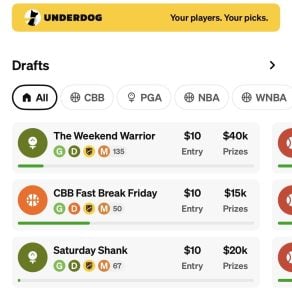
Daily Fantasy Sports have evolved in recent years, going from building lineups with players on a slate with a salary cap, to now there are platforms where you’ll make selections and be paid out based on how many you get correct. Famous examples of daily fantasy sports include DraftKings, where you get a $50,000 salary cap, and you build a roster of players within those constraints, and compete in tournaments against other players, and you win money based on where you finish.
How To Make Money With DFS
Making money with DFS can be a bit more complex due to the size of tournaments, the number of entries you’re allowed, and the number of players that are paid out. First and foremost, before you try, you need to understand the rules of the game you want to get into. Next, when you build a lineup, for example, the goal is to score the most points, yes, but you also want to find players who may not be owned as much as others that’ll also produce points to diversify your lineup from the field.
From there, you’ll want to pick your spots well, such as cash games, which may have a lower payout at the top of the board, but baret’s more consistent for more players. Finally, manage your bankroll, use tools and data to identify players, and be ready to pivot strategies.
Prediction Markets vs. Daily Fantasy Sports Contest Types
While sports prediction market offerings are quite similar to what online sportsbooks tend to offer, a strictly DFS site operates in a slightly different way. Here are the options for players for each.
Prediction Markets
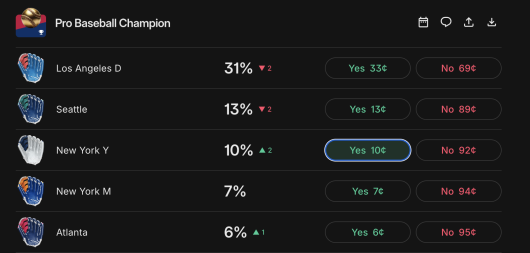
Prediction markets for sports typically let users trade on the outcome of real-world events, such as who will win a game, series, or championship, using contracts that reflect real-time probabilities. Instead of building lineups, participants buy and sell “yes” or “no” positions, with prices moving based on market sentiment and new information leading up to the event.
Beyond sports, there are events based on economics, politics, culture, and more.
The strengths of these markets are that they are more focused on the game’s outcome, so it can be a bit easier to quantify a selection.
That said, if you’re in a state with legal online sports betting, some options will go far beyond what you’ll find at a predictions market. Often, the markets on a prediction platform are centered on the game’s outcome.
The key difference between prediction markets and daily fantasy sports is that they’re massively different from one another. Prediction markets focus on the game and trading positions, and win alongside people.
Daily Fantasy Sports
With Daily Fantasy Sports, you’ll find contests such as cash games, tournaments, single-entry contests, satellite/qualifiers, showdowns, and pick’em-like games.
Here’s a brief description of each:
- Cash games: Pay out to a larger field, but no massive payout to a winner.
- Tournaments: More volatile, but higher payouts at the upper end of finishers.
- Single-entry contests: A bit more stable in that players only have one lineup or entry as opposed to hundreds.
- Satellite: Play to qualify for a bigger tournament.
- Showdown: Focuses on one particular game rather than a full slate, making lineup building a bit more focused.
- Pick’em: Predict over/under on a player’s performance and be paid out based on how many you get correct. For example, you pick five over/under bets, and you get paid out if you get 3 out of 5 selections correct.
The strengths of daily fantasy sports are that there are various types of contests, so there are many ways to play and potentially win.
That said, there are some limitations, and oftentimes, depending on the type of contest you play, it could be your wallet. If you enter one lineup into a tournament that allows up to $250, your chances of winning are not great whatsoever. There’s also a massive skill gap between you and the upper echelon players who are using proprietary programs to help them build lineups optimally.
Daily fantasy sports is more fantasy sports-based in that the goal is to build lineups, get points from players’ performance, and beat other people.
Prediction Markets vs. DFS: Fees & Costs
Whether you decide to try out Predictions Markets, DFS, or both, there are fees and costs associated, though some are more pronounced than others.
Prediction Markets
Users typically pay fees related to trading activity. Trading fees (buying/selling positions), Possible deposit or withdrawal fees, and the chance of market spreads or slippage in low-liquidity markets
In Prediction Markets, players may encounter fees for trading, exchanges, deposits, withdrawals, and temporary slippage.
For example, at Kalshi, if you were to make a $100 deposit with your debit card, you’d face a 2% fee, meaning you’d begin trading with $98. From there, the fee per contract is 2¢. Thus, you’re paying fees as you trade contracts and purchase positions.
Daily Fantasy Sports (DFS)
The fees at Daily Fantasy Sports aren’t as pronounced. You, as the player, don’t ever have to worry about any direct fees, such as depositing $100 and paying a 2% fee. Instead, the fees in DFS come from the rake of the contest.
For example, DraftKings hosts a tournament and takes a cut of the buy-ins, then pays out the remainder. Let’s say a contest has buy-ins that total $100. There are 10 people, and they each paid in $10. DraftKings could take 10% ($10), and the contest would pay out $90 total to whoever is deemed the winner.
The players themselves never paid any fees, but DraftKings or another DFS platform took a portion of the entry fee to host the contest.
Prediction Market Liquidity vs. DFS Contest Availability
Where Prediction Markets and DFS have similarities liquidity-wise is that they both rely on other users. In DFS contests, this depends on the contest size and how quickly it fills, but once a player enters, they can’t withdraw. Conversely, in prediction markets, players can enter, exit, and trade whenever they want.
So, if you’re looking for some with far more flexibility, such as buying into a position on a Monday and wanting to sell on Wednesday, prediction markets make more sense. However, if you want to see something through to the end, you can with prediction markets, but you also must do so with daily fantasy sports; it’s not optional.
Prediction Markets User Experience vs. Daily Fantasy Sports User Experience
The user experience can vary from one type of platform to another, so this is a good time to compare what that might be like for players using both DFS apps and prediction markets.
Prediction Markets
Getting started with prediction markets requires a bit more process. After creating an account, you may also need to complete KYC verification, which requires a copy of your government-issued ID and a selfie or a screen recording to confirm you are who you say you are. This is done at most places relatively fast, but it can sometimes take days.
That said, once you’re in, you can deposit and begin trading across the various markets that are available. It looks a lot like trading stocks in that you’ll see the “Yes/No” position and the price for each contract, select which one you want, purchase it, and then from there you can wait until it’s resolved or hold it and sell later.
A lot of these platforms have mobile apps, or some, like Robinhood Predictions, require you to trade on the mobile app.
So, the verification process can take a bit longer, and there are fees, but it’s straightforward once verification is complete.
Daily Fantasy Sports (DFS)
At Daily Fantasy Sports platforms, you’ll still be asked for personal information as winnings are taxable income, but it’s much faster, and I’ve never needed to complete any kind of KYC where I upload a picture of my government-issued ID.
After you create an account, you’ll also deposit funds and then browse available contests. Again, there are no fees to worry about.
That said, once you find a contest in a sport you want to play in, you’ll need to (at a more “traditional” DFS platform) build a lineup. This will require some thought, as you can’t just pick any players; there’s a salary cap you need to stay within.
You can build these lineups on desktop and mobile, but many of these sites are hyper-optimized for mobile.
Once you enter a contest, you may not be able to leave it.
Overall, it’s easy to get started, but building a lineup could take some time, and once you’re in, you’re in. You can’t “sell” out of your lineup.
Deposits, Withdrawals, & Wallets
| Feature | Prediction Markets | DFS Sites |
|---|---|---|
| Supported Payment Methods | Crypto, fiat, or potentially both | Fiat currency |
| Wallet Setup | Built-in wallet or external crypto wallet | Account balance is built into your account |
| Withdrawal Speed | Varies based on method, including within minutes and up to ~5 days | Can also be done quite quickly, almost instantly, or within 5 business days |
| Payout structure | Sell contracts for $1 per contract | Widely depends on the contest |
Customer Support Comparisons
Customer support is a key area for players to consider when deciding which type of platform is right for them.
Prediction Markets
At Prediction Markets, the most common customer support methods you’ll find are FAQ pages, chatbots, and email. Some will offer live chat, but only after you’ve used the chatbot service and are unable to reach a resolution. That said, some Prediction Market platforms have intuitive AI chatbots that answer questions quite well, including more complex ones about fees, markets, and more.
Also, some others may have social media channels or Discords you can join.
Response times should be quite quick, but for example, Kalshi asks that you allow for up to an hour for human customer support.
Daily Fantasy Sports (DFS)
Customer support at DFS can be similar, but it’s mostly FAQ, email, and live chat. There may be some version of a chatbot, but it’s most just a chatbox that provides answers similar to the FAQ before redirecting to a human. Something else I’ve found, specifically at DraftKings, is that you can request a callback from a human customer service representative.
Overall, my experience with DFS platforms is that there are more “human” customer support options.
Security & Trust: DFS vs. Prediction Markets
| Feature | Prediction Markets | DFS Platforms |
|---|---|---|
| Account Security | 2FA, KYC Verification, email verification, authentication apps | 2FA, facial scan, authentication apps |
| Fund Handling | Custodial or non-custodial | Custodial |
| Known Security Issues | Platform dependent | Platform dependent |
When referring to custodial and non-custodial fund handling, custodial means a third party holds the funds, whereas non-custodial means you hold the funds. For example, if you deposit funds into your wallet on a DFS site, that’s considered custodial. As for non-custodial, if you’re connecting a crypto wallet and using it, it’s non-custodial.
As for known security issues, here are some that have popped up in recent memory:
- DraftKings: Around 68,000 accounts and about $300,000 in unauthorized transactions were impacted after a cyber attack in 2022.
- Polymarket: A security breach via a third-party authentication provider in December 2025.
There are some platforms that haven’t encountered any issues or problems in years, too. Each platform is different.
Prediction Markets Pros & Cons
Pros
- Flexible trading
- Expansive FAQ and education sections
- A wide range of topics beyond sports is available
- Not nearly as competitive
Cons
- More direct fees
- Sports are not available in all states
Daily Fantasy Sports Pros & Cons
Pros
- Available almost everywhere
- More human customer support options
- Large payout upside
- Optimized for mobile usage
Cons
- Extremely competitive
- Locked into contests once you enter
Prediction Markets vs. DFS: Which Platform Is Better?
When it comes to whether Prediction Markets or DFS platforms are better, it’s almost like apples and oranges — they’re just totally different mediums. If you prefer to focus on the game and can stay on top of price shifts or are willing to ride it out until the end, prediction markets offer more potential avenues for you to generate money.
That said, if you enjoy fantasy sports and are more focused on players, DFS could be more enjoyable as you can compete against friends or massive fields of people.
- Choose Prediction Markets if you want: More flexibility on being able to dip in and out of positions when you want and are more interested in the outcome or games and events.
- Choose DFS if you want: To compete against friends and/or large groups of people for large sums of money while knowing it’s an incredibly competitive way to play. Additionally, it may also be for you if you enjoy focusing more on individual player performances.