Kalshi vs. Polymarket: Which Prediction Market Is Better in 2026?


While traditional investing and sports betting have been available for years, prediction markets are surging in popularity as people want to speculate on real-world events.
Prediction markets allow people to buy and sell contracts based on the likelihood of an event’s outcome, such as a political race, a news event, or weather.
Below, I’ll be comparing two of the leading prediction markets right now, Polymarket and Kalshi. We’ll be examining any fees, markets, customer support, and more, so you can have a better idea of what each brings to the table before signing up.
Kalshi vs. Polymarket Overview
Kalshi and Polymarket are two of the biggest prediction market platforms today. Below is a table comparing several core tenets of each platform.
| Kalshi | Polymarket | |
|---|---|---|
| Prediction Market Launch Year | 2021 | 2020 |
| Owner/Operator | Kalshi, Inc., founded by Tarek Mansour and Luana Lopes Lara | Polymarket LLC., founded by Shayne Coplan |
| Headquarter Location | New York City | New York City |
| Regulatory Status | Regulated by the CFTC | Has CFTC approval, working toward launch |
| Who Can Sign Up? | Anyone in states where service is permitted; KYC required | Currently blocked in 30+ countries |
| Assets Needed to Trade | USD | USDC |
| Market Types | Sports, politics, economics, entertainment, weather, and more | Sports, politics, crypto, finance, cultural events, and more |
| Market Liquidity | Consistent in the US markets | Deep on big events, shallow on niche |
| Minimum Deposit | $1 | No minimum |
| Bonuses/Promotions | $10 bonus after depositing $1 and completing $100 in trades | None |
| Supported Payment Methods | Debit card, bank transfer, crypto, wire transfer, Venmo, Google Pay | Crypto, MoonPay |
| Supported Wallets | Link wallet to zerohash | Wallets that support USDC |
| Customer Support Options | Live chat, FAQ, email | Live chat, FAQ, Discord |
| Ease of Getting Started | Beginner-friendly | Requires knowledge of crypto wallets |
| Ideal User | US-based, fiat currency users | More global, crypto-savvy users |
Kalshi Prediction Markets vs. Polymarket Prediction Markets
The most important part of a prediction platform is the available markets. Below, I’ll compare what each brings to the table, which could impact your prediction market strategy.
Kalshi
At Kalshi, you’ll see exactly what’s available on the menu along the top of the site: Politics, Sports, Culture, Crypto, Climate, Economics, Companies, Financials, Tech & Science, and Mentions.
There’s also a Trending section that shows the most popular markets and the platform’s strengths. The two leading markets at Kalshi appear to be sports and politics.
As for limits on market availability, Kalshi has internal rules and regulations that it follows. Thus, not all markets and every possible outcome for something are available year-round.
Polymarket
Polymarket offers a lot of the same markets as Kalshi, including Politics, Sports, Crypto, Finance, Geopolitics, Earnings, Tech, Culture, World, Economy, Climate & Science, Elections, and Mentions.
That said, the options and offerings for each market appear more in-depth than those of Kalshi. Polymarket has a more “global” feel than Kalshi, which makes sense considering their current regulatory status. The markets at Polymarket are a bit broader because of the emphasis on the blockchain and the ease of launching new, diverse topics.
Also, Polymarket offers a 15-minute crypto market, which moves quickly and resolves within about 15 minutes. These will involve fees.
Ultimately, for someone residing in the United States, Kalshi offers more focused, structured markets that will appear to you. In contrast, Polymarket is a bit more global and may have many markets that don’t necessarily appeal to a US-based trader. That said, once a full launch in the United States happens, it’ll be curious to see if Polymarket caters its markets to be more “US-centric.”
Kalshi Fees & Costs vs. Polymarket Fees & Costs
Whenever you trade with prediction markets, there are generally going to be fees of some kind, which I’ll examine below.
Kalshi
- Trading fees: Only pay fees when trades go through. Trades are between 1¢ and 2¢ per contract. If you use limit orders, fees are lower. Some markets related to the S&P 500 and NASDAQ-100 may be cheaper.
- Deposit fees: 2% on debit cards; fees may apply with crypto.
- Withdrawal fees: $2 on debit cards, may apply with crypto
- Other costs to be aware of: No account, membership, or settlement fees.
Here’s an example of what you might pay in fees if you deposit $100 with a debit card and make some trades on standard markets.
- Deposit $100 with a debit card, 2% fee, and start trading with $98 ($2 in fees in this case)
- Make four trades
- Each trade is 10 contracts worth about 50¢
- The fee per contract is roughly 2¢
- 10 contracts = 20¢ per trade
- 4 trades x 20¢ = 80¢ in fees
In all, you’d pay about $2.80 in fees in this example.
Polymarket
- Trading fees: None, except for 15-minute crypto markets, which can be up to 1.56%.
- Deposit fees: None, but third parties such as Coinbase or MoonPay may charge fees.
- Withdrawal fees: None, but third parties such as Coinbase or MoonPay may charge fees.
- Other costs to be aware of: You may encounter fees from the blockchain network, third-party services, and deposit partners. Polymarket says these are all external, and they have no control over them.
Using the same example parameters above, you’d incur no fees directly from Polymarket in any way on standard markets. That said, if you participated in 15-minute crypto markets, you would.
For example, if you bought $30 worth at a 30¢ price, that’s a 33¢ fee. So, you could run into some fees from third parties along with trading fees if you participated in these specific markets.
Liquidity & Trading Activity
Recent data shows that Kalshi’s trading volume is vastly outpacing Polymarket, especially in sports markets. Thus, pricing is a bit smoother. That said, Polymarket typically offers deeper liquidity across a broader range of events.
If you are interested in trading high-volume contracts, Kalshi will generally be smoother, with less price movement. Conversely, Polymarket can offer stronger liquidity across a broader spectrum, so the “smootheness” will depend on what event you’re interested in.
Prediction Market User Experience: Kalshi vs. Polymarket
One of the major factors when it comes to comparing prediction market platforms is user experience. Below, we dig into how Kalshi stacks up with Polymarket in that area.
Kalshi
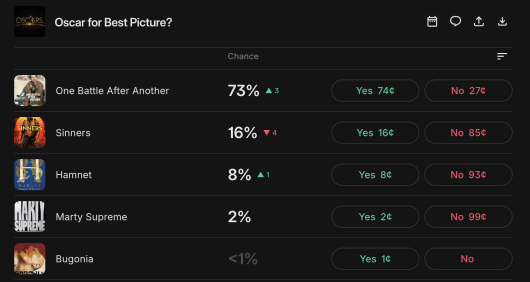
Creating an account at Kalshi was simple. After clicking “Sign up” in the upper-right corner of the page, you’ll be prompted to provide personal information such as your email, name, date of birth, and address. You’ll then be asked for your Social Security number, which is required by law and also for tax reporting purposes.
After I completed those steps and KYC verification, I was able to start depositing and trading.
As for the process of performing a trade, it’s straightforward. You’ll browse the options and decide what you want to trade on.
For example, I clicked on the Los Angeles Dodgers to not win the 2026 World Series in pro baseball. While ‘Yes’ was 33¢ and ‘No’ was 69¢. Trading $100, the payout if they fall short would be $145.
You’ll also earn 3.25% interest on idle cash and open positions. So, assuming you have the money in your account, you just hit “Buy” and wait for the results.
As for the mobile experience, you can download the Kalshi app from the Apple App Store and Google Play Store. The biggest difference between desktop and mobile is that, on mobile, there’s a menu along the bottom of the app for the homepage, live events, a deposit button, the search bar, and Ideas, which is for Kalshi Social, where you can discuss markets, show what you’re doing, and follow others.
Polymarket
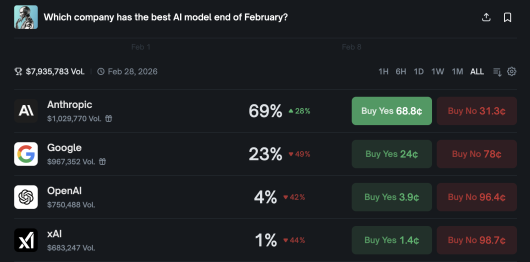
At Polymarket, it was a different experience. Creating an account included providing my email address, entering a code sent to my email, and creating a username. However, Polymarket is subject to state-level restrictions, and it may not be available in some locations.
Even in “view-only” mode, you are still able to navigate around the site and get a feel for how easy it is to trade.
At Polymarket, you’ll locate the market you’re interested in, click on it, and then you can input the amount you want to trade for. For certain markets, such as politics, which can take years to resolve, a 4% APY is applied.
Polymarket also has a mobile app. I downloaded it from the Apple App Store. However, it was invite-only, and I had to submit a phone number to join the wait list.
Deposits, Withdrawals & Wallets
The way to approach deposits, withdrawals, and crypto wallets at Kalshi and Polymarket is slightly different. Below is a table going over those differences to help you make a more informed decision.
| Kalshi | Polymarket | |
|---|---|---|
| Supported Payment Methods | Debit card, wire transfer, Google Pay, Crypto, Venmo, bank transfer | Crypto, debit cards via MoonPay |
| Wallet Setup | Zero Hash built-in setup | External setup, any wallet that allows for USDC |
| Withdrawal Speed | Depends on the method, as bank transfers could take 1-4 days, whereas crypto takes minutes | Almost instant, but may have blockchain/network gas fees |
Prediction Market Customer Support: Kalshi vs. Polymarket
Both Polymarket and Kalshi have various customer support methods to assist their players. Here is a summary of what is offered on each platform.
Kalshi
Kalshi offers several avenues for customer support, including an expansive FAQ section, live chat, and email. Kalshi assures users that its support team is “all US-based and 100% human,” so response times may be longer, but a human will answer your queries.
As for its reputation, in my experience with it, it was fine. I got prompt responses, and the FAQ section answers many questions.
Online, I found a mix of reviews, though some referenced that the customer support had improved a lot recently, so perhaps there was a time when it wasn’t quite up to snuff. But personally, I had no issues.
Polymarket
- Support options
- General reputation for responsiveness
Polymarket’s customer support includes an AI live chat bot, an FAQ, and a Discord server. The AI chatbot was intuitive. Other chatbots I’ve run into seemingly have “pre-set responses” to certain things. This one seemed more interactive and better at handling different prompts.
As for reputation, again, like Kalshi, I didn’t experience any problems. That said, since I’m in view-only mode, I understand that I haven’t needed to contact customer support if there was an errant payment, and I’ve experienced how they deal with it.
On Trustpilot, players have expressed displeasure with customer support regarding payment-related issues.
Kalshi vs. Polymarket: Prediction Market Security & Trust
| Kalshi | Polymarket | |
|---|---|---|
| Account Security | 2FA (text, email, or authenticator app) and KYC verification | Secured by the user's crypto wallet private keys |
| How User Funds Are Handled | Custodial | Non-custodial |
| Known Security Issues | None, regulated by the CFTC | In December 2025, a security breach involving a third-party authentication provider occurred |
Kalshi Pros & Cons
Kalshi has a leg up because the CFTC regulates it, but there are still some things to be aware of.
Pros
- Great for US-based players of all skill levels
- Expansive FAQ section
- Numerous payment methods
- Regulated by the CFTC
Cons
- More fees than some other platforms
- Some markets can be slow to be listed due to regulations
- Sports are only available in specific states
Polymarket Pros & Cons
Polymarket is in a unique position as a blockchain-based platform but similar to Kalshi and other prediction markets, it has its own set of benefits and drawbacks.
Pros
- Great for those who enjoy using crypto
- Wide variety of markets
- The 15-minute crypto market allows for unique trading options
- Almost no fees
Cons
- Access is subject to state-level regulations
- Seemingly fewer “human” customer support channels
- Not beginner-friendly if you don’t use crypto
Kalshi vs. Polymarket: Which Prediction Market Site Is Better?
When comparing Kalshi and Polymarket to determine which is better, there are some important caveats to take into account in addition to personal preference.
Kalshi and Polymarket both offer prediction markets, but Kalshi operates under federal regulation and allows users to trade directly on event outcomes with USD, making it more accessible and legally clear for most U.S. participants. Polymarket, while innovative with its crypto-based markets and broader range of event types, may be less user-friendly for mainstream users and carries more regulatory uncertainty.
So, which is “better” depends on whether you prioritize regulatory oversight and simplicity (Kalshi) or crypto flexibility and wider market variety (Polymarket). Here’s what it boils down to:
- Choose Kalshi if you want: A more beginner-friendly platform that the CFTC regulates, has more human customer support channels, and a social network.
- Choose Polymarket if you want: A platform that may be more reliant on crypto usage, but has more widespread markets. Also, be aware that the platform could change when it launches in the United States.
Bottom line: Kalshi is the better platform for those just starting, which is common in the prediction market space right now. It also allows trading on outcomes in USD, as cryptocurrency isn’t as widely used by the general public.