Prediction Market Strategy: How Prediction Markets Work, Advice For Beginners, & Trading Strategies


Prediction markets have exploded in popularity across the country. These sites give you the chance to earn a profit by betting on future events: elections, football games, inflation prints, and much more. They welcome traders in every state, so analysts expect annual trading volumes to hit $1 trillion by 2030.
You can boost your chances of success by implementing some prediction market strategies. This guide features basic trading advice for beginners, plus advanced strategies for experienced traders. You’ll also learn how to choose the best trading markets site and how to stay safe when buying futures contracts. Let’s get into it.
What Are Prediction Markets?
Prediction markets are apps or websites that let you speculate on future events. You can buy or sell contracts linked to real-world outcomes on these platforms.
Each market features a simple yes/no question. Here are some examples:
- Will the Oklahoma City Thunder win the Western Conference?
- Will there be a government shutdown this year?
- Will Ethereum get over $3,500 this month?
- Will there be above 4 inches of rain in San Francisco this month?
If the answer is “yes,” the contract will pay $1. If the answer is “no,” the contract pays $0. When you visit a prediction markets site, you’ll see a price on each contract. Here’s an example:
- Will the Seattle Seahawks beat the New England Patriots? Yes 58¢, no 43¢.
The prices represent market sentiment. In this example, the market gives Seattle a 58% chance of winning the game.
If you expect Seattle to win, you can buy “Yes” contracts at 58¢. The contracts will pay $1 if the Seahawks win the game, so you’ll earn a 42¢ profit on each contract.
The top prediction sites offer contracts on thousands of events each month. They cover pro sports, college sports, politics, crypto, climate, economics, current events, and much more.
Prediction markets are legal in the United States. They’re treated as financial derivatives, not betting markets, and they’re covered by the Commodity Exchange Act.
The sites offering prediction markets are regulated at a federal level by the Commodity Futures Trading Commission (CFTC). Any sites that gain CFTC approval can sell event contracts nationwide. Some states have pushed back, but the leading prediction market sites currently welcome traders in all 50 states.
In 2025, annual trading volumes hit $44 billion. The analysts at Eilers & Krejcik expect them to reach $1 trillion per year by 2030. Kalshi and Polymarket were the trailblazers, but there are now plenty of rival prediction market sites. They include FanDuel Predicts, DraftKings Predictions, Fanatics Markets, and Robinhood Predictions.
How Prediction Markets Work
Prediction markets allow you to make a profit by betting on the outcomes of real-world events. You have three options when it comes to buying and selling contracts:
- Buy “Yes” contracts if you expect an event to happen.
- Buy “No” contracts if you don’t think an event will happen.
- Sell existing contracts to lock in a profit or cut your losses.
Here’s a simple example that illustrates how prediction markets work. The example from Kalshi focuses on professional baseball and the 2026 World Series winner:
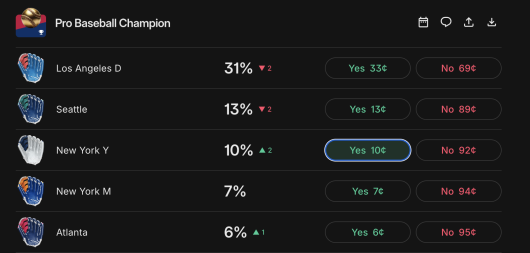
Let’s say you think the Yankees (Yes 10¢, No 92¢) will win the World Series, and you want to risk $50. You’d then follow these steps:
- Click “Yes” next to the New York Yankees. Your pick will then appear in a new window in the middle of the screen.
- You’ll see the price is 10¢. Type “50” into the “Amount” section.
- The app will tell you that you’re buying 500 contracts at 10¢ each. That will cost you $50, and your payout will be $500 if the Yankees win the World Series.
- You can then confirm the trade.
You’ll then have two options. You can hold onto your contracts, or you can sell them at a later date. Let’s say the Yankees enjoy a strong season, and they make the playoffs. By the time the ALDS rolls around, they’re priced at 36¢ to win the World Series.
At this point, you might decide to sell your 500 contracts for 36¢ apiece. That would earn you $180, which is a $130 profit on the $50 you invested. Alternatively, you could scale out (sell some of your contracts and let the rest of them run).
Why People Use Prediction Markets
People use prediction markets for a few key reasons:
- To earn a profit: Traders buy and sell event contracts in a bid to make profits.
- Hedge economic risk: Companies use prediction markets to hedge against risks in their businesses.
- Aid price discovery: Event contracts help markets understand how much an asset is worth.
- Aggregate information: Prediction markets can harness the wisdom of the crowd. They can be more accurate than polls, as people are less likely to lie when they’re risking money.
- Improve strategy: Governments and companies use prediction markets to shape their strategic decisions. It can help them understand geopolitical risks, whether new products will succeed, or how likely scientific breakthroughs are.
Prediction Market Strategies
You can follow a few key prediction market strategies to improve your chances of earning a profit. Here are our six strategies:
Think in probabilities, not opinions
Effective traders translate beliefs into probabilities. Your goal is to work out the likelihood of an event happening. That can help you spot mispriced markets.
For example, let’s say you think an event is very likely to occur. Ask yourself, are you 60%, 75%, or 90% sure it will happen?
A market price of $0.70 (or 70¢) implies a 70% chance of the event happening. If you think the real probability is 85%, that trade offers value.
Thinking in probabilities forces discipline. You aren’t simply making bets based on vague opinions, emotions, and weak analysis. Instead, you’re applying rigor to the process, and you’re comparing probabilities with market prices.
Identify and exploit mispriced markets
The best opportunities arise when market prices don’t reflect reality. There are all sorts of reasons why markets can be mispriced:
- Emotions: Hype around a popular team, a polarizing politician, or a company with a cult following.
- Low liquidity: This can disrupt the balance between supply and demand, allowing small trades to cause large price swings.
- Early markets: If the market has only just opened, the wisdom of the crowd won’t be reflected in the price yet.
- Misunderstood information: Prices can be driven by the flawed interpretation of data. If traders fail to accurately analyze, contextualize, or react to the data, their trades can create a gap between the price and the asset’s true value.
Your edge occurs when you spot these mispriced markets. You can do so if you’re an expert in a certain field, and you understand the data better than fellow traders.
There’s also the opportunity to profit from poor liquidity. Study similar markets, past results, or implied probabilities on other platforms and look for discrepancies.
For example, let’s say the sportsbooks are offering -200 on a team to win, which implies a 66.7% probability. If you can buy a futures contract at 55¢, that suggests a mispriced market.
Specialize in markets you understand
Don’t be a generalist. They tend to struggle in prediction markets. It’s tempting to make predictions on a wide range of events, as the best sites cover a dazzling array of topics. Avoid that temptation, as you’re unlikely to succeed.
Specialists thrive. Focus on subjects that you’re an expert in – sports leagues, local elections, companies, cryptocurrencies, cultural niches, and so on. This will help you cut through the noise and identify genuinely useful information.
It’s better to trade five markets you know deeply rather than 100 markets that you barely understand. Depth beats breadth at prediction markets sites.
Trade price movement, not just final outcomes
Remember that you don’t need to be right to make money. Here’s an example:
- Let’s say you buy contracts on the Cowboys to win the Super Bowl at 10¢.
- The Cowboys go on a seven-game winning streak, and they’re trading at 20¢.
- You then sell your contracts for a 100% profit.
- The Cowboys end up losing in the first round of the playoffs.
Your initial prediction was incorrect, but your timing was strong. Many profitable trades come from simply buying underpriced contracts and selling when sentiment shifts. News cycles, debates, injuries to key players, and economic data will often move contracts beyond fair value.
Smart traders focus on where the price is likely to go next. If you anticipate those moves, you can capitalize on price swings, exit your tradesearly, and lock in profits.
Manage bankroll and position size
Make sure no single trade can wipe out your account balance. Remember that even great ideas can fail sometimes. Practice sensible bankroll management, as that will help you ride out volatility and allow you to capitalize on your edge in the long-term.
Avoid risking too much on any single outcome. This is especially important in low-liquidity markets, where exiting a position can be tricky.
Use consistent trade sizes and focus on capital preservation. Consider expected value over many trades, without pinning your hopes on one or two ideas.
Avoid emotional and biased trading
Prediction markets ruthlessly expose bias. This applies to recency bias, confirmation bias, overconfidence, and tribal thinking.
Strip emotion from the process. Don’t blindly back your favorite sports teams or political parties, and don’t be afraid to change your mind.
It’s dangerous to fall in love with a position and defend it, rather than reassessing it. If new information appears, update your probabilities.
You can also boost your chances of success by tracking your trades and reviewing your mistakes. Try to spot patterns:
- Do you overtrade headlines?
- Do you chase losses?
- Are you guilty of holding onto losing trades for too long?
- Do you bet with your heart rather than your head?
This can help you improve your trading decisions. It may also help you find your niche. If you have more success trading economics than basketball, double down on it.
Emotional discipline gives you a major edge. The best traders are calm, rational, and above all, flexible. They aren’t governed by ego, they overcome biases, and they’re willing to change their minds when new information arises.
Basic Trading Advice for Beginners
When you’re getting started, the primary goal isn’t to make a quick buck. Instead, you can focus on improving your knowledge, honing your strategy, and developing discipline.
Here are some prediction markets strategies for newcomers:
- Start small and treat your early trades as a learning curve.
- Master bankroll management and avoid going all-in on a single trade.
- Focus on liquid markets, so you can exit positions if you make mistakes.
- Read the rules carefully and avoid ambiguous contracts.
- Learn how prices move, how news impacts markets, and how liquidity works.
- Keep a simple record of each trade you make and review it regularly.
- This will reveal mistakes, help you spot your biases, and allow you to correct them.
- Accept losses calmly and remember that you’re playing a long game.
- Practice consistency, discipline, and patience.
Advanced Prediction Market Trading Advice
Advanced traders focus on market structure. While beginners often chase indicators, advanced traders prioritize understanding the underlying price dynamics. They’re focused on market phases, liquidity pools, and order flow.
Here are some prediction market strategies to consider as you grow more experienced:
- Arbitrage: You’ll sometimes spot opportunities to cover both sides of the same bet and lock in a guaranteed profit. For example, you can occasionally capitalize on conflicting prices at rival prediction market sites. Alternatively, you might be able to pounce on related markets that imply conflicting probabilities.
- Hedging: This is the art of holding positions across correlated markets to reduce downside, while preserving upside. You can often lock in a profit by hedging. This is especially useful in long-duration markets, where new information emerges gradually.
- Liquidity and timing: Advanced traders are always aware of liquidity. Thin markets may offer value, but they also make it difficult to exit a trade. Focus on order books to figure out depth, sentiment, and execution risk. Adapt your position sizes, timings, and order types based on liquidity conditions and market lifecycle.
Strategies for Choosing Prediction Market Sites
You can focus on a range of key features when choosing a prediction market site. The best sites excel in each of these areas:
Market variety and relevance: Find a site that offers a wide range of prediction markets on your favorite subjects. Make sure it matches your interests and expertise.
- Liquidity and active user base: Choose a site with a large active user base and strong liquidity. That will create tight spreads, and it will make it easier for you to enter and exit trades. Prioritize sites with visible order books and consistent volumes.
- Fees and pricing transparency: The main goal is to earn a profit, so find a site with low fees and transparent pricing. Hidden fees can erode your profits, so make sure you’re aware of the costs before making trades.
- Regulation, legality, and trust: Make sure the site is licensed and regulated by the CFTC. Stick to sites with strong average user ratings on platforms like Trustpilot. They should also offer a clear dispute resolution process, fast withdrawals, and clear T&Cs.
- Usability and interface quality: It should be quick and easy to find markets, buy contracts, and exit trades. The best sites and apps are fast, reliable, and accessible, with a clean, intuitive user interface and 24/7 support. You should also be able to understand prices, probabilities, order types, and settlement rules easily, without digging through menus.
Using Prediction Markets Safely
Sensible bankroll management is vital when using prediction markets. Never trade with money you can’t afford to lose. Set a strict budget and stick to it. Only risk a small percentage of your bankroll on each trade. Don’t chase losses, and don’t trade when you’re angry, stressed, or drunk.
Try to enjoy these sites in moderation. Set daily, weekly, and monthly time limits on your account. Don’t let events trading encroach on other areas of your life – work, family, friends, or your hobbies.
It’s also important to stay safe. Protect your account with a strong, unique password, and never share it with anyone. Enable two-factor authentication, and choose safe payment methods like Visa, Mastercard, PayPal, or online banking.
Common Mistakes to Avoid with Predictions Markets
Traders often make the same mistakes at prediction markets sites. These are some of the most common errors to avoid:
- Treating opinions or strong feelings as an edge.
- Not paying close attention to market rules or settlement criteria.
- Risking too much on a single trade due to overconfidence.
- Chasing losses in the heat of the moment.
- Trading illiquid markets without exit plans.
- Focusing on potential payouts instead of probabilities.
- Letting politics, fandom, or identity drive decisions.
- Assuming the market is wrong without evidence.
- Holding losing positions too long out of pride.
- Neglecting fees, slippage, and execution costs.
Glossary & Prediction Market Terms to Know
Prediction market sites often feature jargon. It can sound confusing at first, but it’s actually pretty simple when you learn what a few key terms mean. Here’s a simple glossary to help you navigate these platforms:
- Ask – The lowest price a trader is willing to sell a contract.
- Bid – The highest price a trader is willing to pay for a contract.
- Contract – A financial derivative that pays out if a specific event occurs (or doesn’t).
- Edge – A consistent advantage over the market, usually from better information, analysis, or execution.
- Implied probability – How likely an event is to happen, according to the market price. For example, a price of $0.65 implies a 65% chance of the event occurring.
- Liquidity – How easily contracts can be bought or sold without significantly moving the price. Higher liquidity means tighter spreads and easier exits.
- Limit order – An order to buy or sell at a specific price or better. This gives you control over the execution price.
- Market order – An order that executes immediately at the best available price, prioritizing speed over price.
- Market price – The current trading price of a contract, which is usually between $0 and $1.
- Order book – A list of all open buy and sell orders at different prices, showing market depth and trader interest.
- Position – The number of contracts you hold, and whether they’re “Yes” or “No” contracts.
- Resolution – How a market is settled after the event takes place. It determines whether contracts pay out at $0 or $1.
- Settlement – The final payout of a contract after resolution, usually $0 or $1 in binary markets.
- Slippage – The difference between the expected price of a trade and the actual execution price, often caused by low liquidity.
- Spread – The difference between the highest buy price (bid) and lowest sell price (ask). Narrow spreads indicate healthy markets.
- Volume – The total number of contracts traded in a market over a given period, often used as a liquidity indicator.
- Yes/No market – A binary market where traders buy “Yes” (event happens) or “No” (event doesn’t happen) contracts.
Final Thoughts on Prediction Market Success
Prediction markets reward discipline, rational thinking, and adaptability. You can seriously boost your chances of success by managing risk, choosing the right markets, and turning beliefs into probabilities.
Choosing the right site is also crucial. Stick to sites that offer strong liquidity, low fees, and a wide range of markets. Only trade at licensed, regulated sites, and practice sensible bankroll management.
Stick to the subjects you’re an expert in, and don’t let emotions cloud your judgement. Trade price movements, not final outcomes, and be prepared to change your mind when new information emerges. Keep a record of your trades, and learn from any mistakes you make along the way. This will give you a valuable edge as a trader.