
 Share


The ATP enters the week with two events on tap, both indoor hard court events with the Erste Bank Open in Vienna and the Swiss Indoors in Basel.
Be sure to check out our tennis match trends page for daily odds, trends and insights on each match.
Up to $1,500 in Bonus Bets if Your First Bet Doesn't Win*
*Bonus Bets Expire in 7 Days. One New Customer Offer Only. Add’l terms. 21+. Gambling Problem? Call 1-800-GAMBLER or 1-800-MY-RESET
Up to $1,500 in Bonus Bets if Your First Bet Doesn't Win*
*Bonus Bets Expire in 7 Days. One New Customer Offer Only. Add’l terms. 21+. Gambling Problem? Call 1-800-GAMBLER or 1-800-MY-RESET
ATP Erste Bank Open
Favorite to Win: Carlos Alcaraz +175, Daniil Medvedev +700
Sleeper Pick: Alex De Minaur +1100
ATP Erste Bank Open Information
- Dates: October 26 – November 1, 2026
- Location: Vienna, Austria
- Surface: Hard (Indoor)
- Tier: 500
- Defending Champion: Jannik Sinner
ATP Erste Bank Open Odds to Win
| Seed | Country | Player | Odds to Win |
|---|---|---|---|
| 2 | 🇪🇸 | Carlos Alcaraz | +175 |
| 1 | 🇩🇪 | Alexander Zverev | +330 |
| 3 | Daniil Medvedev | +700 | |
| 7 | 🇺🇸 | Tommy Paul | +1100 |
| 5 | 🇦🇺 | Alex De Minaur | +1100 |
| 🇺🇸 | Learner Tien | +1800 | |
| 🇦🇷 | Francisco Cerundolo | +2000 | |
| Andrey Rublev | +2000 | ||
| 🇮🇹 | Lorenzo Musetti | +2200 | |
| 8 | 🇨🇿 | Jakub Menšík | +2200 |
| 6 | 🇺🇸 | Frances Tiafoe | +2200 |
| Karen Khachanov | +2800 | ||
| 🇺🇸 | Brandon Nakashima | +2800 | |
| 🇮🇹 | Matteo Berrettini | +3500 | |
| 4 | 🇮🇹 | Flavio Cobolli | +3500 |
| 🇳🇱 | Tallon Griekspoor | +4000 | |
| 🇫🇷 | Luca Van Assche | +5000 | |
| 🇬🇧 | Cameron Norrie | +6500 | |
| 🇧🇬 | Grigor Dimitrov | +8000 | |
| 🇪🇸 | Daniel Merida Aguilar | +8000 | |
| 🇬🇧 | Arthur Fery | +8000 | |
| 🇬🇪 | Nikoloz Basilashvili | +10000 | |
| 🇮🇹 | Matteo Arnaldi | +10000 | |
| 🇪🇸 | Martin Landaluce | +13000 | |
| 🇮🇹 | Luciano Darderi | +13000 | |
| 🇵🇪 | Ignacio Buse | +13000 | |
| 🇦🇷 | Tomas Martin Etcheverry | +15000 | |
| 🇦🇹 | Jurij Rodionov | +20000 |
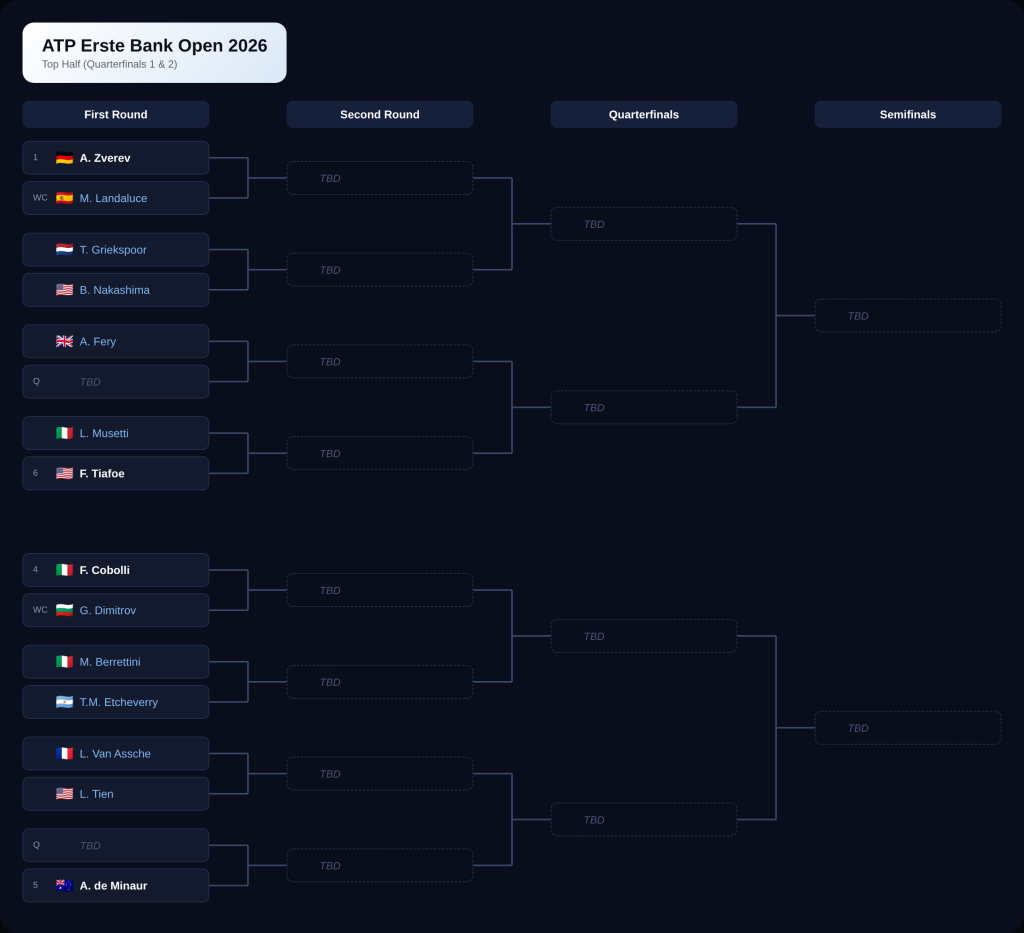
ATP Erste Bank Open Draw
Top Half (Quarters 1 & 2)
No. 1 seed Alexander Zverev opens against Spanish wildcard Martín Landaluce, with a potential quarterfinal meeting against the winner of No. 6 Frances Tiafoe and Lorenzo Musetti’s side of the draw. The bottom section pits No. 4 Flavio Cobolli against wildcard Grigor Dimitrov, while No. 5 Alex de Minaur’s side is loaded with Matteo Berrettini, Tomás Martín Etcheverry, and Luca Van Assche/Learner Tien.
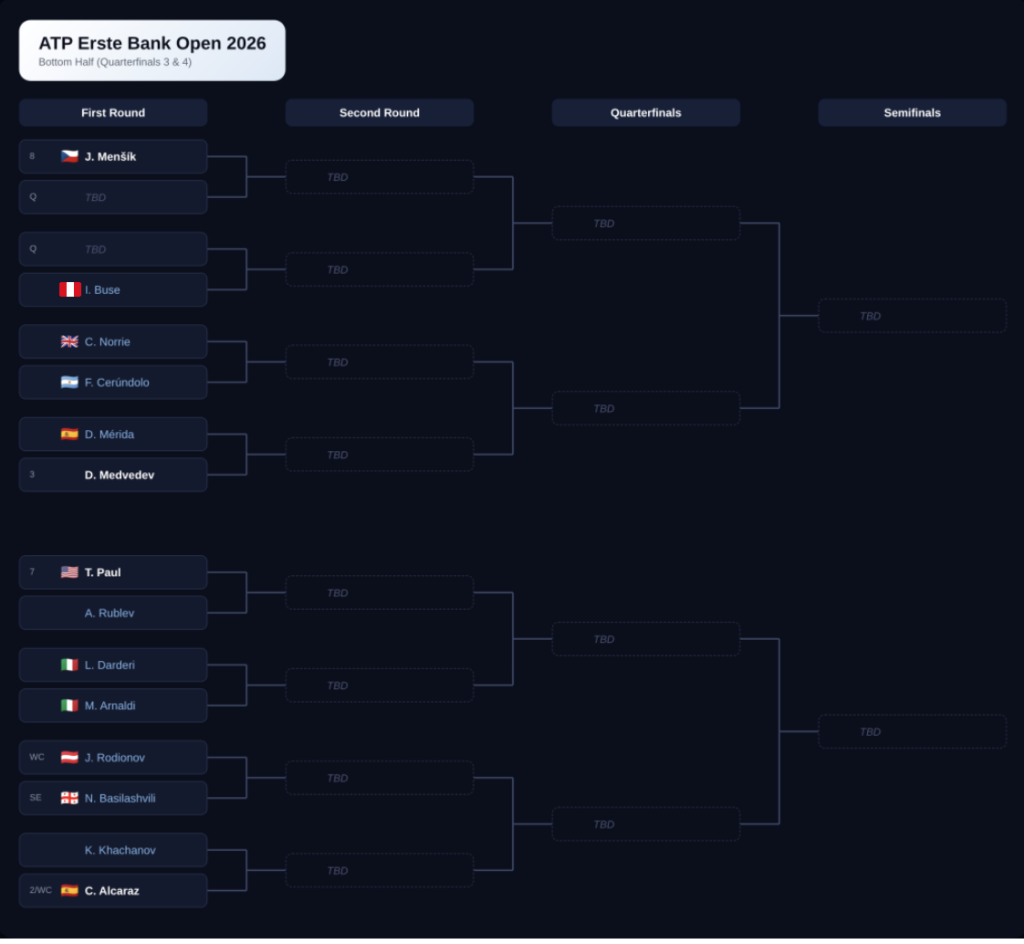
Bottom Half (Quarters 3 & 4)
No. 8 Jakub Menšík and No. 3 Daniil Medvedev headline the third quarter, which still has two qualifying spots unresolved alongside Cameron Norrie and Francisco Cerúndolo. The fourth quarter is the group to watch, with No. 7 Tommy Paul, Andrey Rublev, wildcard Jurij Rodionov, and top seed Carlos Alcaraz (2/WC) all packed into the same section.
ATP Erste Bank Open Bracket Analysis
Quarter 1 – Deciding Factors
Zverev’s Historic Season vs. the Ankle and Fatigue He’s Carrying Into His Home Turf
On the full-season résumé, nobody in this quarter is close to Zverev: he’s won both the French Open and US Open this year, reached the Wimbledon final, and is guaranteed to rise to world No. 1 in November — arguably the best season of his career. But the data right before Vienna raises real questions. Ten days ago at the Shanghai Masters, he was upset in the semifinal by Alejandro Davidovich Fokina 5-7, 6-4, 6-3, saving two match points along the way before the third set got away from him, and he said afterward, in his own words, that he “carried a little bit of injury” and “carried fatigue into the tournament,” specifically citing his ankle and saying he planned to monitor his fitness before Vienna. That’s about as direct a data point as exists — the player himself flagging the exact concern for the exact event in question. Griekspoor’s case is real but should be kept in proportion: he reached the Stockholm Open semifinal last week, highlighted by a win over world No. 8 Casper Ruud (7-5, 7-6(5)) in the quarterfinal, genuine evidence of a player peaking at the right time, even if the semifinal result itself (a clash with Grigor Dimitrov) isn’t fully confirmed in what’s available.
Nakashima’s post-Wimbledon stretch is arguably the most statistically substantial of the three: a Washington semifinal (upsetting defending champion de Minaur), his first career Masters 1000 final at the Canadian Open (wins over Rinderknech, Darderi, and Jódar along the way, falling to Shelton in the final), and a Cincinnati run to the semis that included back-to-back wins over Medvedev and Fritz — a genuinely elite six-to-eight-week stretch that pushed him to a career-high ranking near No. 17. The letdown is that his most recent result (an early loss to Berrettini in Shanghai) suggests that heater has cooled somewhat heading into Vienna. Taken together, the data says Zverev should still advance on talent and results alone, but his own injury/fatigue admission is the single most current, most specific red flag in the entire quarter — and if anyone is positioned to exploit it, the numbers favor Nakashima’s recent sustained level over Griekspoor’s one big result last week.
Tiafoe’s Statistical Edge Over Musetti vs. Fery’s Post-Wimbledon Cooling Off
The Musetti-Tiafoe pick is well supported by the data, and specifically in Tiafoe’s favor. He leads their head-to-head 4-3 and won the most recent meeting in straight sets at the Cincinnati quarterfinal this past August. His season numbers are also a notch above Musetti’s across the board: a 44-19 record (70%) to Musetti’s 25-12 (68%), a significantly higher ranking (No. 9 to No. 26) and Elo rating, and a clear statistical edge on serve — 6.6 aces per match to Musetti’s 4.0, and 75% of first-serve points won to Musetti’s 71% — with Musetti only marginally ahead on return points won (39% to 36%). The two are scheduled to meet in the first round in Vienna, and both the Elo model (63.7%) and the market (-175) back Tiafoe clearly.
As for Fery, his Wimbledon run was genuinely special for a wildcard — wins over Dimitrov and then 10th-seeded Flavio Cobolli (6-4, 7-6(4), 6-0) before losing to Zverev himself in the semifinal, a run that carried him to a career-high No. 33. Since then, though, it’s been a clear step down: a third-round-level loss to fifth-seeded de Minaur in Cincinnati, a Winston-Salem final loss to Ignacio Buse, a first-round exit at the US Open, and a second-round finish in Shanghai. None of that is disastrous, but none of it matches the Wimbledon peak either. The data lines up squarely behind your read: Tiafoe is the statistically favored side of that opening match, and whoever comes out of it — Tiafoe especially — looks like the better bet against a Fery who’s settled back into a solid-but-unspectacular form level after his summer breakout.
Quarter 2 – Deciding Factors
Cobolli’s Real but Overstated Hard-Court Gap vs. Dimitrov’s Faded Peak
Cobolli holds up only partially in the data. His 2026 splits show clay clearly as his best surface (14-7, 67%) against a hard-court mark of 15-13 (54%) — a real gap, but not a glaring weakness, since he’s still above .500 on hard and has produced genuine quality there: an Acapulco ATP 500 title, semifinal runs at both Delray Beach and Cincinnati, and his first career hard-court Masters quarterfinal after fighting past Rafael Jódar. The soft spots are mostly concentrated at the very top level — first-round exits at the Australian Open and a third-round finish at the US Open — rather than a wholesale inability to win on the surface.
Dimitrov, meanwhile, is a much clearer case of diminished form, whatever the seeding implies about him being a tough opener. His ranking fell outside the top 100 for the first time in 14 years, forcing him into Wimbledon on a wildcard, a season shaped by a torn pectoral in 2025 and multiple retirements at majors since. His Wimbledon run this year — wins over Dane Sweeny and 15th-seeded Jakub Menšík, then a five-set escape against Berrettini to reach the fourth round — was a genuine, emotional resurgence, but it came on a single surface at a reduced ranking, not evidence of a return to his world-No.-3 peak. The data backs treating that Wimbledon week as the exception rather than the form line, which makes Dimitrov considerably less of a threat on paper than his name recognition suggests.
De Minaur’s Statement Fall Swing vs. Tien’s Break-Point Wobble
De Minaur’s season numbers lead this comparison outright: 37-13 (74%) in 2026, with a career hard-court win rate of 73% (82-31) underlining how comfortable he is on this exact surface. His fall swing adds real substance to that baseline. At the China Open in Beijing, he beat Hubert Hurkacz in the semifinal — leading 6-4, 3-2, 40-0 when Hurkacz retired injured — to reach the final against an undefeated Djokovic, where he himself was forced to retire with an adductor injury. He didn’t linger on it: roughly eight days later at the Shanghai Masters, saying he felt “better and better every single day,” he beat Karen Khachanov to reach the quarterfinal before running into Zverev. That head-to-head is lopsided on paper — Zverev had won all eight of their prior tour-level and Davis Cup meetings — but de Minaur has won their last two meetings in team competition, at the ATP Cup/United Cup and, most recently, the Laver Cup less than three weeks before this stretch. Two deep runs against elite fields, on his best surface, inside the same month, with the only loss coming against the player about to finish the year at world No. 1.
Tien’s season is also genuinely strong by the numbers: 31-17 (65%) overall, 19-10 (66%) specifically on hard, a No. 16 ranking, and sharp underlying serve figures — 71.6% of first-serve points won, an 80.3% hold rate, and an ace rate (0.069 per service point) up from 0.047 last year. His best results include a Geneva Open title (beating Alexander Bublik in the semifinal), a win over Ben Shelton at Indian Wells, and an Australian Open quarterfinal, his best Grand Slam result. But his most recent marquee result carries a specific warning sign: at the US Open, he beat Borges, Monfils, and Menšík before losing to Karen Khachanov in the fourth round after leading two sets to one, converting only 3 of 12 break points in that match. That’s a tell on his return game buckling under pressure in exactly the moments that decide close matches — a real contrast with de Minaur, whose two most recent results came against a top-10 field with no equivalent collapse, aside from the physical issue that ended the China Open final rather than a tactical one.
Quarter 3 – Deciding Factors
Medvedev’s Post-Disqualification Surge vs. Mensik’s Shaky Finish
Medvedev’s season numbers are the best of anyone in this section: 44-12 (79%) in 2026 with two titles, and a career hard-court win rate of 76% (106-33) that underlines how at home he is on this surface. The “red hot lately” read holds up even accounting for the ugly moment at the China Open, where he was disqualified for hitting a spectator with a ball during his match against Djokovic. Rather than letting that linger, he responded at the Shanghai Masters the following week by beating Tsitsipas to reach the quarterfinal and then reaching the semifinal before losing to Rafael Jódar, who went on to the final against Davidovich Fokina — a genuinely strong finish at a Masters 1000 just over a week before Vienna.
Mensik’s underlying numbers are also excellent — 33-15 (69%), a hard-court record of 24-9 (73%), and elite serve metrics (78.7% of first-serve points won, ranked 8th of 159 on tour, with an 84.8% hold rate) — but his most recent result cuts against the “biggest threat” framing: at that same Shanghai Masters, after beating Miomir Kecmanović and Francisco Cerundolo, he lost in the round of 16 to Arthur Gea, a player ranked outside the top 50. That loss sits alongside an earlier round-of-32 exit at the US Open to Learner Tien and a round-of-16 loss at Cincinnati to Tirante — a pattern of dropping matches to lower-ranked opposition that Medvedev hasn’t shown recently. The numbers support Medvedev as the stronger pick of the two right now, with Mensik’s raw serve quality still making him the more credible threat on paper than anyone else in the section.
Cerundolo’s Dark-Horse Numbers vs. Norrie’s Rough Patch in the Opener
Cerundolo’s season totals make a real case for dark-horse status: 34-19 (64%) with two titles (Queen’s Club and the Argentina Open), a hard-court record of 14-10 (58%), and strong underlying serve numbers (70.4% of first-serve points won, a 78.8% hold rate, 60.1% of break points saved). His most recent stretch has cooled slightly — a loss to Mensik in the Shanghai third round (Mensik saved 6 of 7 break points in that match) and a loss to Griekspoor in the European Open semifinal after Griekspoor came back from a set down — but both losses came against quality, in-form opponents, and he beat Damm and Chidekh (holding every service game in the latter) earlier in that same tournament.
His first-round opponent in Vienna, Norrie, is in a clearly rougher patch: a 20-21 (49%) season record, a ranking that’s slipped to No. 40, and a current losing streak that includes a round-of-128 loss to Luca Van Assche. The head-to-head sits at 2-1 in Cerundolo’s favor across three career meetings, though all three came on clay and none in 2026, so it carries limited weight on a Vienna hard court. Between the two players’ current numbers, the data favors Cerundolo advancing out of that opener and gives real statistical support to the dark-horse framing, even with his own recent form showing a couple of losses to clearly live opponents.
Quarter 4 – Deciding Factors
Paul’s Superior 2026 Season vs. Rublev’s Lopsided Head-to-Head History
The head-to-head between Paul and Rublev looks decisive on the surface — Rublev leads 5-1 across their six meetings — but that record is heavily backloaded with older results, including a run of wins dating back to 2018-2022, and their most recent meeting (a Shanghai Masters match back in October 2023) is now two years stale. The far more current signal is this season’s numbers: Paul is 43-20 (68%) in 2026, clearly ahead of Rublev’s 33-21 (61%), and Paul’s lone head-to-head win came specifically on a hard court at Indian Wells, the same surface this quarter is being played on. History favors Rublev, but the data from the season actually in progress favors Paul. As for who the winner would face next, the numbers point toward Paul or Rublev being favored over whoever comes through Darderi-Arnaldi.
Darderi’s broader 2026 season has been excellent — he reached his first-ever Masters 1000 hard-court quarterfinal at Montreal in August (beating Nuno Borges in three sets, having also beaten him in the Bastad final a month earlier), has racked up 30 wins on the year, already matching his 2025 career-best season total with months to spare, and leads the entire tour with 10 quarterfinals in 2026. That’s real, recent evidence of hard-court growth for a player built mostly on clay. But his most current result tells a different story: he was beaten in the second round in Shanghai by Stefanos Tsitsipas just two weeks ago. Arnaldi’s case is considerably weaker across the board — an 11-17 record (39%) this season, a hard-court sample so thin that a late-September win was publicly noted as just his second hard-court win of the entire year, and a current two-match losing streak (to Alcaraz in Tokyo, then to Musetti in Lyon). Between the two, Darderi’s season-long numbers and his specific hard-court breakthroughs clearly outweigh Arnaldi’s, even accounting for his recent dip — but neither profile looks strong enough to suggest an upset over whichever of Paul or Rublev reaches that round, with Paul’s overall numbers giving him the slight additional edge if it comes to that.
Alcaraz’s Dominant Form vs. Basilashvili’s Modest Week in Almaty
Alcaraz is the easy data-backed pick in this quarter, and recent results only reinforce it: he just defended his Japan Open title in Tokyo, beating Jiří Lehecka in the final, and along the way dismissed Matteo Arnaldi in the round of 16 in straightforward fashion, 7-6, 6-1, winning 76 total points to Arnaldi’s 63 and more than half of his own first-serve points at a 44-of-54 clip. That’s a player operating at a clear level above the rest of this section. Basilashvili’s recent form in Almaty is real but modest in scale: the Georgian, whose 2026 season had otherwise been thin (a 3-5 record through the summer and a ranking in the 130s), strung together a genuine week — beating Marin Cilic 6-2, 7-5 in the first round and then Facundo Diaz Acosta to reach the second week of that draw. It’s a legitimate uptick in form after a quiet year, but nothing in that run — beating a well-past-peak Cilic and a modestly ranked Diaz Acosta — compares to the level Alcaraz has shown closing out Tokyo. The data doesn’t suggest the Almaty week meaningfully narrows the gap here; Alcaraz remains the clear favorite by a wide margin regardless of how Basilashvili arrives.
ATP Swiss Indoors Basel
Favorite to Win: Ben Shelton +550, Novak Djokovic +650
Sleeper Pick: Hubert Hurkacz +1400
ATP Swiss Indoors Basel Information
- Dates: October 26 – November 1, 2026
- Location: Basel, Switzerland
- Surface: Hard (Indoor)
- Tier: 500
- Defending Champion: Joao Fonseca
ATP Swiss Indoors Basel Odds to Win
| Seed | Country | Player | Odds to Win |
|---|---|---|---|
| 1 | 🇺🇸 | Ben Shelton | +550 |
| 4 | 🇷🇸 | Novak Djokovic | +650 |
| 2 | 🇫🇷 | Arthur Fils | +700 |
| 3 | 🇪🇸 | Rafael Jódar | +700 |
| 6 | 🇺🇸 | Taylor Fritz | +800 |
| 8 | 🇨🇿 | Jiří Lehečka | +1100 |
| 10 | 🇵🇱 | Hubert Hurkacz | +1600 |
| 🇺🇸 | Alex Michelsen | +2000 | |
| 🇫🇷 | Ugo Humbert | +2000 | |
| 9 | 🇳🇴 | Casper Ruud | +2200 |
| 🇬🇷 | Stefanos Tsitsipas | +2500 | |
| 🇩🇰 | Holger Rune | +2800 | |
| 🇲🇨 | Valentin Vacherot | +3000 | |
| 🇨🇦 | Denis Shapovalov | +3500 | |
| 🇳🇱 | Botic Van De Zandschulp | +4000 | |
| 🇫🇷 | Arthur Rinderknech | +4000 | |
| 🇫🇷 | Quentin Halys | +4000 | |
| 🇧🇪 | Zizou Bergs | +5000 | |
| 🇨🇭 | Dominic Stricker | +5000 | |
| 🇵🇹 | Nuno Borges | +6500 | |
| 🇩🇪 | Jan-Lennard Struff | +6500 | |
| 🇨🇱 | Alejandro Tabilo | +8000 | |
| 🇨🇭 | Jérôme Kym | +8000 | |
| 🇨🇭 | Stan Wawrinka | +10000 | |
| 🇦🇷 | Mariano Navone | +10000 |
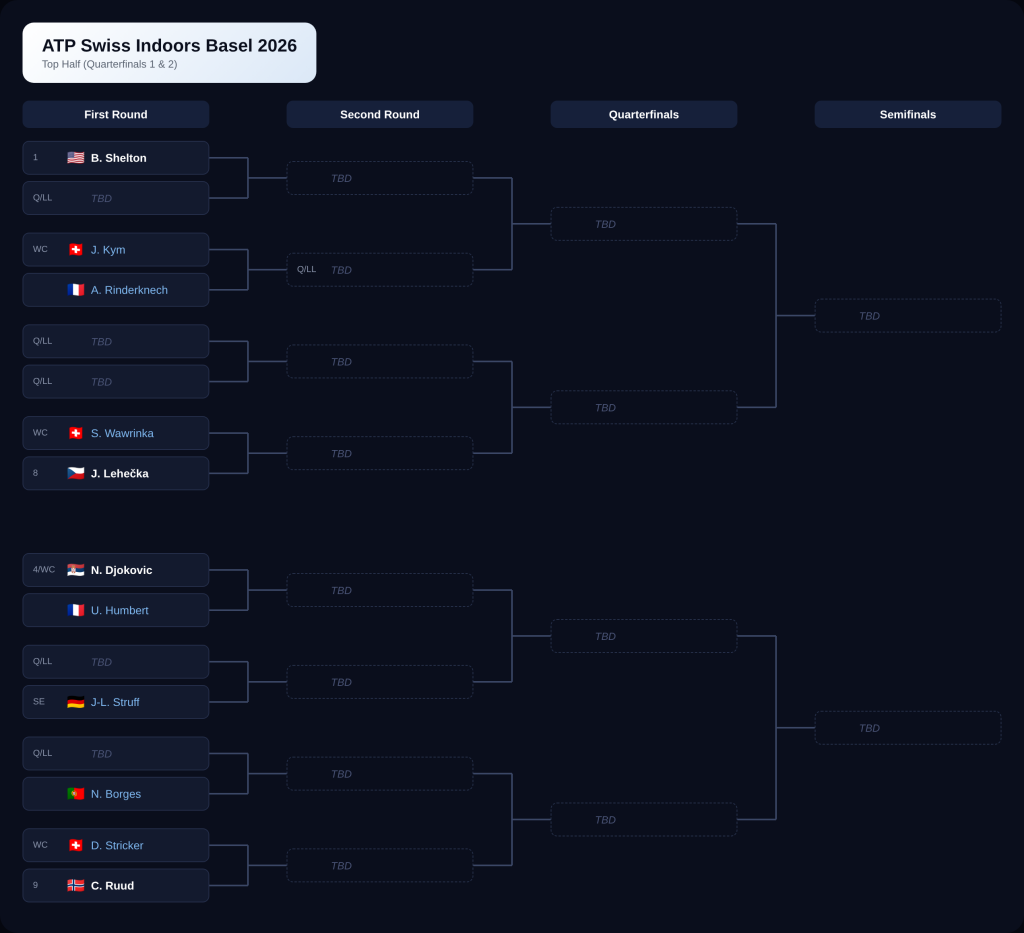
ATP Swiss Indoors Basel Draw
Top Half (Quarters 1 & 2)
No. 1 seed Ben Shelton opens the draw against a qualifier/lucky loser, with wildcard Jérôme Kym, Arthur Rinderknech, and No. 8 Jiří Lehečka/Stan Wawrinka’s section all in his quarter. The bottom section is headlined by No. 4 seed Novak Djokovic (also wildcarded in) against Ugo Humbert’s side, with No. 9 Casper Ruud, wildcard Dominic Stricker, and Nuno Borges rounding out a quarter that still has two unresolved qualifying spots.
Bottom Half (Quarters 3 & 4)
10th seed Hubert Hurkacz and third seed Rafael Jódar lead the top quarter of the bottom half, with Monaco’s Valentin Vacherot — fresh off his stunning Shanghai breakthrough — headlining a group of floaters that includes Zizou Bergs, Holger Rune, and Mariano Navone. The lower quarter is loaded up top: sixth seed Taylor Fritz and second seed Arthur Fils anchor it, but both of their likely second-round opponents are now open qualifying/lucky-loser slots after Davidovich Fokina and Bublik withdrew, leaving Stefanos Tsitsipas and Denis Shapovalov as the most dangerous confirmed names left in that section.
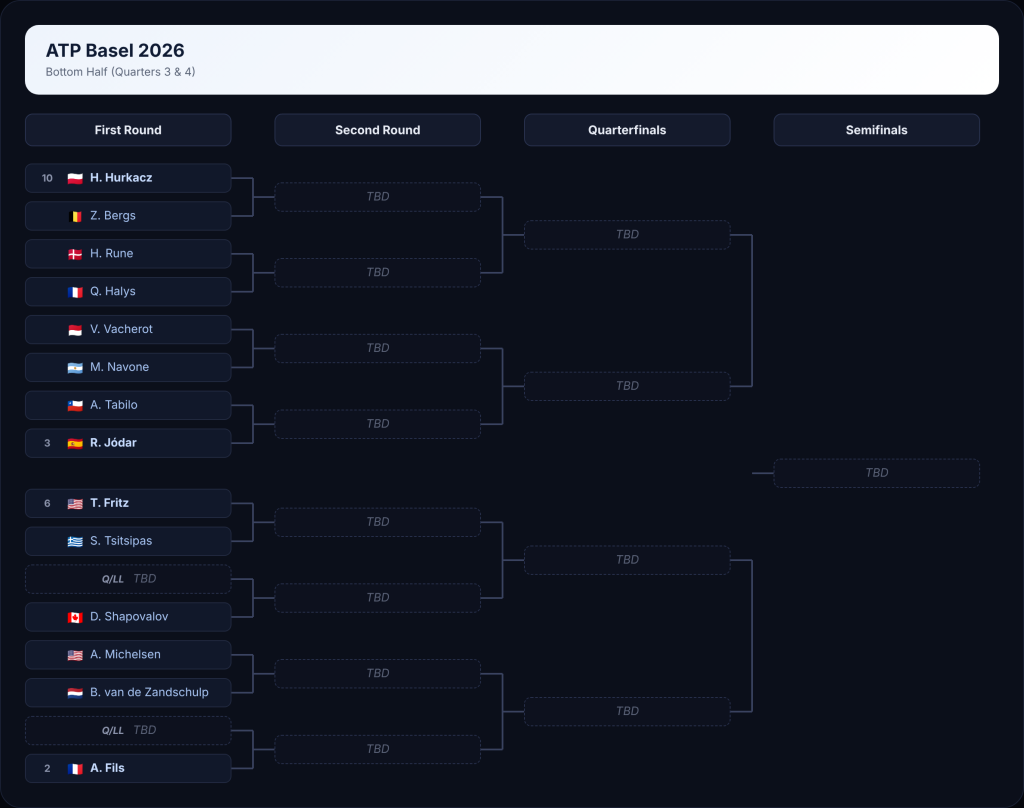
ATP Swiss Indoors Basel Bracket Analysis
Quarter 1 – Deciding Factors
Shelton’s Service Numbers vs. the Depth Problem Around Him
The top seed’s path to a quarterfinal is backed by numbers that separate him from everyone else in this section. Shelton sits at 41-16 (72%) for the 2026 season with four titles, including hard-court wins at the Dallas Open and the Canadian Open, and a hard-court record of 26-8 (77%) overall. His serve is the single biggest reason an indoor hard court like Basel sets up well for him: a 90.3% hold rate, 76.8% of first-serve points won, and 0.113 aces per service point, numbers that make him extremely difficult to break even on an off night. That form carried him to the US Open final in September, where he beat Carlos Alcaraz in the quarterfinal after dropping the first set and came back from a set down against Frances Tiafoe in the semifinal before losing to Alexander Zverev.
His only blemish since is a round-of-32 loss to Arthur Gea at the Shanghai Masters in two tiebreak sets, a result against a player who has been quietly knocking off ranked opponents all fall rather than a sign of a broader slide. The bigger factor working in Shelton’s favor is the state of the section around him: his likely round-two opponent is the winner of Jerome Kym, a wildcard ranked outside the top 200 with a 6-6 record in limited 2026 action, against Arthur Rinderknech, who enters Basel on a 16-20 season and is still working back from a torn abdominal muscle. Neither profile represents the kind of resistance that threatens a player with Shelton’s serve numbers over best-of-three on a fast indoor court.
Lehecka’s Breakout Year vs. Wawrinka’s Sentimental but Limited Push
Lehecka’s case for reaching the same quarterfinal rests on one of the better seasons of his career: a 35-20 record (64%), a 21-13 mark on hard courts, and a run that has included a Miami Open final where he reached the title match without being broken until he met Jannik Sinner, plus a second final at the Japan Open earlier this month against Carlos Alcaraz. His serve metrics back up the results, with 75.8% of first-serve points won and an 87.3% hold rate for the season. Just as relevant is how fresh that form is: he reached the European Open quarterfinal in Antwerp this week by beating Raphael Collignon 6-4, 6-3, and although he lost a tight three-set decider to Tallon Griekspoor in the semifinal two days ago, that’s a result against a player who has been in excellent form himself, not evidence of fatigue or decline heading into Basel.
His seeding (8th) puts him on paper as the clear favorite to escape the bottom of this section, and his first-round opponent, Stan Wawrinka, is playing on a wildcard with the crowd behind him but without the physical standard or current results to match it; the 40-year-old’s results in 2026 have been sparse and largely limited to wildcard entries at home events. Beyond Wawrinka, the only obstacle on that side is a qualifier or lucky loser, giving Lehecka a considerably clearer road than the bracket’s seeding alone would suggest. The two men’s one 2026 meeting, a Stuttgart semifinal in June that Shelton won 6-7(4), 7-6(14), 7-6(6), needed three tiebreaks to separate them, underlining just how evenly matched they are when they do meet.
Rinderknech’s Injury Return vs. the Lack of a Real Alternative
The numbers make the Rinderknech dark-horse case difficult to build. His 2026 season sits at 16-20 (44%), his hard-court record is 6-9 (40%), and he is playing his way back from an abdominal tear suffered during a doubles match at the China Open that forced him out of the Shanghai Masters entirely, a tournament he had reached the final of just a year earlier. His ranking has fallen to the low 60s as a result, and his break-point conversion (32.6%) and return games won (14.3%) are both modest even by the standards of a player who wins points mainly on serve. His first-round opponent, Kym, is a wildcard without a ranking inside the top 200, yet oddsmakers list that match as close to a coin flip, which says more about Rinderknech’s current physical state than it does about Kym’s level.
Even a win there sets up a second-round match against Shelton or a qualifier, and nothing in Rinderknech’s serve or return profile this season suggests he is positioned to trouble a player with Shelton’s hold rate over two sets. Nothing else in the section offers a stronger case, either: the only players standing between the Shelton and Lehecka paths are qualifiers, lucky losers, and Wawrinka, none of whom bring 2026 results or underlying stats that rival what the top two seeds have produced this year. The data points toward the section playing out as seeded, with Shelton’s serve-driven consistency and Lehecka’s career-best season putting the two of them on course to meet in the quarterfinal as the bracket intends.
Quarter 2 – Deciding Factors
Djokovic’s Beijing Peak vs. Humbert’s Leaky Return Game
Djokovic’s 2026 season looked shaky well before the Asian hard-court swing began: a 14-7 record with no titles through August, a runner-up finish at the Australian Open (he beat Sinner in the semifinal before losing to Alcaraz in four), and a string of early exits that included a fourth-round loss to Jack Draper at Indian Wells, a second-round defeat to qualifier Dino Prižmić in Rome, a third-round loss to João Fonseca at the French Open, and a first-round exit to Mariano Navone at the US Open, sandwiched around withdrawals from Adelaide, Qatar, Miami, Monte-Carlo, Madrid, Geneva, and Montreal. The China Open result in Beijing changed the picture meaningfully rather than just cosmetically: he beat top seed Alexander Zverev in the quarterfinal, advanced to the final when Daniil Medvedev was disqualified, then beat Alex de Minaur in a match de Minaur didn’t finish, extending an unbeaten run in that city to 34 matches and claiming his 102nd career title, which he called his best performance of the year.
That peak did come with an asterisk — a 6-4, 6-3 second-round loss to Hubert Hurkacz at the Shanghai Masters the following week, in which he credited Hurkacz’s serve rather than his own fatigue — but a title at a China Open field that included the Zverev and de Minaur results is a stronger indicator of where his level actually sits than the early-season form losses. Against Humbert, the data leans heavily toward Djokovic continuing that level: he holds a 1-0 head-to-head (Wimbledon 2019, straight sets), and Humbert enters Basel on a three-match losing streak that includes a round-of-32 exit at the Lyon Open to Moutet and a Cincinnati loss to world No. 113 Zheng in which he won zero of his nine return games. Humbert’s season-long return numbers (34.9% of return points won, 15.6% of return games won) are already modest, and his best realistic path in this match is his serve: a 75.5% first-serve-points-won rate and an indoor-friendly lefty delivery that has produced two finals this year, at Eastbourne and Adelaide, built almost entirely on holding serve through tiebreaks rather than generating break chances.
Struff’s One-Week Form vs. Djokovic’s History with Ruud on Hard Courts
Struff’s form is real, not just a good week on paper: he reached the European Open final in Brussels this past weekend, and the semifinal win alone, 6-4, 6-7(7), 7-6(5) over top seed Arthur Fils, was his third top-10 win of the season and made him the first German man to reach that tournament’s final, a result he earned at 34 years old while chasing his first title since Munich in 2024. That’s a legitimate signal of form heading into Basel, and it makes him a live threat to whichever of Djokovic or Humbert he draws, but it doesn’t change the larger picture of who the data favors to reach the quarterfinal from the bottom half of this section. Casper Ruud, the 9 seed, profiles as the more likely survivor of that side: he’s 27-16 for the season with a 10-9 hard-court record that undersells his recent form, since it includes an Italian Open final run on clay and a Shanghai Masters quarterfinal just weeks ago, where he beat Felix Auger-Aliassime by retirement before losing to Rafael Jódar, the same player who went on to beat Medvedev in the semifinal there.
Nuno Borges, the other name in that bottom section, has been limited largely to Grand Slam third-round finishes in 2026 and doesn’t carry comparable recent hard-court form into a potential run through this group. If Djokovic and Ruud do meet in the quarterfinal, the data backs Djokovic clearly: he leads their head-to-head 5-2, and specifically on indoor hard court, the surface Basel is played on, he’s a perfect 2-0 against Ruud, with both of Ruud’s career wins over him coming on clay at Monte-Carlo and Roland Garros in 2024. Between Djokovic’s indoor hard-court dominance in that matchup and the momentum he carries from Beijing, the numbers support him advancing through this section even accounting for Struff’s hot week and Humbert’s serve-driven upside.
Quarter 3 – Deciding Factors
Hurkacz’s Beijing-Slayer Serve vs. a Shanghai Near-Miss
Hurkacz’s case as a sleeper starts with the signature result already on his resume this month: a 6-4, 6-3 win over Novak Djokovic in the Shanghai Masters round of 64, just a week after Djokovic had won the China Open title in Beijing. He followed it with a round-of-16 loss to Alejandro Davidovich Fokina that looked far better than the scoreline suggests — he won the first set 6-1, out-pointed Davidovich Fokina 99-88 across the full match, and still lost in a final-set tiebreak after saving two match points. That’s not a form concern given who it came against: Davidovich Fokina used that same week as a springboard to a third title of the season and a career-high ranking, so losing a near-even battle to him is a credible result, not a red flag.
Hurkacz’s season numbers back up a player built to punish exactly this kind of draw: a 53% win rate overall (20-18), a 52% hard-court record, a 90.4% hold rate, and an elite 0.166 aces per service point, the kind of free-points profile that travels especially well on a fast indoor court like Basel’s. Between the Djokovic scalp and the competitive Davidovich Fokina loss, Hurkacz has already shown this month that his serve holds up against both a seven-time Beijing champion and the tour’s hottest player, which is the real basis for the sleeper case regardless of which seed ends up across the net in the opening rounds.
Jodar’s Masters 1000 Breakout vs. a Tabilo Rematch and a Collapsing Vacherot
Of the four names in this node, Jodar is the one the numbers clearly separate from the pack. He arrives off a Shanghai Masters final run that took him to a career-high world No. 11, including a 6-3, 6-4 semifinal win over Daniil Medvedev and a final loss to Davidovich Fokina in which he led 6-1, 3-2 with a double break before it slipped away. That built on an already strong season that included a runner-up finish at the Washington DC 500 in August, where he beat his first-round opponent here, Alejandro Tabilo, in a comeback semifinal before losing the final to Taylor Fritz. That head-to-head result matters directly: Tabilo, now ranked No. 30 with a modest 25-24 season record, has already lost to Jodar once in a significant spot this year and enters Basel on a one-match losing streak of his own, a round-of-16 exit to Shapovalov at the Japan Open.
The winner of that match would likely face either Navone or Vacherot, and neither profile suggests a real threat to Jodar’s current level. Navone’s season includes the novelty of a five-set win over Djokovic at the US Open, a match in which Djokovic made 70 unforced errors, but his actual hard-court form is thin at 7-11 (39%) for the year, the weakest surface mark of anyone in this group. Vacherot, despite a strong run to the Japan Open semifinal, enters Basel in free fall: his Shanghai Masters title defense ended in the third round against Tommy Paul, 6-4, 6-2, a loss he described himself as playing “terribly,” and one that has provisionally dropped his ranking from No. 14 to No. 32. Between Jodar’s current form, his seeding, and the fact that he’s already beaten Tabilo once this season in a comparable moment, the data points clearly to Jodar advancing out of this four-man group.
Quarter 4 – Deciding Factors
Tsitsipas’s Fresh Head-to-Head Edge vs. Fritz’s Season-Long Dominance
The season-long numbers favor Fritz clearly: he’s 31-10 (76%) in 2026 with a title, elite serve numbers (69.7% of service points won, 87.9% of service games held, 78.4% of first-serve points won), and a career hard-court win rate of 68%. Tsitsipas’s overall season is comparatively modest at 30-23 (57%), and his results through most of 2025 were hurt badly by inconsistent form and a back injury that carried into the start of this year. But the most relevant data point here isn’t the full-season record, it’s what happened between these two specific players less than three weeks ago. Tsitsipas beat Fritz 3-6, 7-5, 6-3 in the third round of the Shanghai Masters, a match in which Fritz actually won the first set before Tsitsipas raised his level, saved eight of nine break points he faced, and took over in the final two sets, extending his head-to-head lead over Fritz to 5-2.
That win was part of a broader 2026 turnaround for Tsitsipas that includes seven wins over top-20 opponents this season (after going 0-5 against that group in 2025), a title at Gstaad that ended a 16-month drought, and two fourth-round finishes at Masters 1000 events. He followed the Fritz win with a competitive 6-4, 7-5 loss to Medvedev and then reached the Almaty final, where he beat Kovacevic in a deciding set without facing a break point before losing to Basilashvili. Given that Tsitsipas has already solved Fritz’s game once this month in a near-identical big-stage setting, with the exact pattern of erasing break chances and taking over mentally after dropping the first set, the data leans toward him repeating that result in Basel.
Van de Zandschulp’s Shanghai Breakthrough vs. Fils’s Repeated Letdowns
Fils is the name with the better season by a wide margin, 36-13 (73%) with two titles and a 26-10 hard-court record, and on paper he should be the favorite to emerge from this entire section. But his results over the last three weeks tell a different story: a Shanghai Masters second-round loss in which he converted just 1 of 9 break points, a European Open quarterfinal win over Michelsen that took seven match points to finish, and a semifinal loss to Struff in Brussels after leading. The player who beat him in Shanghai, Botic van de Zandschulp, is exactly the kind of in-form, high-variance opponent this draw has lined up for him again if both advance: van de Zandschulp reached the Shanghai round of 16, his best Masters 1000 result and his third top-20 win of the season, by first beating his Basel first-round opponent here, Alex Michelsen, and then beating Fils 7-5, 6-4, a match in which Fils lost his temper and smashed a racket after dropping the first set.
Van de Zandschulp’s underlying return numbers back up that run, with 37.6% of return points won and 42.9% of break points converted, both better than Michelsen’s comparable marks (37.3% and 37.8%) and ahead of most others in this section. The one caution on the sleeper case is that his very next match after Shanghai was a round-of-32 loss to a 146th-ranked qualifier at the European Open, so the form isn’t flawless. Still, with a confirmed recent win over Michelsen and a near-identical win over Fils already on his resume this fall, the data supports treating Van de Zandschulp, not Fils, as live to be this section’s second storyline behind the Fritz-Tsitsipas winner, rather than going all-in on Fils reaching the latter rounds on name value alone.