
 Share


The WTA is set for two events this week, with a 500-level tournament in Tokyo while a 250-level event is also to be played out in Guangzhou, China. Defending Guangzhou champion Ann Li will be in Tokyo this year instead.
Be sure to check out our tennis match trends page for daily odds, trends and insights on each match.
Up to $1,500 in Bonus Bets if Your First Bet Doesn't Win*
*Bonus Bets Expire in 7 Days. One New Customer Offer Only. Add’l terms. 21+. Gambling Problem? Call 1-800-GAMBLER or 1-800-MY-RESET
Up to $1,500 in Bonus Bets if Your First Bet Doesn't Win*
*Bonus Bets Expire in 7 Days. One New Customer Offer Only. Add’l terms. 21+. Gambling Problem? Call 1-800-GAMBLER or 1-800-MY-RESET
WTA Toray Pan Pacific Open
Favorite to Win: Elena Rybakina +160, Diana Shnaider +500
Sleeper Pick: Ekaterina Alexandrova +1400, Maja Chwalinska +2000
WTA Toray Pan Pacific Open Information
- Dates: October 26 – November 1, 2026
- Location: Tokyo, Japan
- Surface: Hard
- Tier: 500
- Defending Champion: Belinda Bencic
WTA Toray Pan Pacific Open Odds to Win
| Seed | Country | Player | Odds to Win |
|---|---|---|---|
| 1 | 🇰🇿 | Elena Rybakina | +160 |
| 3 | Diana Shnaider | +500 | |
| 7 | 🇯🇵 | Naomi Osaka | +600 |
| 8 | 🇵🇭 | Alexandra Eala | +1100 |
| 5 | 🇧🇪 | Elise Mertens | +1300 |
| 4 | 🇨🇭 | Belinda Bencic | +1300 |
| Ekaterina Alexandrova | +1400 | ||
| 🇨🇦 | Leylah Fernandez | +1800 | |
| 2 | 🇵🇱 | Maja Chwalińska | +2000 |
| 🇺🇸 | Ann Li | +3000 | |
| 6 | 🇷🇴 | Sorana Cîrstea | +3500 |
| 🇨🇿 | Tereza Valentová | +3500 | |
| 🇦🇺 | Talia Gibson | +5000 | |
| 🇨🇿 | Nikola Bartůňková | +5000 | |
| 🇬🇷 | Maria Sakkari | +5000 | |
| 🇮🇹 | Jasmine Paolini | +5000 | |
| 🇦🇺 | Maya Joint | +5000 | |
| 🇨🇳 | Xinyu Wang | +6000 | |
| 🇫🇷 | Diane Parry | +6500 | |
| 🇦🇺 | Daria Kasatkina | +6500 | |
| 🇪🇸 | Cristina Bucșa | +8000 | |
| 🇰🇿 | Yulia Putintseva | +8000 | |
| 🇺🇸 | Alycia Parks | +8000 | |
| Aliaksandra Sasnovich | +10000 | ||
| 🇸🇰 | Mia Pohánková | +15000 | |
| 🇯🇵 | Moyuka Uchijima | +25000 | |
| 🇬🇧 | Mika Stojsavljevic | +25000 | |
| 🇯🇵 | Himeno Sakatsume | +25000 |
WTA Toray Pan Pacific Open Draw
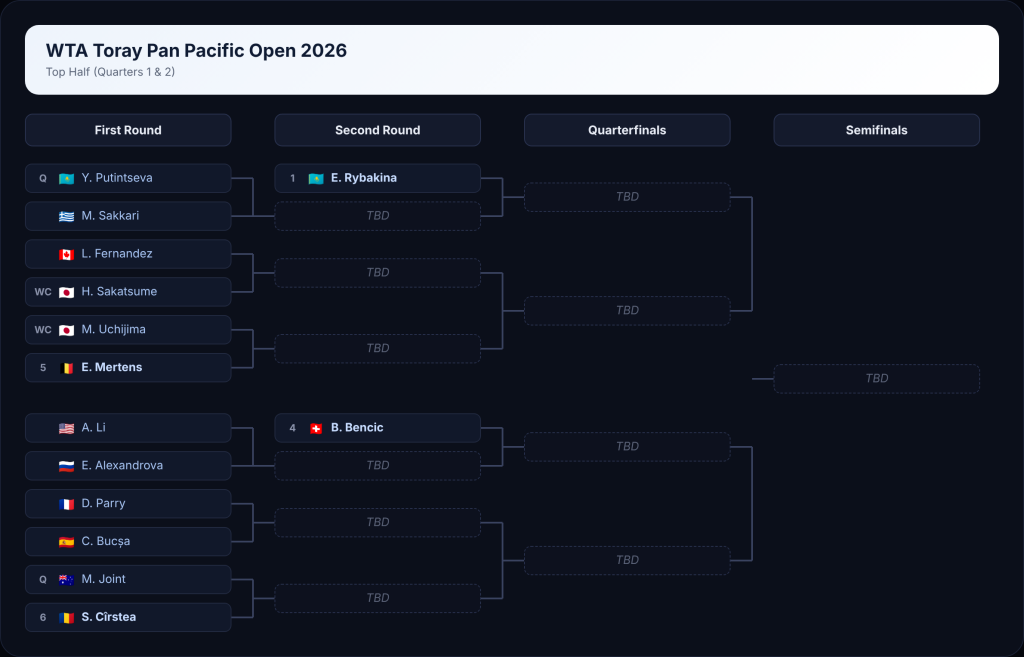
Top Half (Quarters 1 & 2)
World No. 1 seed Elena Rybakina headlines the top half after a first-round bye, with Belgium’s Elise Mertens (5) the first seed in action against wildcard Moyuka Uchijima. Fourth seed Belinda Bencic anchors the bottom of this section, while Sorana Cîrstea (6) opens against qualifier Maya Joint.
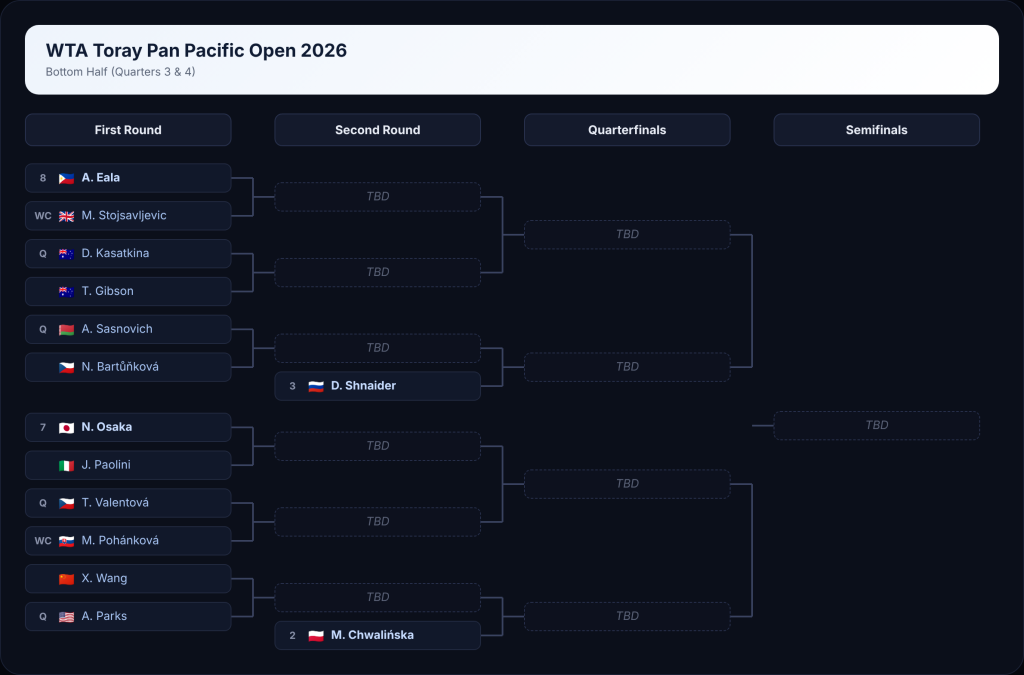
Bottom Half (Quarters 3 & 4)
Alex Eala (8) and Naomi Osaka (7) lead the bottom half, each kicking off against a wildcard. Diana Shnaider (3) and Maja Chwalińska (2) both enter with byes into the second round, rounding out a section stacked with qualifiers including Daria Kasatkina, Taylah Valentová, and Alycia Parks.
WTA Toray Pan Pacific Open Bracket Analysis
Quarter 1 – Deciding Factors
Rybakina’s Serve-First Strategy vs. A Field She’s Already Beaten in 2026
Every big result on Rybakina’s résumé this season shares the same fingerprint: she tees off on serve and dares the other side to keep up. She reached 47 aces across her run to the Australian Open title — just under seven a match, building on the fact she entered 2026 as the tour’s reigning ace leader — then backed it up by beating Sabalenka in the US Open final (6-4, 5-7, 6-2) to claim the No. 1 ranking, and closed last week by steamrolling the Ningbo Open field, dropping a set only once (to Kawa in the quarterfinal) before handling Diana Shnaider in the semis and Leylah Fernandez 6-2, 6-2 in the final.
That same blueprint has already solved both of her likely second-round opponents this year: she beat Yulia Putintseva 6-3, 6-3 in the Miami second round and Maria Sakkari 6-4, 6-1 at the Italian Open, both straight-set beatdowns. The historical wrinkle is that neither matchup was always this one-sided — Sakkari has an Indian Wells upset of Rybakina on her résumé, and Putintseva beat her as recently as 2021 at Indian Wells before Rybakina “scored her first win” in that series at this year’s Madrid Open — but with the 2026 ledger reading 2-0 against both and Rybakina fresh off two majors, there’s little in the data suggesting either poses the threat they once did.
Fernandez’s Recent Surge vs. The 6-2, 6-2 Reality Check
Fernandez arrives having played her best tennis of the season at exactly the right time: after a 12-19 record (39%) through the French Open, she ripped off four straight wins in Ningbo, beating seventh-seeded Elise Mertens in a 2-6, 6-3, 7-5 comeback, outlasting Aliaksandra Sasnovich 7-5, 6-7(2), 6-3, flipping a 4-6 deficit against Ekaterina Alexandrova to win the quarterfinal 4-6, 6-2, 6-1, and closing out Marie Bouzková 6-3, 7-5 in the semis — a run built entirely on grinding back from behind.
The problem is who was waiting in the final: Rybakina, who has now won 3 of their 5 career meetings, including a Stuttgart quarterfinal comeback from a set down where she saved two match points, and who gave Fernandez almost nothing in Ningbo, closing it out 6-2, 6-2 for the loss of just four games. If the seeds hold through this quarter, that’s a plausible quarterfinal rematch, and Fernandez will need a significant step up from the version of her serve and return game that managed only four total games last time out — her three-set wins prove she can battle, but this particular opponent hasn’t let her get that far.
Mertens’s Wimbledon Blueprint and Beijing Breakthrough vs. Her Ningbo Hangover
The case for Mertens as this quarter’s sleeper starts with the fact she’s the only player in the draw who’s already beaten Rybakina in 2026 — and not early in the season, either. At Wimbledon, Mertens snapped what had been a brutal personal history (Rybakina had won 7 of their first 8 meetings, including a sixth straight win over her at that same year’s Australian Open) with a 7-6(4), 6-1) third-round upset, converting 4 of 10 break points to Rybakina’s 2. She carried that into the fall, reaching her first WTA 1000 semifinal since 2021 at the China Open in Beijing by beating three different Grand Slam champions in succession — Jelena Ostapenko, Coco Gauff, and finally eighth-seeded Iga Świątek 7-6(0), 6-3, a match in which she never faced a single break point and won 87% of her first-serve points.
That’s as good a two-week stretch as anyone in this section has put together. The catch is what happened last week: dropped into Ningbo, Mertens blew a 6-2 first-set lead and lost in three to Leylah Fernandez, 2-6, 6-3, 7-5 — the same Fernandez who’s also lurking in this quarter. The swing between her Beijing level and her Ningbo collapse is wide enough that Mertens looks genuinely capable of another Rybakina upset if she shows up at her peak, but she may have to get through this draw’s hottest in-form player first just to get the chance.
Quarter 2 – Deciding Factors
Alexandrova’s Near-Miss in Beijing vs. Li’s Proven Blueprint for Asian Hard Courts
Whoever comes out of this opener arrives at Bencic with real credentials behind them, just from different angles. Alexandrova is playing the better tennis of the two right now: she reached the China Open quarterfinal in Beijing on October 8 and had Mirra Andreeva on the ropes, serving for the match at 5-3 in the second set before Andreeva rallied to win it 7-6(4), 7-6(3) — a gut-punch loss, but one that confirms her huge, 172 km/h first serve (57.9% of total service points won, 69.8% of service games held on the season) is translating against elite competition on exactly this kind of hard court.
Li’s case is less about current week-to-week form (12-13 on the season) and more about pedigree on this specific surface family: she’s the defending Guangzhou champion from 2025, and her best 2026 week came on an Asian-swing-adjacent hard court in Madrid, where she beat an ailing Iga Świątek — her second top-10 scalp of the year. Their head-to-head sits 3-1 for Alexandrova, but Li took the most recent meeting in Strasbourg (4-6, 6-4, 6-3) as she upset the No. 2 seed en route to her first clay semifinal, before Alexandrova avenged it quickly at Bad Homburg. Either profile — Alexandrova’s raw, booming serve or Li’s history of peaking on Chinese hard courts against ranked competition — is the kind of first-strike game that has given Bencic trouble, since her own game is built on redirecting pace rather than generating it.
Bencic’s United Cup Peak vs. the Hip-and-Form Alarm Bells Since
Bencic’s floor this year has been genuinely elite — she went 9-1 at the United Cup in January, including a win over then-world-No.-2 Iga Świątek in the final, and rode that into a return to the top 10 for the first time since her maternity leave. But the version of her showing up to Tokyo looks shakier. Her four Grand Slams produced a second-round exit to world No. 126 Nikola Bartůňková as the No. 10 seed at the Australian Open, back-to-back three-set fourth-round losses to Svitolina and Gauff, and a first-round defeat to Yulia Putintseva at the US Open — a match that ended in controversy after she hit a ball into the crowd late in the second set.
Physically, the picture is worse: she withdrew from the Canadian Open quarterfinals with a hip injury, then retired after dropping the first set of her very next match, a second-round loss to wildcard Loïs Boisson in Cincinnati. She’s walking into this quarter as the unquestioned top seed on paper but with hardly any recent match data to confirm the hip issue is fully behind her — exactly the kind of uncertainty a big-serving or in-form opponent out of the Li/Alexandrova match can exploit early.
Cirstea’s Historical Asia Allergy vs. Her Break-Point-Powered Breakout Season
The résumé argument against Cirstea advancing deep here is specific and well-documented: her career record in China is just 5-7, her combined Pan Pacific/Wuhan-area mark is 4-5, and her blended China record of 9-12 (43%) sits well below her 52% career win rate — and she’s already lost in the Ningbo second round two weeks ago, falling to Sara Bejlek 7-6(3), 6-4 despite holding two set points at 6-5 in the first. But 2026 has been the best season of her 20-year career by win total (39-15, a pace she’s never hit this fast before), and the engine behind it isn’t serve-driven — she’s averaging a modest 4.3 aces per match but has racked up 216 won break points on the season, a return-and-redirect game that doesn’t depend on fast conditions to function.
That formula is exactly what carried her to a career-first WTA 1000 semifinal in Rome at age 36, a run that included a win over world No. 1 Aryna Sabalenka (2-6, 6-3, 7-5) after trailing in the third, and she’s also won four of her last five meetings with Jelena Ostapenko, including both in 2026 — evidence she’s currently sharp against the kind of flat, aggressive ball-striking she’ll likely see from this field. A break-point-and-redirect game built on hustle rather than raw pace is a profile that should travel better across continents than a serve-first one, even if her historical Asia numbers say otherwise.
Quarter 3 – Deciding Factors
Eala’s Serve-First Reinvention vs. Match Skids at the Wrong Time
The season-long numbers still scream breakout: Eala has racked up 34 tour-level wins in 2026 after managing just 15 in her career before this year, and she arrives in Japan seeded 8th. But the form line right before Toray is alarming — she dropped three straight matches, capped by a stunning first-round exit at the Wuhan 1000 to Shi Han, a Chinese qualifier ranked outside the top 200, 4-6, 6-3, 6-3, after Shi reeled off seven straight games to blow the match open in the decider. That loss came immediately after Eala skipped the China Open entirely to win bronze at the Asian Games, and her uncle and coach, Noli Eala, called it a “wake-up call,” saying she simply looked drained of her usual energy rather than tactically outplayed. She snapped the skid in Ningbo’s first round, beating Diane Parry efficiently (6-3, 6-1, a sharp 12 winners to 9 unforced errors against Parry’s 11-to-25 ratio), but the underlying stat trail shows her game has genuinely changed shape this year.
Her return numbers have actually regressed from 2025 (break percentage down from 41.3% to 36.8%, return points won down from 46.6% to 44.5%), while her first-serve efficiency has jumped sharply (as high as 68% of first-serve points won in one sampled match, up from 59% a year ago) — she’s become more of a serve-first hitter than the counterpunching teenager who first broke through. That shift should work heavily in her favor if her projected second-round opponent is Kasatkina, who enters off a mental-health break, a hip injury, and a Madrid meltdown in which she squandered four match points in a third-round-collapse loss to a qualifier, sliding to World No. 84 — her lowest ranking since 2015, with next to nothing in her recent form to punish a bigger serve. Gibson is the tougher name in that match: fresh off a breakout season that included upsets of Alexandrova and Clara Tauson and an Indian Wells 1000 quarterfinal, she arrived in Japan off first-round losses in Beijing and Wuhan but has already won two straight sets-unlost matches at the Japan Open in Osaka, including a 7-5, 7-6(6) win over Harriet Dart and a 6-2, 6-1 rout of Sinja Kraus. The numbers suggest Eala’s path to the quarters is very much alive, but it runs far more comfortably through Kasatkina’s side of that bracket than through Gibson’s.
Shnaider’s Signature Slam-Level Win vs. Bartunkova’s Recent Breakthrough
Shnaider’s case for the pick rests on one enormous data point: a win over then-world-No.-1 Aryna Sabalenka at the French Open, 3-6, 7-5, 6-0, while ranked just 23rd, on her way to a Roland Garros semifinal — still her best result and win of the season. She backed that up two weeks ago with a Ningbo semifinal run, beating Kudermetova and Kawa before falling to a red-hot Rybakina 6-3, 7-5. But her broader 2026 numbers are more pedestrian than those two results suggest: an 18-12 record overall (60%) and just 8-7 on hard courts this season, nowhere close to a dominant seed’s resume. Bartunkova, by contrast, is the player who has most recently “made noise” in exactly this kind of event: she reached her first WTA 1000 semifinal in Beijing less than three weeks ago, beating Sabalenka 6-4, 6-3 in 1 hour 35 minutes — denying her any of five break points in one pivotal game and shutting her out of every break chance in the second set — then routing seventh-seeded Karolina Muchova 6-3, 6-0 in just 67 minutes (19 winners to 12, forcing 37 unforced errors with drop shots and changes of pace) before a manageable 6-2, 6-2 loss to a similarly in-form Mirra Andreeva.
That run pushed her to a career-high ranking near No. 29 and a 7-2 mark in her last nine matches. The two players’ best 2026 results are nearly mirror images — both built around taking down a Sabalenka-caliber opponent — but Bartunkova’s came three weeks ago rather than five months ago, and her underlying numbers right now (the Beijing serve-and-redirect formula that also handled a quality mover in Muchova) look sharper than anything Shnaider has produced since Paris. The data doesn’t say Shnaider is too strong for the field; it says this could be a genuine coin-flip if the two meet, with Shnaider’s higher career ceiling offset by Bartunkova’s more current, more battle-tested form.
Quarter 4 – Deciding Factors
Chwalinska’s Career-Peak Title Run vs. Osaka’s Pedigree at This Exact Event
The bye almost undersells how dangerous Chwalinska is walking in. She didn’t just make noise in the lead-up — she won the Wuhan Open outright, a WTA 1000, for her first career title, beating Sonay Kartal in a 2-6, 6-4, 6-2 comeback final after dropping the opener, and she got there by beating her childhood friend Iga Świątek in the semifinal for her first-ever top-10 win. That run carried her from a No. 146 start to 2026 all the way to a Top 20 debut and now a climb to world No. 11 — an 11-place jump off one tournament alone. That’s about as red-hot as a player can be entering a draw, seeded or not.
Osaka’s counter-argument isn’t current red-hot form so much as proven pedigree at this specific event and a demonstrated ability to hang with the very best right now: she’s a two-time Toray runner-up (2016, 2018) and the 2019 champion, and even though her broader 2026 has been quiet by her standards (no titles, a Bad Homburg final lost retiring down a set), she pushed seventh-seeded Karolina Muchova to a 2-hour, 52-minute, three-set classic at the China Open in Beijing, saving eight match points in the decider and the final tiebreak before finally falling 7-5, 1-6, 7-6(7). The numbers suggest “despite the bye” undersells it the wrong way — Chwalinska’s title-winning three weeks are arguably the best current form of anyone in this whole quarter, and whoever survives the bottom section inherits a legitimate coin-flip quarterfinal against her rather than a free pass past an underwhelming 2-seed.
Osaka’s Fights Against the Elite vs. Paolini’s Season-Long Confidence Collapse
The head-to-head technically tilts to Paolini — she beat Osaka in the Miami fourth round back in March 2025, their only prior meeting — but that result is nearly two years old and predates a sharp divergence in both players’ trajectories since. Paolini’s 2026 has been a genuine crisis: she fell out of the top 15 for the first time since February 2024 after a first-round loss to Tatjana Maria at Eastbourne as the No. 1 seed, went long stretches without back-to-back wins, carried a foot injury dating back to Rome, sat at 16-13 and ranked 20th by the US Open, and split from coach Marc Lopez after an early Wimbledon exit before re-hiring him days before the US Open in an outcome that’s still playing out. Osaka, meanwhile, has spent the back half of 2026 trading blows with the game’s best and losing competitive matches rather than bad ones — the Muchova three-setter above, plus a Wimbledon run in which she beat Aryna Sabalenka (her first-ever win over her, and her first win over a reigning No. 1 away from a hard court) before falling to Muchova again in the quarterfinal. Every current data point says Osaka is playing elevated, high-stakes tennis against elite competition and losing heartbreakers, while Paolini’s results say she’s lost confidence against the field broadly, elite or not. The stats line up overwhelmingly behind Osaka in round one, with Paolini’s upset case resting almost entirely on a stale head-to-head rather than anything in her present form.
A couple of extra notes worth flagging: the other two first-round matches in this quarter (Valentová vs. Pohánková, and Wang vs. Parks) are genuine depth matches with no standout statistical storyline — nothing in either player’s recent results suggests they’re live threats to disrupt the section, so the real action funnels toward whoever survives Osaka-Paolini meeting Chwalinska in the quarterfinal. It’s also worth noting Osaka’s long injury history specifically at Japan hard-court events in this same window of the calendar (a stomach-injury withdrawal from this very tournament in 2022, among others) — nothing in the 2026 data points to a current issue, but it’s a standing fragility risk given how physically taxing that Beijing marathon with Muchova was just weeks ago.
WTA Guangzhou Open
Favorite to Win: Paula Badosa +900
Sleeper Pick: Daria Snigur +1000, Anna Bondar +5000
WTA Guangzhou Open Information
- Dates: October 26 – November 1, 2026
- Location: Guangzhou, China
- Surface: Hard
- Tier: 250
- Defending Champion: Ann Li
WTA Guangzhou Open Odds to Win
| Seed | Country | Player | Odds to Win |
|---|---|---|---|
| 4 | 🇦🇹 | Lilli Tagger | +550 |
| 🇨🇿 | Katerina Siniaková | +750 | |
| 5 | 🇪🇸 | Paula Badosa | +900 |
| 2 | 🇮🇩 | Janice Tjen | +900 |
| 1 | 🇺🇦 | Daria Snigur | +1000 |
| 8 | 🇺🇸 | Katie Volynets | +1400 |
| 6 | 🇹🇷 | Zeynep Sönmez | +1800 |
| 7 | Maria Timofeeva | +1800 | |
| 🇺🇦 | Dayana Yastremska | +1800 | |
| 🇺🇸 | Claire Liu | +2000 | |
| 🇺🇸 | Sofia Kenin | +2200 | |
| 🇪🇸 | Kaitlin Quevedo | +2200 | |
| Polina Kudermetova | +2800 | ||
| Tatiana Prozorova | +3000 | ||
| 🇦🇹 | Sinja Kraus | +3000 | |
| 🇹🇭 | Mananchaya Sawangkaew | +3000 | |
| 🇵🇱 | Magda Linette | +3500 | |
| 🇨🇭 | Jil Teichmann | +3500 | |
| 🇨🇳 | Han Shi | +3500 | |
| 🇭🇷 | Antonia Ružić | +3500 | |
| Anastasia Zakharova | +3500 | ||
| 🇷🇸 | Teodora Kostović | +3500 | |
| 🇬🇧 | Harriet Dart | +3500 | |
| 🇨🇭 | Simona Waltert | +3500 | |
| 3 | 🇹🇭 | Lanlana Tararudee | +4000 |
| 🇺🇸 | Carol Young Suh Lee | +4000 | |
| 🇭🇺 | Anna Bondár | +5000 | |
| 🇪🇸 | Sara Sorribes Tormo | +6500 | |
| 🇨🇳 | Xinran Sun | +8000 | |
| Alevtina Ibragimova | +10000 | ||
| 🇺🇸 | Venus Williams | +10000 | |
| 🇭🇺 | Panna Udvardy | +10000 |
WTA Guangzhou Open Draw
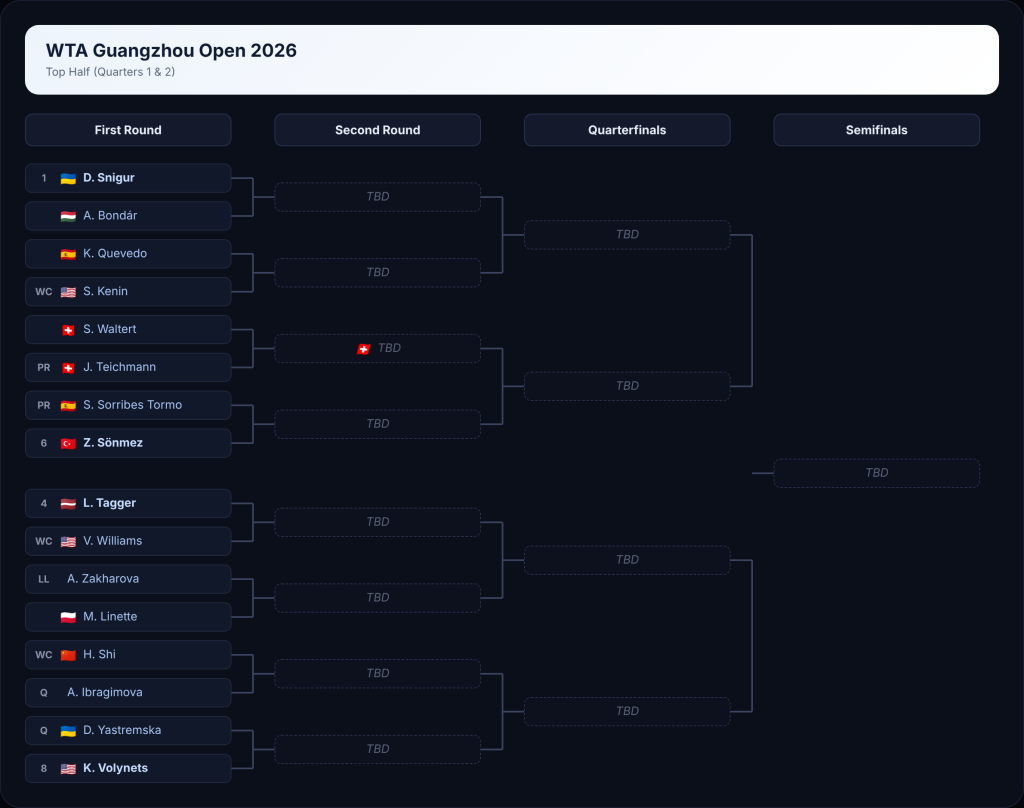
Top Half (Quarters 1 & 2)
Top seed Daria Snigur leads the top half and could open against Spain’s Sara Sorribes Tormo or Swiss qualifier-turned-protected-ranking entrant Jil Teichmann, who shares an all-Swiss second-round matchup with countrywoman Simona Waltert. Fourth seed Lilli Tagger anchors the lower quarter in a section loaded with Americans (Venus Williams, Sofia Kenin, Katie Volynets) and former Guangzhou-area contenders Magda Linette and Dayana Yastremska.
Bottom Half (Quarters 3 & 4)
Seventh seed Maria Timofeeva and third seed Lanlana Tararudee lead the top quarter. The bottom quarter is headlined by fifth seed Paula Badosa and second seed Janice Tjen, with Harriet Dart, qualifier Tatiana Prozorova and Polina Kudermetova rounding out a group still waiting on one qualifying spot to be confirmed.
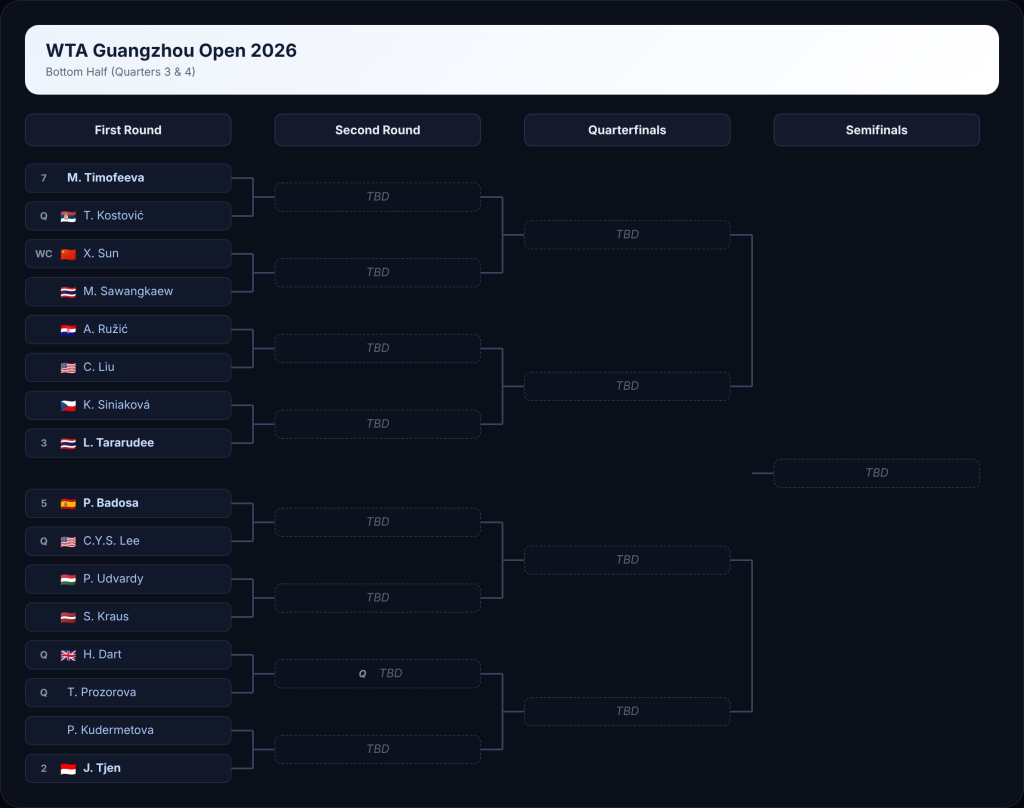
WTA Guangzhou Open Bracket Analysis
Quarter 1 – Deciding Factors
Bondár’s Quietly Elite Season Numbers vs. Snigur’s Paper-Thin Case as the 1-Seed
By the underlying tour-wide data, Bondár is the best hard-court performer in this entire section, even though her ranking (No. 64, having climbed back from 78 in mid-August) doesn’t scream favorite. Across her 48 matches played this season, she ranks top-25 on tour in several key categories: 23rd in aces (179), 9th in second-serve points won (733), 5th in break points saved (255), and 10th in total points won (3,836) — the profile of a player who’s quietly been one of the more efficient, hard-to-break competitors on the surface all year. She also has the freshest relevant form of anyone in the bottom half of this quarter: she reached the Korea Open semifinal just weeks ago, beating fourth-seeded Elena-Gabriela Ruse in the quarterfinal before falling to second-seeded Kimberly Birrell — a live, recent Asian hard-court result, even if her very next outing (a first-round exit at the China Open to Renata Zărăzua) says she isn’t unbeatable right now either.
Snigur, by contrast, is a thin No. 1 seed on paper: her entire 2026 is a 4-2 record, all of it at the WTA 125/W75 level and all of it indoors (titles at Oeiras and Murska Sobota, a final loss at Trnava), for a career-high ranking of just No. 93. She has zero tour-level history in Asia whatsoever — no China Open, Wuhan, or Pan Pacific appearances on record at any point in her career — meaning she’s not just a seed with a thin résumé, she’s stepping into entirely unfamiliar outdoor Asian hard-court conditions for the first time as the top seed of a section. The data backs the read that this is a genuinely tough ask for Snigur, and Bondár’s broader statistical profile plus recent regional form make her a live threat to win that match outright.
Kenin’s Guangzhou Pedigree vs. the Worst Hard-Court Season of Her Career
The history-versus-form split here is about as stark as it gets anywhere in this draw. On history, Kenin is a name to take seriously in Guangzhou specifically: she won this exact title in 2019, beating Samantha Stosur in the final, and her broader Asia résumé includes a Pan Pacific Open runner-up finish in 2024 (beating Kasatkina along the way), a Pan Pacific quarterfinal win over Alexandrova in 2025, and multiple third-round China Open and Wuhan Open results. That’s a legitimately strong regional track record for a former Grand Slam champion who has a history of raising her level specifically on these courts. But the current-season numbers say fade, not take.
Kenin is 6-20 (23%) overall in 2026, and a brutal 3-14 (18%) on hard courts specifically — one of the worst hard-court seasons of any player left in the field, let alone a former No. 4 in the world. Her underlying serve/return numbers back up the decline (57.3% service points won, just 38.8% return points won on the season), showing a player who’s lost the margins on both sides of the ball, not just dropping close matches. Precedent says don’t completely write her off in this city, but the 2026 data says the pedigree is carrying very little weight right now.
Sönmez’s Scalp-Collecting Streaks vs. Her Week-to-Week Inconsistency
Sönmez is genuinely hard to peg, and the data explains why: she’s clearly capable of beating very good players, but she’s equally capable of losing early to much lower-ranked ones, often in the same tournament window. Her 2026 highlight reel includes a win over then-world-No.-8 Jasmine Paolini in Stuttgart (her first top-10 win) and a run to the Australian Open third round where she won three qualifying matches and then beat No. 11 Ekaterina Alexandrova and Anna Bondár — her own quarter-mate here — before finally losing in three sets to Yulia Putintseva. That’s two wins over a combined top-11-and-former-top-10 level of competition inside a few months.
But her ranking trajectory tells the inconsistency story just as clearly: a career-high of No. 48 in mid-July slipped back to No. 52 within six weeks, she’s a modest 7-8 at the WTA 1000 level with early exits at Indian Wells, Miami, Canada, and Cincinnati, and she lost in the first round of the French Open to a Daria Kasatkina who was herself ranked outside the top 50 at the time. Her Asia-specific sample is thin and mixed — a 2024 Pan Pacific upset of seventh-seeded Fręch as a No. 148-ranked qualifier shows she can catch fire from nowhere in this region, but she’s also 0-3 lifetime in Doha with first-round exits every year. The data says she’s a legitimate scalp-collector who should never be dismissed, but not someone to trust as a steady, round-by-round favorite — she’s as likely to produce another Alexandrova-or-Paolini-level upset as she is to lose early to someone well outside the top 100.
Quarter 2 – Deciding Factors
Tagger’s Rising Numbers vs. the Volatility and Fatigue Sitting Across From Her
By the data, Tagger is the clear form player of the top section. The Austrian has had the best 2026 of anyone in this section: she rocketed from a 2025 year-end ranking of No. 153 to a career-high No. 45, highlighted by her first WTA Tour title at the Prague Open — beating Barbora Krejčíková in the semifinal and Daria Snigur (the No. 1 seed in this very draw’s other quarter) in the final — plus wins over Paula Badosa and third-seeded Liudmila Samsonova at Linz. Her 10-8 hard-court record isn’t huge in volume, but it’s loaded with real scalps, and unlike either name across from her, she’s trending up rather than treading water. Zakharova is the volatile name: her 2026 is built on two standout results — a three-set comeback win over Anna Bondár and a match-point save against Anna Kalinskaya in Miami, a legitimate top-30 scalp — but she’s still only ranked 81st, came through as a lucky loser here, and the page on her season is otherwise thin, exactly the profile of a player who can produce a signature upset in one round and vanish the next.
Linette is the more interesting case against the field than against Tagger specifically: her raw 2026 numbers (14-13, a hard-court-best 13-10, third rounds at both the Australian Open and French Open, and a win over world No. 2 Iga Świątek in Miami) are better on paper than Zakharova’s by volume, and physically she’s shown none of the decline that’s caught up with Venus Williams, who was bounced in the first round of her 26th US Open by Sofia Kenin. But Linette’s season has trailed off hard since that Miami win — first-round exits at both Wimbledon and the US Open — suggesting the engine still runs, it just stalls on the bigger occasions. If the numbers are the tiebreaker, Tagger’s title-winning current form makes her the one to beat in this section, with Linette’s physical staying power (not Venus’s) as the more realistic spoiler than anything in Zakharova’s streaky ledger.
Volynets’s Return-Game Edge vs. Shi’s Quiet Streak Lurking in Round Two
Between Yastremska and Volynets directly, the data leans Volynets. Her overall ranking (No. 78) undersells a real strength in exactly the stat that wins tight matches: she’s 12th on tour in break points converted (187) and 36th in break points saved (188), and she arrives fresh off a title run at the Philly Open in August and a Korea Open quarterfinal last month, where she beat eighth-seeded Kamilla Rakhimova before a tight three-set loss to second-seeded Kimberly Birrell. Yastremska, by contrast, is in a genuine slide — down to No. 103, with first-round exits at three of her four majors this year (Australian Open, French Open, US Open) — and her only real 2026 highlight is a WTA 125-level title in Parma, nothing close to the form that carried her to the 2024 Australian Open semifinal.
The numbers favor Volynets getting through that opener. As for Shi, her recent run is genuine but still untested against this level: she stunned 13th-seeded Alex Eala at the Wuhan Open two weeks ago, then beat Margarita Gasparyan at the Hong Kong Open before losing cleanly to ninth-seeded Bernarda Pera in that event’s second round. That’s two real wins — one over a recent major-seeded player, one over a tour veteran — immediately capped by a loss the moment she met a proper seed, which reads as a legitimate round-two threat rather than a proven one. The data still points to Volynets as the one standing after that second round, with Shi as the name most likely to make it interesting if she gets there.
Quarter 3 – Deciding Factors
Timofeeva’s Hard-Court Blank Slate vs. Whoever Survives the Sun/Sawangkaew Half
The data actually argues against Timofeeva here, and it’s not close. Despite carrying the 7-seed into a hard-court event, her entire 2026 season is built on clay: all three of her titles this year — Istanbul, Makarska, and the Chiasso Open — came on clay courts, and there’s no documented 2026 hard-court result for her at all, good or bad. That’s a real gap for a seeded player at a hard-court 250, and it makes her first-round match with qualifier Teodora Kostović (herself unproven on hard, with no completed 2026 hard-court results either) something closer to a coin flip than the seeding suggests.
On the other side, reliable data on the Chinese wildcard Sun is too thin to assess with confidence, but her likely opponent, Sawangkaew, actually brings a stronger hard-court case than Timofeeva does: she won a hard-court WTA 125 title in Japan this year (the Kangaroo Cup, over Emerson Jones) and reached her first career Grand Slam third round at Wimbledon by beating Maja Chwalinska and Alycia Parks along the way. If Sawangkaew is the one who emerges from that side, the stats would actually favor her over Timofeeva in the next round, not the reverse — this top half looks far more vulnerable for the 7-seed than the bracket position implies.
Siniaková’s Title-Winning Week vs. the Zero-Rest Turnaround Into Guangzhou
The form case for Siniaková is as strong as it gets: she just won the Japan Open in Osaka — her sixth career title and first since 2023 — beating second-seeded Peyton Stearns, Magda Linette, Mary Stoiana, and eighth-seeded Katie Boulter en route, then closing out the final by winning the last 10 straight games against Ashlyn Krueger, 6-1, 6-0, with a sharp 16-winners-to-19-unforced-errors line. She dropped only one set the entire week. But the fatigue question the data raises is real and specific, not speculative: Siniaková herself said after the final that she travels to Guangzhou “the next day” — meaning zero rest days between a five-match, title-winning week and the start of this tournament.
That’s a legitimate physical cliff to walk into a first-round match. Tararudee was in that same Osaka draw and lost earlier to eventual finalist Krueger, which means she’s carrying more recovery time into this match, even if her own 2026 hard-court résumé (a career-high ranking of just 94, one hard-court WTA 125 title in Austin, and a runner-up finish on home-region hard courts in Japan back in April) is considerably thinner than what Siniaková just showed in Osaka. The stats support Siniaková as the better player right now, full stop — but the scheduling data genuinely supports fading her freshness in this specific match more than fading her level.
Tararudee’s Seeding vs. The Rest of the Quarter
Even clearing Siniaková wouldn’t make Tararudee an obvious favorite for the rest of this section. Her season has been defined more by ranking milestones — Thailand’s first ever top-100 debut, a career-high of No. 94 — than by the kind of signature, multi-seed-beating week Siniaková just produced in Osaka, and she’d still have to get past the Ružić/Liu winner before reaching a quarterfinal that would likely include whoever survives the shaky Timofeeva/Sun-Sawangkaew half. Beating a fatigued Siniaková would be a genuine résumé win, but it wouldn’t erase the gap in proven hard-court weapons between the two. Taken together, the data backs the read that this entire quarter is wide open at the top: Timofeeva’s complete lack of 2026 hard-court form and Siniaková’s zero-rest turnaround are both real, specific, well-documented risk factors — which is exactly why “to lose” feels like the more accurate framing for both of them than “the pick.”
Quarter 4 – Deciding Factors
Badosa’s Serve Reliability (and Health) vs. a Field She Should Be Beating
Badosa’s season is close to a coin flip by the raw numbers — 19-20 overall, and specifically 9-11 (45%) on hard courts, actually worse than her 8-6 mark on clay — in a year that’s been defined more by her body than her game: a back muscle tear forced another withdrawal (from Dubai), and she’s spoken publicly about nearing retirement thoughts amid the physical toll, even while framing the year as a reset she needed. When the underlying numbers are good, she’s genuinely dangerous: a healthy-week Badosa holds serve at 65.2% and saves over half her break points (52.7%), with a 65.9% first-serve-points-won rate that would rank among the better marks in this field.
But her double-fault rate (0.089 per serve point) is noticeably worse than everyone else in this section — more than double Kraus’s 0.042 and Udvardy’s 0.040 — and that’s the tell: when her service motion tightens up under physical strain, the free points start flowing the other way. For her to get through what should be a beatable field (an unproven qualifier in Lee, then a winnable Udvardy/Kraus path), the stat to track isn’t a signature weapon, it’s whether that double-fault number stays controlled match to match — that’s historically been the clearest real-time signal of whether it’s a “good” Badosa week or a “bad” one.
Kudermetova’s Alternating Current vs. Tjen’s Ranking-Outpacing-Results Problem
The data backs “better lately” for Kudermetova, but “inconsistent” is still the more accurate word than “trending.” Her results since mid-September have gone win-loss-win-loss-win in near-perfect alternation: a loss to Rakhimova, wins over Ma and a seeded Clara Tauson in Beijing, a loss to Andreeva, and most recently a win over Cristina Bucșa in Ningbo. That’s a real signature scalp (Tauson) sitting right next to a run of true coin-flip results, and her season totals fit the modest-but-rising framing — 6-8 overall, exactly 5-5 (50%) on hard, with her ranking climbing from No. 167 in January to a season-best No. 108.
Tjen’s case for being overseeded holds up statistically: despite a career-high of No. 35, she’s just 6-12 (33%) in 2026, and six of those losses came in the first round — at three of her four majors and three different WTA 1000 events (Indian Wells, Miami, Canada). Her ranking is being propped up by a thin spread of decent results (a Hobart doubles title, a couple of third rounds) rather than repeated deep runs, exactly the profile of a seed vulnerable to an early exit. Put together, the data does support the idea that the draw is clearing for Tjen on paper, but her own 33% win rate against a No. 35 ranking means “clear draw” isn’t the same as “safe” — Kudermetova is live, if streaky, and whoever wins this one looks more like a sleeper than a lock.
Udvardy’s Clay-Built Season vs. Kraus Finding Her Best Surface
Udvardy has had a genuinely good season overall (17-19, with a strong 11-8/58% specifically on clay), and hard court really is the soft spot — she’s just 4-8 (33%) on it this year, her worst surface by a wide margin. The underlying numbers explain why: her return game rates in just the 1st percentile tour-wide, meaning when she can’t dictate behind her own serve (56.2% service points won, a 65.3% hold rate that isn’t commanding), she has almost no way to win points back on return — a profile that survives on clay’s longer rallies but gets exposed on a faster surface.
Kraus has had a rough season overall (6-13, 32%), but hard court is relatively her best surface by record (5-6, clearly ahead of 1-5 on clay and 0-2 on grass), even though her own serve and return numbers are both below average (11th and 19th percentile, respectively). Neither player’s full-season data screams dark horse, but the surface-specific numbers do support this being closer than the records suggest — Udvardy’s single biggest statistical weakness lines up precisely with the court speed she’s walking into, while Kraus is at least playing her relative best surface rather than her worst. If either is the sleeper, the data leans toward Kraus having the more favorable matchup here, even with a clearly worse season on paper.
Photo Credit: REUTERS