



 Share


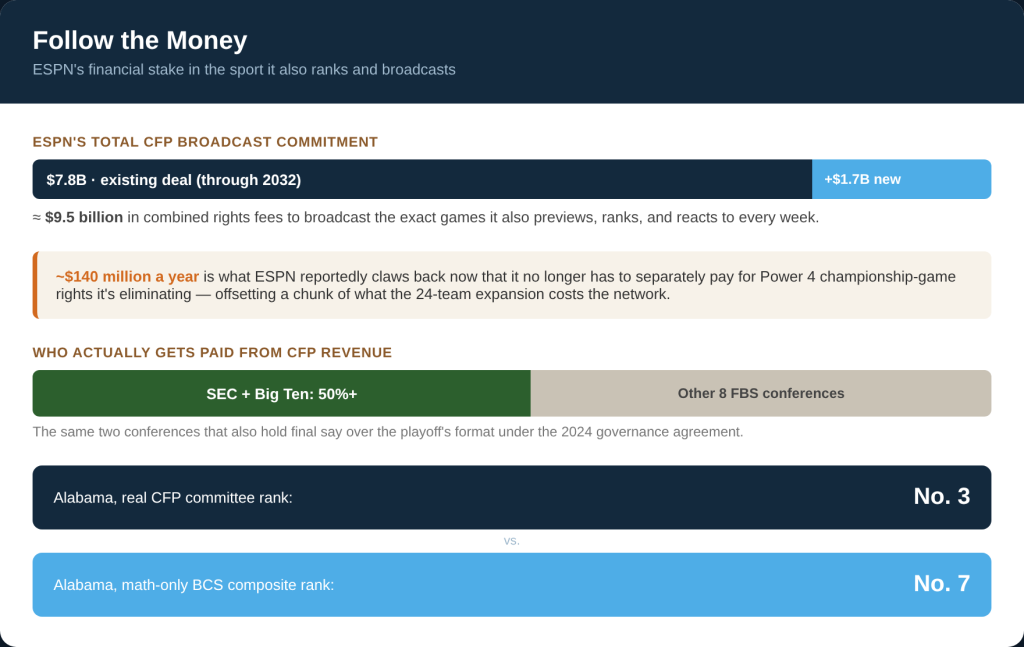
On November 9, 2026, the College Football Playoff and ESPN agreed to blow the field open to 24 teams starting in 2027 — a five-year, nearly $1.7 billion extension that, almost as an afterthought, also kills off the Power Four conference championship games. It’s being sold as access. More teams, more hope, more inventory. But strip away the press release language and what actually happened is this: the sport just made its selection problem bigger while doing nothing to fix the only part of it that was ever actually broken — who decides, and why we should trust them?
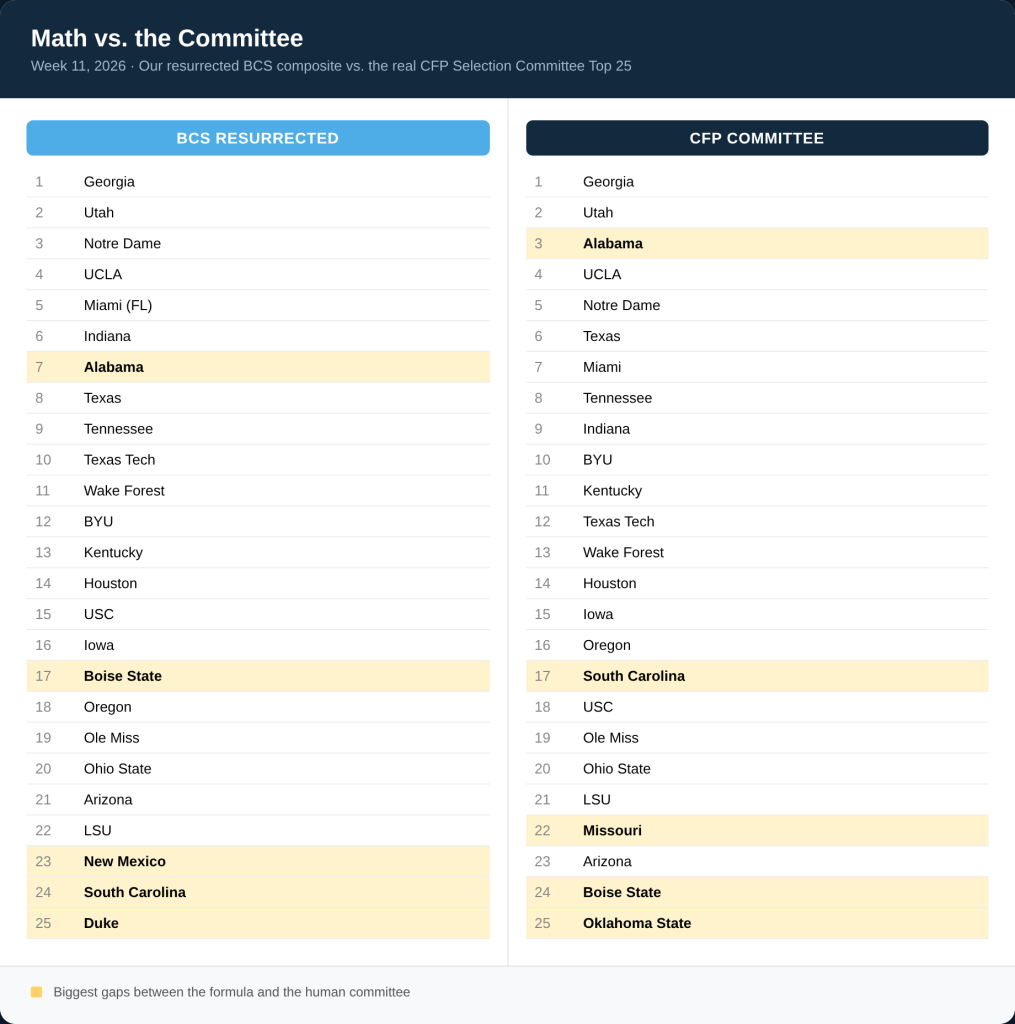
We built something to test that. Using the final-era BCS formula — one-third AP Poll, one-third Coaches Poll, one-third computer rankings (Wolfe Ratings and an independent power-rating system standing in for the now-defunct originals) — we generated a Week 11, 2026 composite ranking using nothing but publicly available numbers. No committee room, no TV deal, no brand-name bias. Just math. Then we put it next to the real CFP Selection Committee’s actual Top 25 from the same week. The gaps are not subtle, and they make the case better than we could in prose alone.
What Is the BCS?
The Bowl Championship Series ran college football’s postseason from 1998 to 2013, and in its final and most stable form, it determined a team’s ranking with one literal formula: one-third of the score came from the Harris Interactive Poll, a panel of roughly 100 former players, coaches, and media members who each submitted a weekly top-25 ballot; one-third came from the USA Today Coaches Poll, the same idea but voted on by current major-college head coaches; and the final third came from an average of six separate computer ranking systems — Anderson & Hester, Billingsley, Colley Matrix, Massey, Sagarin, and Wolfe — each of which took every FBS team’s full schedule and spat out a ranking using nothing but wins, losses, and opponent strength (margin of victory was explicitly banned as an input, specifically to stop teams from running up scores).
For the computer leg, each team’s highest and lowest ranking among the six was thrown out before the remaining four were averaged. Every component was converted to a 0-to-1 score — a team’s share of the maximum points or ranking value available — and the three thirds were added together for a final BCS score. The top two scores met in the national title game. That’s it. That’s the whole formula.
What Is Our ‘Resurrected’ BCS?
We rebuilt that exact structure for Week 11 of the 2026 season, with two substitutions forced by the fact that two of the three legs no longer exist. The Harris Poll was discontinued when the BCS ended in 2013, so we used the AP Top 25 poll in its place, alongside the Coaches Poll, as the two human-panel legs. The original six-computer panel is almost entirely dead — Anderson & Hester stopped publishing when the BCS ended, and neither Colley Matrix nor Massey had reachable current output — so we used the two legacy-style systems we could actually pull and verify this week: Wolfe Ratings, which is literally one of the six original BCS computers and is still active, and an independent power-rating system (James Howell’s) that works the same way the others did, taking in full schedules and spitting out an opponent-adjusted number with no human opinion involved.
The literal math: for each team, we took its AP Poll points as a share of the AP leader’s points, its Coaches Poll points as a share of the Coaches leader’s points, its Wolfe rating as a share of the Wolfe leader’s rating, and its Howell rating as a share of the Howell leader’s rating. We averaged the two computer shares together into one “computer” number, the same way the original formula averaged its six down to one. Then we added the AP share, the Coaches share, and the computer average, and divided by three. That sum is the BCS Score in our table — same one-third/one-third/one-third structure as the original, just rebuilt with the inputs that are actually still alive in 2026. Any team outside a given poll or system’s own published top 25 scored a flat zero in that leg, exactly the way it worked under the real BCS.
The Money Is Not Hidden Anymore
Start with the most uncomfortable fact in the sport: ESPN is both the network that broadcasts the College Football Playoff and a financial partner embedded in SEC Network revenue, and it also produces the weekly rankings-reveal show that shapes public perception of the committee’s work before the committee has even finished talking.
Indiana head coach Curt Cignetti said the quiet part out loud this month, telling his own radio audience that ESPN’s rankings-show analysts are “given instructions on what to say” and that the network’s writers “march to their drum” on SEC coverage. He was reacting to a committee reveal that had ten SEC teams in the initial Top 25 against six from the Big Ten — including a two-loss Alabama team at No. 5 and a two-loss Texas team, which had lost to two unranked opponents, at No. 7, while a one-loss Ohio State team was left out of the field entirely. FOX’s Joel Klatt made a related point from a different angle, ripping the committee for parking a 9-0 UCLA team at No. 8 and saying flatly that the committee “likely hadn’t watched much football.”
Our own numbers from this week land the same punch more quietly. In the real CFP rankings, Alabama sits at No. 3. In the math-only BCS composite, built from the exact same games, Alabama is No. 7 — a four-spot gap that exists for one reason: a committee room full of humans, several of them with direct financial and reputational ties to the sport’s television ecosystem, decided a two-loss SEC team belonged four spots higher than its results support. A formula doesn’t care who’s paying for the broadcast rights. It can’t be lobbied, and it can’t be talked into a brand name.
If There’s No Conference Championship, What Is a Conference For?
This is the part of the ESPN deal that should worry even fans who don’t care about selection fairness. All four power conferences have now confirmed their championship games end after this December. The SEC title game — a fixture since 1992 that reportedly generates the conference roughly $100 million a year — is gone. Commissioner Greg Sankey called it “a defining event” in the sport on his way out the door, which tells you everything about how this decision actually got made: not because the games stopped mattering, but because a bigger playoff bracket made them redundant on the calendar.
Once there’s no championship game, conference membership stops being about an actual competition for a crown and starts being purely administrative — a scheduling bloc and a revenue-sharing agreement. You can already see teams meeting twice in the same season, once in the regular slate and again in an expanded bracket, with zero format difference between the two games beyond the stakes. That’s not a deeper postseason. That’s the regular season getting diluted into the postseason until the two blur together, which is exactly what ESPN’s own college football desk argued internally — the same article that called the 24-team field a format with “a multitude of issues,” including the blunt point that teams can now lose far more games and still get in, stripping jeopardy out of roughly 30 additional games a year.
Realignment Already Broke the Geography. Now It’s Breaking the Actual Point of Existence.
None of this happens in a vacuum. The conference map has already been scrambled past recognition — UCLA playing Big Ten football as a West Coast school thousands of miles, Cal (Berkeley) now wearing ACC colors on the opposite coast entirely. These moves were made for media-rights money, not competitive or geographic logic, and they already strained the idea that a “conference championship” meant anything coherent. Eliminating the championship games doesn’t fix that strain — it just removes the one mechanism that still forced those mismatched leagues to crown something real. What’s left is conference affiliation as a logo on a television contract.
Access for Everyone Except the Teams That Actually Need It
The expansion’s pitch is “more access.” The structure says otherwise. Of the 24 spots, 19 are at-large and only five are automatic — four to the Power Four champions, and exactly one to the single highest-ranked Group of Five/Group of Six team. That’s not a door opening for mid-major programs; it’s the same narrow crack that’s existed all along, just with a bigger number attached to make it sound generous. Josh Pate’s read on this was blunt: he said the Group of Six “loses the most” in this new structure, because the new 10-game power-conference scheduling requirement will choke off the very non-conference games those schools rely on to build playoff résumés, and he suggested mid-major conferences start planning their own alternative postseason entirely.
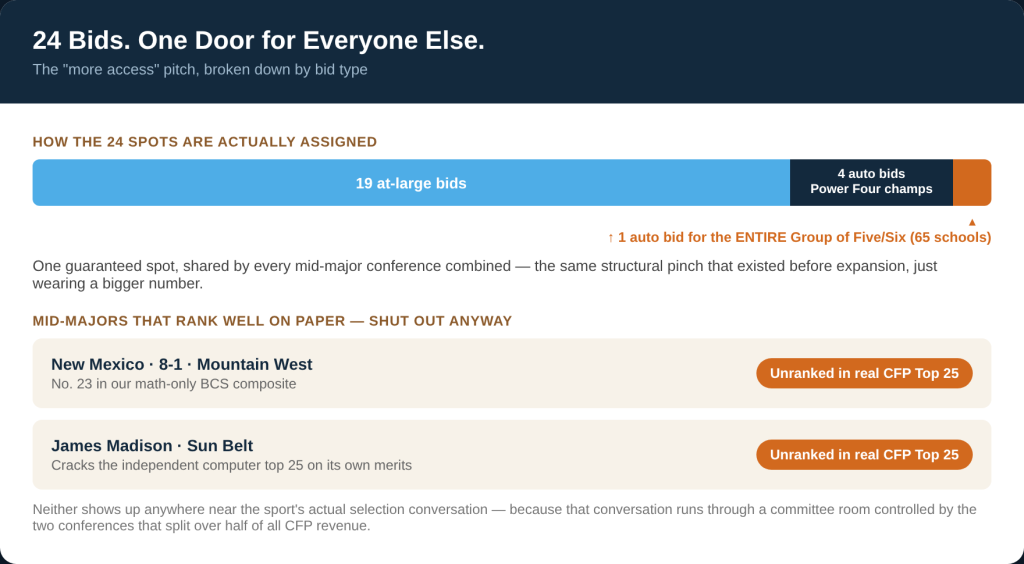
Our own data backs that up in a way that’s hard to argue with. New Mexico is 8-1, a Mountain West team, and it shows up at No. 23 in our math-only BCS composite. The actual CFP committee doesn’t rank them anywhere in its real Top 25. James Madison — Sun Belt, another Group of Five program — rates highly enough in the independent computer rankings we used to crack a top-25 computer list on its own merits. Neither shows up anywhere near the sport’s actual selection conversation, because that conversation still runs through a committee room that, by its own voting structure, is controlled by the SEC and Big Ten under the 2024 memorandum of understanding — the same two conferences that combine for more than half of all CFP revenue.
And this isn’t theoretical. Duke won the ACC championship outright in 2025 and still got left out of the 12-team field and FSU was undefeated years prior but left out because of a quarterback injury that apparently doesn’t apply to Ohio State this season. Duke’s snub this week is exactly why it is instructive again right now: in our BCS composite, Duke ranks 25th, scraping into our resurrected field. In the real CFP committee’s current Top 25, Duke isn’t there at all — Missouri and Oklahoma State, neither of which cracked the AP or Coaches polls’ top 25 this week, occupy spots 22 and 25 instead. A math formula and a room full of people looking at the same season produced two different answers, and the version with the brand names in it is the one deciding who plays for a championship.
Notre Dame Gets a Different Set of Rules
Then there’s the carve-out nobody else in the sport gets. Notre Dame plays no conference football and is guaranteed a CFP bid if it finishes in the top 12 — a standing exemption that exists for exactly one program. After Notre Dame was left out of the 2025 field, the school’s own athletic director called the process a “farce,” and the backlash from outside South Bend was pointed in the other direction: a “special carveout” that asks whether anyone else should even bother being independent, and one CFP committee chairman at the time, Hunter Yurachek, justified ranking the Irish 11th by saying they simply had no “signature wins” — a soft, subjective standard that no computer ranking would ever need to invoke, because it would just look at the full body of work and assign a number.
The BCS Was Never the Problem. The Lack of a Playoff Was.
Here’s the part of this conversation that keeps getting flattened into nostalgia-bashing: the BCS formula itself was never what people hated. Nobody was out here in 2008 arguing that two-thirds human polls plus one-third computer rankings was a bad way to measure a team’s season. What people hated was that there was no playoff behind it — one math-driven ranking simply handed two teams a single title game, and every other team’s season ended in a bowl exhibition with no path to a championship, no matter how good they were. That was a structural problem, not a formula problem. Now that an actual playoff exists — with real elimination games that settle arguments on the field — the thing the BCS formula was built to do (produce an objective, defensible ranking) is more useful than it’s ever been, not less. The playoff was supposed to replace the need for a committee’s subjective judgment to crown a champion. Instead, the sport kept the subjective committee and bolted a playoff on top of it, which is the worst version of both systems.
Two Fairer Paths Exist. Both Solutions For Current Landscape.
There are two straightforward ways to fix this, and either one is more defensible than a committee room with financial ties to the outcome.
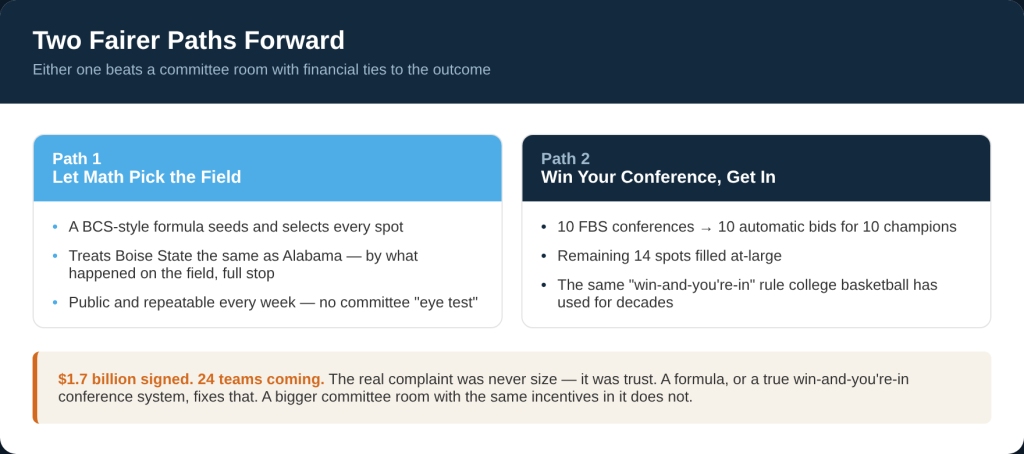
The first is to let a BCS-style formula do what a committee currently does: seed and select the field. Math doesn’t have a TV contract. It doesn’t need to “trust the process” on a two-loss team because of where that team’s logo appears on Saturday afternoons. It treats Boise State, New Mexico, and James Madison exactly the same way it treats Alabama and Notre Dame — by what happened on the field, full stop. Every team would know, in real time, every single week, exactly where it stands and exactly what it needs to do to move up, because the formula is public and repeatable in a way “signature wins” and committee “eye tests” never are.
The second is to borrow directly from how college basketball has run this argument for decades: win your conference, get a guaranteed bid, no committee required. There are 10 FBS conferences today — a number confirmed by the sport’s own unanimous expansion vote this month, which required sign-off from all 10 conferences plus Notre Dame’s administration. 10 automatic bids for 10 conference champions, with the other 14 spots filled at-large, gives every single program in the sport a “win-and-you’re-in” path that it knows on day one of the season, the same deal mid-major and power-conference teams alike have lived with in March Madness forever. It protects the regular season by keeping conference races meaningful even with championship games gone. It removes the committee’s discretion on the bubble, where the financial incentives currently live. And it stops punishing teams like Boise State and New Mexico for the sin of playing in the wrong conference.
The 24-team playoff is coming regardless. The $1.7 billion is signed. The conference championship games are already being mourned in real time. But “bigger” was never the actual complaint college football fans had about its postseason — “untrustworthy” was. A formula, or a true win-and-you’re-in conference system, fixes that. A bigger committee room with the same incentives in it does not.
Photo Credit: REUTERS