
 Share


The ATP hits Paris for a 1000-level event before the 2026 season comes to an end. The Rolex Paris Masters is this week and will be played on an indoor hard court surface, favoring many players with bigger serves. Let’s dive into the big event with betting odds, predictions, stats and analysis below.
Be sure to check out our tennis match trends page for daily odds, trends and insights on each match.
Up to $1,000 Back in Bonus Bets Over First 10 Days*
*Bonus Bets Expire in 7 Days. One New Customer Offer Only. Add’l terms. 21+. Gambling Problem? Call 1-800-GAMBLER or 1-800-MY-RESET
Up to $1,000 Back in Bonus Bets Over First 10 Days*
*Bonus Bets Expire in 7 Days. One New Customer Offer Only. Add’l terms. 21+. Gambling Problem? Call 1-800-GAMBLER or 1-800-MY-RESET
ATP Rolex Paris Masters
Favorite to Win: Carlos Alcaraz +175
Sleeper Pick: Novak Djokovic +1200, Rafael Jodar +1400
ATP Rolex Paris Masters Information
- Dates: November 2 – November 8, 2026
- Location: Paris, France
- Surface: Hard (Indoor)
- Tier: 1000
- Defending Champion: Jannik Sinner
ATP Rolex Paris Masters Odds to Win
| Seed | Country | Player | Odds to Win |
|---|---|---|---|
| 2 | 🇪🇸 | Carlos Alcaraz | +175 |
| 1 | 🇩🇪 | Alexander Zverev | +650 |
| 3 | 🇺🇸 | Ben Shelton | +1100 |
| 11 | 🇺🇸 | Taylor Fritz | +1100 |
| 6 | 🇫🇷 | Arthur Fils | +1200 |
| 10 | 🇷🇸 | Novak Djokovic | +1200 |
| 9 | 🇪🇸 | Rafael Jodar | +1400 |
| 8 | 🇦🇺 | Alex De Minaur | +1700 |
| 4 | Daniil Medvedev | +2000 | |
| 13 | 🇪🇸 | Alejandro Davidovich Fokina | +2200 |
| 🇮🇹 | Lorenzo Musetti | +2800 | |
| 15 | 🇺🇸 | Learner Tien | +2800 |
| 12 | 🇺🇸 | Tommy Paul | +2800 |
| 🇨🇿 | Jiri Lehecka | +3000 | |
| 🇵🇱 | Hubert Hurkacz | +4000 | |
| 7 | 🇺🇸 | Frances Tiafoe | +4000 |
| 🇩🇪 | Jan-Lennard Struff | +5000 | |
| 16 | 🇦🇷 | Francisco Cerundolo | +5000 |
| 5 | 🇮🇹 | Flavio Cobolli | +6000 |
| Karen Khachanov | +6500 | ||
| 🇲🇨 | Valentin Vacherot | +6500 | |
| 🇩🇰 | Holger Rune | +8000 | |
| 🇳🇴 | Casper Ruud | +8000 | |
| 🇫🇷 | Ugo Humbert | +8000 | |
| Andrey Rublev | +10000 | ||
| 🇺🇸 | Alex Michelsen | +10000 | |
| 🇮🇹 | Matteo Berrettini | +12000 | |
| 14 | 🇺🇸 | Brandon Nakashima | +12000 |
| 🇫🇷 | Arthur Gea | +12000 | |
| 🇧🇪 | Alexander Blockx | +12000 | |
| 🇫🇷 | Arthur Rinderknech | +15000 | |
| 🇧🇪 | Zizou Bergs | +15000 | |
| 🇬🇷 | Stefanos Tsitsipas | +15000 | |
| 🇫🇷 | Quentin Halys | +15000 | |
| 🇬🇧 | Cameron Norrie | +20000 | |
| 🇳🇱 | Botic Van De Zandschulp | +20000 | |
| 🇬🇧 | Arthur Fery | +20000 | |
| 🇨🇱 | Alejandro Tabilo | +20000 | |
| 🇨🇦 | Denis Shapovalov | +25000 | |
| 🇮🇹 | Matteo Arnaldi | +30000 | |
| 🇦🇷 | Mariano Navone | +30000 | |
| 🇮🇹 | Luciano Darderi | +30000 | |
| 🇫🇷 | Luca Van Assche | +30000 | |
| 🇫🇷 | Kyrian Jacquet | +30000 | |
| 🇵🇪 | Ignacio Buse | +30000 | |
| 🇪🇸 | Daniel Merida Aguilar | +30000 | |
| 🇦🇷 | Tomas Martin Etcheverry | +30000 | |
| 🇫🇷 | Titouan Droguet | +30000 | |
| 🇫🇷 | Moise Kouame | +30000 |
ATP Rolex Paris Masters Draw
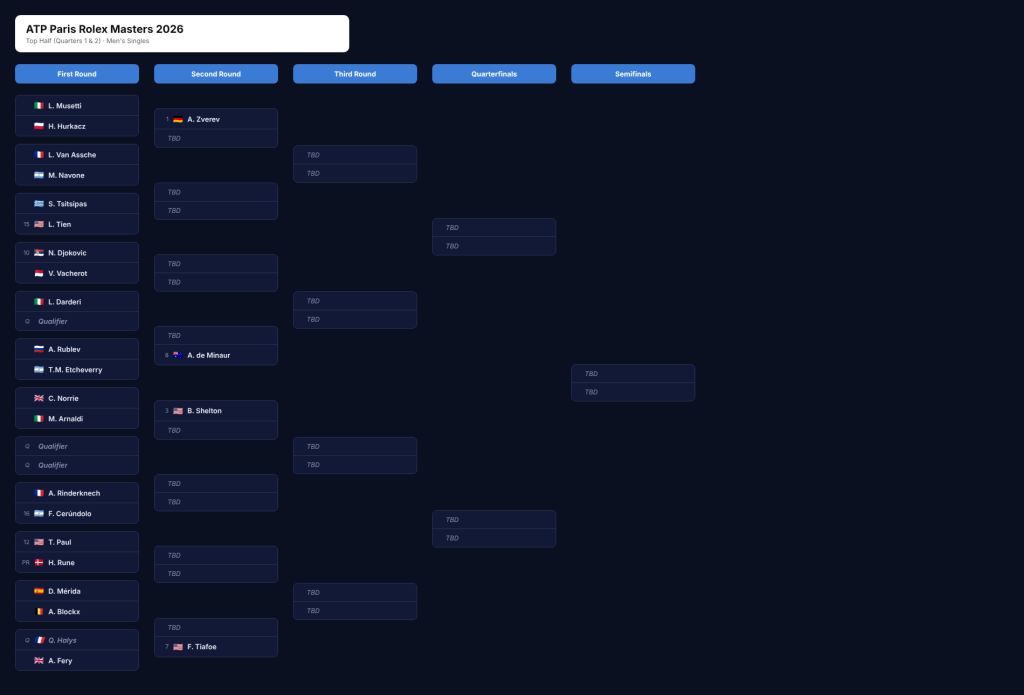
Top Half (Quarters 1 & 2)
Zverev opens with a bye and likely meets Musetti or Hurkacz in round two, but the section’s real intrigue is Djokovic, unseeded for this one and drawn into a bruiser with Vacherot before a potential third-round date with de Minaur. Tsitsipas-Tien and Rublev-Etcheverry add plenty of first-round bite. Shelton gets the free pass while Tiafoe anchors the bottom, but Paul vs. Rune (playing on a protected ranking) is the first-round match to watch, and Cerúndolo has a tricky test against Rinderknech right away. A clean section on paper for the two American seeds if they handle their business.
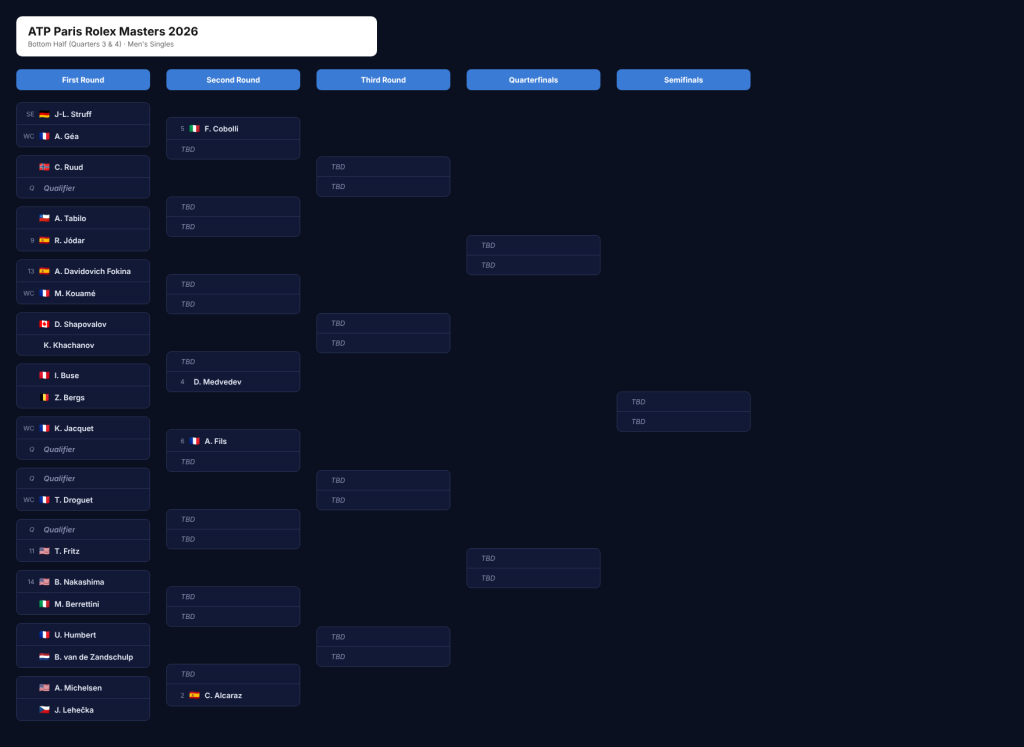
Top Half (Quarters 3 & 4)
Medvedev slots in at the bottom and could see Shapovalov or Khachanov down the line. Struff-Géa and Davidovich Fokina-Kouamé are classic Masters 1000 first-round landmines, with Ruud needing to get past a qualifier just to get started. The headline is Alcaraz working through a loaded back end of the draw, with Lehečka, Michelsen, Humbert, van de Zandschulp and Berrettini all stacked into the bottom quarter. Fils has home crowd support and a relatively open top path, with Fritz and Nakashima the seeded threats in his way.
ATP Rolex Paris Masters Bracket Analysis
Quarter 1 – Deciding Factors
Alexander Zverev’s World No. 1 Ranking vs. Recent Results Late in Events
The data on Zverev’s 2026 season tells a specific story: he’s been good enough to reach the final weekend constantly, but not good enough to win it against anyone playing their best tennis. He’s lost nine semifinals or finals this season — the Australian Open semifinal to Alcaraz, three separate semifinals to Sinner (Indian Wells, Miami, Monte-Carlo), a Madrid final to Sinner, a Wimbledon final to Sinner, semifinal losses to Cobolli (Munich) and Davidovich Fokina (Shanghai), and, most pointedly, a 6-4, 1-6, 7-6(4) semifinal loss to Alex de Minaur in Vienna on Saturday that cost him the chance to claim the world No. 1 ranking this week. His head-to-head against Sinner this year sits at 0-5, with every one of those losses coming at the semifinal stage or later. Layer on a first-round-level exit to Djokovic at the China Open quarterfinal in October, and the picture is of a player who gets to the finish line consistently but tightens up once he’s there. That’s not a reason to pick against him in round one or two of a 56-man draw — his results say he’ll likely still be playing well into the second week — but it is real evidence for fading him the deeper this section goes, particularly against anyone who has already shown they can match his level in a deciding set.
Learner Tien’s Season-Long Résumé vs. Stefanos Tsitsipas’s Hotter Hand
Tien and Tsitsipas play each other in the first round, and the underlying numbers point in different directions depending on which window you look at. Tien’s full-season body of work is the better one on paper — he’s 33-21 (61.1%) with a title in Geneva, a semifinal at the Canadian Open, and quarterfinals at both the Australian Open and Indian Wells — but his form has cooled recently, with just 4 wins in his last 10 matches and a 3-6 record against Top 10 opponents overall. Tsitsipas, meanwhile, has had a far choppier season overall (37-23, with first-round exits at Indian Wells, Rome, and Monte-Carlo, among others) but is playing his best tennis of the year right now, going 7-3 over his last 10 matches with a round-of-16 run at Shanghai and a similar result at Madrid. If recent form matters more than the season-long log line, Tsitsipas is the one of these two in better shape to be the dangerous name a potential Zverev third-round matchup has to account for.
De Minaur’s Statement Win vs. a Djokovic-Vacherot Rematch With History
The bottom half of this quarter carries at least as much weight as Zverev’s own path. De Minaur enters off the best possible form a player could have against this specific opponent — he just beat Zverev in a deciding-set tiebreak in Vienna two days ago, a result that also keeps him in strong position for the season-ending ATP Finals, and he did it after taking a set, losing one, and still closing it out, the exact finishing quality Zverev has been missing all year. Djokovic, drawn against Vacherot in the first round, brings his own recent proof of beating elite competition, having knocked out top-seeded Zverev in the China Open quarterfinal in October in a match multiple outlets described as a rally from behind.
Vacherot is not an easy out for him, either — the Monegasque beat Djokovic in the semifinal of last year’s Shanghai Masters on his way to the title as a 204th-ranked qualifier, even though his 2026 title defense ended in the third round against Tommy Paul and dropped him from No. 14 to roughly No. 32. Whichever of Djokovic or Vacherot comes through that first-round meeting, both have very recent evidence they can beat elite-level opponents, which sets up a potential path to Zverev stacked with players who already have a current-season win over him or a head-to-head data point in their favor
Quarter 2 – Deciding Factors
Ben Shelton’s Serve-and-Forehand Weapon vs. a Return Game That Can’t Keep Up
Shelton’s game starts and ends with two shots: a serve that can look like a “serving clinic” on its best days, drawing directly on the power and explosiveness he built as a football player before switching sports, and a forehand that can end points from almost anywhere on the court. That combination has produced three titles this season — Dallas, Munich, and Stuttgart (the last over Taylor Fritz) — plus an Australian Open quarterfinal, and it travels well to a fast indoor court like Paris.
The return side of the ball, meanwhile, is where the profile breaks down: he won just 34% of return points and broke serve in only 14% of his return games during his 2026 grass-court season, leaving him so dependent on his own serve (a 92% hold rate) that he has little margin if it ever goes cold for a set. His backhand slice sits up high off the bounce, inviting better opponents to step in and take control, and his footwork and shot selection are still catching up to the rest of his game — a byproduct of starting serious tennis at 12 rather than as a young child. Against a lesser returner, that one-weapon approach is often enough. Against anyone who can consistently get his second serve back in play, the lack of a second gear becomes the bigger story.
Frances Tiafoe’s Costly Composure Cracks vs. A Pair of Solid Sleepers Waiting
When Tiafoe is playing well, he’s one of the most watchable shot-makers in the sport — soft hands, improvisational touch, and a game that has historically traveled best on faster hard courts, the exact conditions Paris provides indoors. That shotmaking shows up in his results against the very best when he’s locked in, and at his best this year he’s looked sharp enough to beat anyone on tour on a given day. The issue is what happens when a match gets tight. In his most recent Masters 1000 start, in Shanghai, he lost a third-set tiebreak to Roman Safiullin after a time-violation call at 5-5 appeared to cost him a pivotal point — and his reaction wasn’t just frustration but a public, extended berating of the umpire that continued well after the match ended. That’s not an isolated data point on a player with a 30-22 record and no titles this season despite a Top 20 ranking; it fits a broader pattern of a player whose emotional temperature can spike at exactly the moments that decide close matches. The talent to beat anyone in this section is real. Whether he can keep his composure long enough to use it in a deciding set is the more relevant question.
Both of this section’s sleeper picks have already shown they belong against elite competition, just in very different settings. Fery, a former Stanford All-American now up to a career-high No. 33, rode a wild card to a Wimbledon semifinal this year, beating Flavio Cobolli along the way — proof his game can hold up on the biggest stages when the surface suits him. The concern is how much of that is grass-specific: outside Wimbledon, his 2026 results have been considerably more mixed, with early exits at several other events and only a 1-1 record against Top 10 opponents. Blockx, by contrast, has built his best results specifically at the Masters 1000 level, reaching the Madrid semifinal this year by beating Félix Auger-Aliassime, Francisco Cerúndolo, and Casper Ruud in succession before running into Zverev — a résumé that suggests his game, not just his ranking, is built for exactly this tier of event, backed by a strong 9-3 Masters record in 2026. Neither player has won an ATP title yet, and both carry sub-.500 records against the Top 10 (Fery 1-1 on a small sample, Blockx 1-3), which is the honest caveat on any sleeper pick: the scalps are real, but neither has yet shown he can close out the matches that would be required to do real damage in this section rather than simply cause a single upset.
Quarter 3 – Deciding Factors
Daniil Medvedev’s Return Game vs. Alejandro Davidovich Fokina’s Newfound Composure
Medvedev’s underlying skill set hasn’t disappeared — he still stands unusually deep on return to take full cuts at serves most players are forced to block back, his backhand remains one of the best on tour, and his serve can reach 148 mph when he needs it. That skill set produced three titles this season (Brisbane, Dubai, Hangzhou) and an Indian Wells final. The problem is how often that level simply doesn’t show up: he’s been bagelled four times in 2026, a joint-worst mark on tour, has lost to seven players ranked outside the Top 50, and has reached only two wins over Top 10 opponents all year. The pattern repeated itself most recently in Shanghai, where he lost the semifinal to Rafael Jódar 6-3, 6-4 after a mid-match temper flare-up that Jódar answered with an ace to quiet the crowd. Cobolli and Struff have each already beaten him this year, too — meaning two of the three “hurdles” in this section already have the blueprint for exploiting exactly this kind of lapse. The talent floor here is a former US Open champion; the floor his results actually show is a player who can unravel without much warning.
Davidovich Fokina arrives as the in-form player of this entire section, and arguably the whole tournament. He’s gone from No. 26 to a career-high No. 13 this season on the back of three titles — Mallorca, Chengdu (his first event back from a two-month back injury), and the Shanghai Masters, his first ATP 1000 title — and the way he won Shanghai is the more telling data point: he dropped the first set of the final 1-6, then won a second-set tiebreak and closed it out 6-4 in the third. Beating a top seed (Zverev, in the semifinal, also from a set down) and winning a title after getting bageled in the opening set are not things a mentally fragile player does. The countervailing fact is recent history rather than this season specifically: before this year, he had lost his first five ATP finals, a seven-year wait for his first title that speaks to real past struggles closing matches out. The version of him from the last six weeks has looked like that pattern is broken; this section is the first real test of whether that was a genuine level shift or a hot streak on favorable courts
Jan-Lennard Struff’s Proven Big-Match Upset Game vs. Rafael Jódar’s Two Week Hot Hand
Struff’s game is built to cause one-off problems for better players — a strong serve, a heavy forehand, and a willingness to come forward and finish at net — and he’s shown it can still work at 36, reaching his first career Grand Slam quarterfinal at Wimbledon this year, the oldest player in the Open Era to do so for the first time, and picking up notable wins over Alexander Bublik and, pointedly, Daniil Medvedev, one of the very players lurking in this section. That’s a real, repeatable formula: big server who raises his level against name opponents on a given day. The data that works against him is specific to this event and surface: his 2026 hard-court record sits at just 6-11, his weakest surface by a wide margin, and his career mark against Top 10 opponents is a lopsided 16-52. He has the game to spring a single upset against anyone in this section — he’s already proven it can work against Medvedev specifically — but the surface-specific numbers suggest he’s a live threat for one match rather than a player built to string together the three or four wins needed to get through Cobolli, Ruud, or Khachanov as well.
No one in this draw has a better recent two-week stretch than Jódar. At 20, he beat Casper Ruud in the Shanghai quarterfinal (4-6, 6-4, 6-3) to become the youngest semifinalist in that tournament’s history, then beat Medvedev in the semifinal, before falling to Davidovich Fokina in a final he was competitive in throughout. He’s 15-3 on clay this season and climbed from outside the Top 700 a year ago to a career-high ranking in the teens — one of the fastest rises in recent tour history, built on a 6’3″ frame that should scale well to an indoor hard court. The red flag from that same Shanghai final is physical rather than tactical: he needed a medical timeout for his right thigh at 4-3 down in the third set and treatment for his left thigh at 5-4, the kind of bilateral leg issue that often follows a player into the next event rather than resolving in a week off. Jódar has already beaten one of this section’s three “hurdles” (Ruud) within the last month; whether his legs have recovered from the matches it took to do that is the open question hanging over his Paris run.
Quarter 4 – Deciding Factors
Carlos Alcaraz’s Elite Returning vs. Jiri Lehecka’s Service Hold Game
The single most relevant stat for this exact matchup has nothing to do with Lehečka himself — it’s how elite Alcaraz’s return game has become. Tracking data from this season shows he gets more first serves back in play than all but four players on tour and wins a higher share of those return points than almost anyone in the sample, a combination with essentially no tradeoff: he isn’t sacrificing return quality for return volume or vice versa. The clearest illustration is what he did to Djokovic at this year’s Australian Open, holding him to 65.9% of first-serve points won — a figure so low for an elite server that it’s been described as turning Djokovic into a journeyman on serve for that match.
Lehečka’s path to an upset runs directly through holding serve consistently against exactly that kind of return pressure, and his own game doesn’t have a clear answer for it: his best results this season have come at a Miami Masters final and a Wimbledon fourth round, but his only previous meeting with Alcaraz — a 2025 US Open quarterfinal — ended in straight-set-adjacent fashion, a three-set loss. Nothing in Lehečka’s statistical profile suggests he has a service weapon capable of consistently beating the single best return game in the sport, which is the specific swing factor his own numbers would need to overcome.
Arthur Fils’ Serve That’s Become a Weapon vs. Taylor Fritz’s Elite Serve-Forehand Combination
Fils’s 2026 breakthrough is traceable to one specific improvement: his serve. He’s won 86.8% of his service games this season, up from an 82% career mark, driven by a second-serve-points-won rate that jumped from 51% for his career to 56.4% this year — the difference between a vulnerable second shot and a genuine weapon. He’s also, notably, in the same elite tier as Alcaraz as a returner, one of only a handful of players on tour who both get an above-average number of serves back and win an above-average share of those points. That two-way profile — excellent server, excellent returner — is as complete a statistical picture as anyone in this section carries. The flip side shows up in his own loss column: in every one of his nine losses this season, he’s lost serve at least three times, and none of those matches went to a deciding set, meaning his results are almost entirely downstream of whether his serve holds up on a given day. When the hold rate is where it’s been all year, he’s a legitimate threat to anyone in the draw; the moment that number regresses toward his career norms, the results follow it down just as fast.
Fritz’s identity is built on two shots doing nearly all the work: a serve that touches 149 mph and a forehand hit with a grip so extreme it’s been described as “bordering on Hawaiian,” generating the power and sharp cross-court angles that let him end points outright. Pair that with a flat, low two-hander off the backhand side that he can hit aggressively from either wing, and the result is a textbook offensive baseliner who has been a fixture in the Top 15 for two years, including a Wimbledon quarterfinal this season. What’s less present in his profile, by comparison to Fils or Alcaraz in this same quarter, is an elite return game — nothing in his data suggests he belongs in that same tier of players who neutralize serve as a weapon the way they do. That makes his formula more one-directional: control points behind his own serve and forehand, rather than consistently winning points on both sides of the ball. Against a server who can match his pace, that leaves him without the second avenue to pull away that the two best returners in this section both have.
Photo Credit: REUTERS