
 Share


The WTA has two more events before the finals in Indian Wells, with the Hong Kong Open and the Chennai Open rounding out a fantastic 2026 regular season of women’s tennis. Let’s go through the final two events on the 2026 calendar with odds, picks and analysis below.
Be sure to check out our tennis match trends page for daily odds, trends and insights on each match.
Up to $1,000 Back in Bonus Bets Over First 10 Days*
*Bonus Bets Expire in 7 Days. One New Customer Offer Only. Add’l terms. 21+. Gambling Problem? Call 1-800-GAMBLER or 1-800-MY-RESET
Up to $1,000 Back in Bonus Bets Over First 10 Days*
*Bonus Bets Expire in 7 Days. One New Customer Offer Only. Add’l terms. 21+. Gambling Problem? Call 1-800-GAMBLER or 1-800-MY-RESET
WTA Hong Kong Open
Favorite to Win: Alexandra Eala +500, Leylah Fernandez +550
Sleeper Pick: Paula Badosa +1000; Talia Gibson +1800
WTA Hong Kong Open Information
- Dates: November 2 – November 8, 2026
- Location: Hong Kong
- Surface: Hard
- Tier: 250
- Defending Champion: Victoria Mboko
WTA Hong Kong Open Odds to Win
| Seed | Country | Player | Odds to Win |
|---|---|---|---|
| 2 | 🇵🇭 | Alexandra Eala | +500 |
| 3 | 🇨🇦 | Leylah Fernandez | +550 |
| 4 | 🇬🇷 | Maria Sakkari | +600 |
| 1 | 🇷🇴 | Sorana Cirstea | +700 |
| 7 | Liudmila Samsonova | +850 | |
| 🇪🇸 | Paula Badosa | +1000 | |
| 🇨🇿 | Tereza Valentova | +1200 | |
| 6 | 🇨🇳 | Xinyu Wang | +1400 |
| 5 | 🇦🇺 | Talia Gibson | +1800 |
| Aliaksandra Sasnovich | +1800 | ||
| 🇦🇺 | Maya Joint | +2200 | |
| 🇺🇸 | Katie Volynets | +2500 | |
| 8 | 🇬🇧 | Katie Boulter | +2500 |
| 🇺🇸 | Sofia Kenin | +3000 | |
| 🇺🇦 | Dayana Yastremska | +3000 | |
| 🇺🇸 | Alycia Parks | +3500 | |
| 🇨🇭 | Viktorija Golubic | +4000 | |
| 🇺🇸 | Mary Stoiana | +4000 | |
| 🇭🇷 | Antonia Ruzic | +4000 | |
| 🇹🇷 | Zeynep Sonmez | +5000 | |
| Tatiana Prozorova | +5000 | ||
| 🇺🇿 | Maria Timofeeva | +5000 | |
| 🇯🇵 | Himeno Sakatsume | +5000 | |
| 🇺🇸 | Claire Liu | +5000 | |
| 🇦🇺 | Maddison Inglis | +6500 | |
| Alina Charaeva | +6500 | ||
| 🇺🇦 | Oleksandra Oliynykova | +10000 | |
| Alexandra Shubladze | +10000 | ||
| Elena Pridankina | +12000 | ||
| 🇺🇸 | Carol Young Suh Lee | +15000 | |
| 🇺🇸 | Venus Williams | +25000 | |
| 🇭🇰 | Adithya Karunaratne | +25000 |
WTA Hong Kong Open Draw
Top Half (Quarters 1 & 2)
Sorana Cirstea enters Hong Kong as the No. 1 seed and the top name in the brackets. She gets Maria Timofeeva first and an American in the Second Round, should she advance. Other seeds include No. 3 Leylah Fernandez, No. 8 Katie Boulter and No. 7 Liudmila Samsonova. It will be interesting to see how Fernandez fares after a couple of long and grueling weeks prior to this event.
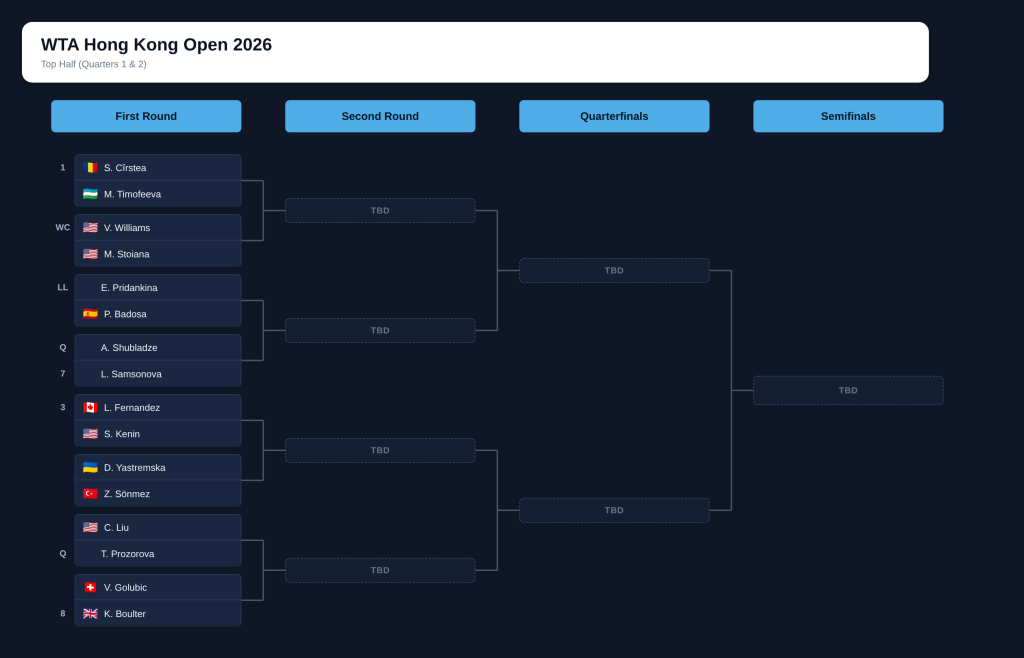
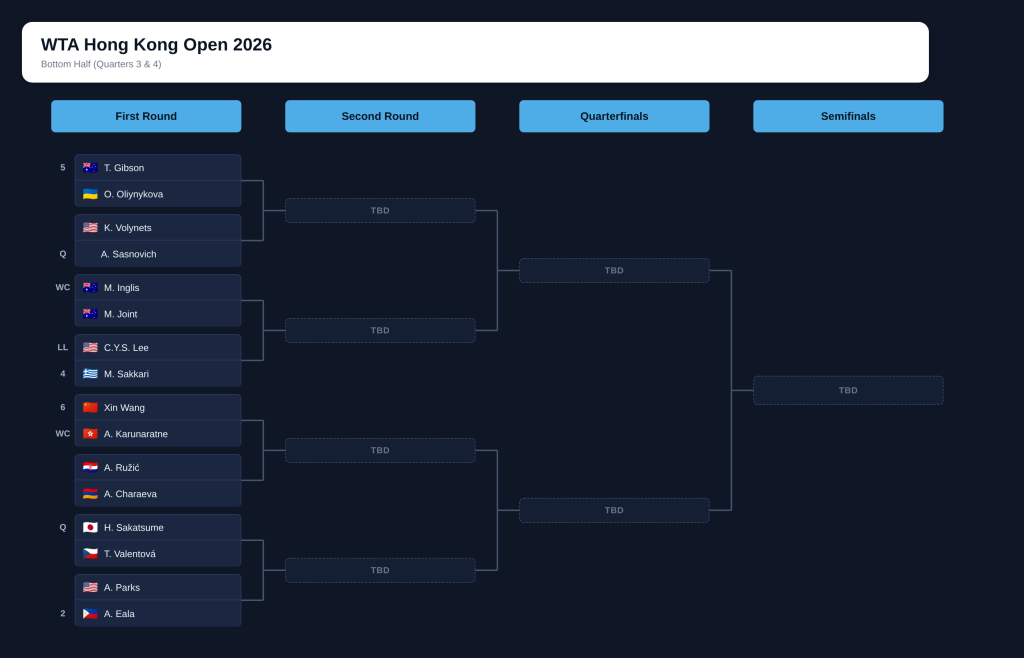
Bottom Half (Quarters 3 & 4)
No. 2 seed Alexandra Eala is looking to have a bounce back performance this week, but gets a tough Alycia Parks in the First Round match. Some other seeds in this half include No. 5 Talia Gibson, No. 4 Maria Sakkari and No. 6 Xinyu Wang. There are many names to watch in this half including Maya Joint, Alina Charaeva, Tereza Valentova and the winner of Katie Volynets vs. Aliaksandra Sasnovich in the First Round.
WTA Hong Kong Open Bracket Analysis
Quarter 1 – Deciding Factors
Sorana Cirstea’s Career-Best Season vs. Her Form Since Flushing Meadows
Cirstea’s 2026 season is comfortably the best of her 15-year career, and it’s the resume that makes her an obvious No. 1 seed in a field this thin: a 33-14 record, a title at the Transylvania Open (a 6-0, 6-2 beatdown of Emma Raducanu), a run to the Italian Open semifinals that included a 2-6, 6-3, 7-5 upset of world No. 1 Aryna Sabalenka, a French Open quarterfinal, and a gutting third-set tiebreak loss to Linda Noskova (6-2, 3-6, 7-6(9)) at Wimbledon that was closer than the scoreline of most of her other losses all year. That run pushed her to a career-high ranking of No. 15, and at a depleted WTA 250 missing every top-10 player to the Finals in Indian Wells, the numbers say she should be favored to play deep into the week against a field anchored by qualifiers, wildcards and a lucky loser.
The flip side, though, is that Cirstea’s game has come apart specifically on the hard courts she’s about to play on again. She was blown off the court by Karolina Muchova 6-2, 6-3 at the China Open, needed to erase a 1-3 third-set deficit just to get past world No. 83 Claire Liu 7-5, 4-6, 6-3 at Ningbo, and then — as the No. 12 seed — was bounced in the first round at Wuhan by Chinese wildcard Guo Hanyu, ranked outside the top 200, 1-6, 7-6(6), 7-5 after winning the opening set 6-1. That’s three straight Asian hard-court results where she either lost outright or barely survived a three-setter, the exact format (best-of-three, outdoor hard) she now faces again. Her round-one opponent, Maria Timofeeva, is unremarkable on paper at world No. 98, but she’s 2026’s busiest title-collector on the lower tours (Istanbul 125, Makarska and Chiasso ITF crowns) and already beat Heather Watson this year at Wimbledon — the same Heather Watson who just ended Samsonova’s week in Tokyo qualifying. If Cirstea’s Wuhan hangover shows up again in round one, the top of this draw is far more open than a No. 1 seed in a 250 event should ever allow.
Paula Badosa’s Second-Half Resurgence vs. Liudmila Samsonova’s Free Fall Into Hong Kong
Badosa arrives unseeded at world No. 61 — a steep drop from her 2022 peak of No. 2 — but the ranking lags well behind the form. Since Wimbledon, she’s gone quarterfinal-or-better in five of seven non-major events: the Nordea Open title in Båstad, a runner-up finish in Iași (retired trailing Mayar Sherif), a Hamburg quarterfinal, a São Paulo semifinal (wins over Mikulskyte, Ortenzi and Stoiana), and a Guangzhou quarterfinal just last week, where she took the first set 6-3 off Harriet Dart before the match slipped away 2-6, 4-6 amid 10 double faults. She also beat a ranked-above-her Daria Kasatkina in three sets at the China Open before falling to Ostapenko. It’s an inconsistent run, but a clearly upward-trending one for a player who was outside the top 100 as recently as the spring, and she opens against lucky loser Elena Pridankina.
Samsonova, meanwhile, is sliding in the opposite direction at the worst possible time. The seventh seed has fallen to world No. 43 — down from a 2026-opening ranking in the high teens and a career-high of No. 12 — and sits on a losing 21-26 record for the season. Her last five results: a three-set 2R loss to Muchova at the China Open, a win over Siniaková immediately erased by a three-set loss to Svitolina at Wuhan, a straight-sets first-round exit to Lilli Tagger at the Japan Women’s Open, and, most alarmingly, a first-round qualifying loss to Heather Watson 6-2, 5-7, 6-7(3) at the Pan Pacific Open barely a week before Hong Kong — a qualifying-round defeat for a player seeded No. 7 here. If Badosa gets past Pridankina and Samsonova can’t solve qualifier Alexandra Shubladze, their projected second-round meeting would pit the hottest hand in the section against a player who just lost in Tokyo qualifying, a matchup the seeding numbers alone badly undersell.
Quarter 2 – Deciding Factors
Leylah Fernandez’s Historic Six-Week Surge vs. the Toll of Three Straight Finals
Outside Fernandez, this quarter is as wide open as any section in the draw — which is exactly the problem for everyone else, because no player in the 32-woman field is playing better tennis right now. Since mid-September, the No. 23-ranked Fernandez has reached three straight finals across three different countries: she won the Singapore Tennis Open outright (beating No. 1 seed Mirra Andreeva 6-2, 7-5 in the semifinal before routing Talia Gibson 7-5, 6-0 in the final), fell in the Ningbo Open final to Elena Rybakina, and advanced to Sunday’s Toray Pan Pacific Open final in Tokyo against Diana Shnaider. Along the way she’s beaten Elise Mertens twice in three weeks (2-6, 6-3, 7-5 over the then-No. 7 seed at Ningbo; 6-2, 7-6(10-8) over the No. 5 seed in Tokyo), avenged an earlier China Open loss to Kamilla Rakhimova with a 7-5, 6-3 win in the Tokyo semifinal, and drew a walkover past world No. 1 Rybakina in that same round when Rybakina withdrew with a neck injury. It’s the kind of six-week stretch — repeatedly matching up with and beating top-10-caliber players — that makes her the clear gravitational favorite in an otherwise toss-up section.
The flip side, though, is pure workload math. Fernandez played Sunday’s Tokyo final roughly 36 hours before Hong Kong’s first round begins, capping a stretch that has sent her through five tournaments (Singapore, Beijing, Wuhan, Ningbo, Tokyo) and at least 19 tour-level matches since mid-September, including a three-set slog over Aliaksandra Sasnovich (7-5, 6-7(3-7), 6-3) just ten days ago. The one time in this run she ran into elite resistance in a final, she didn’t just lose to Rybakina in Ningbo — she was blanked in straight sets, 2-6, 2-6, suggesting the tank does eventually hit empty. Her round-one opponent in Hong Kong, former Australian Open champion Sofia Kenin, has nothing to lose as the lower-ranked player and has made a career out of punishing opponents who look even a step slow. If the legs aren’t there after Tokyo, this is exactly the kind of letdown spot where a three-final heater goes cold.
Dayana Yastremska’s Match-Point Escapes vs. Zeynep Sönmez’s Decider-Set Collapses
Yastremska is the significantly lower-ranked player here at No. 103 against Sönmez’s No. 59-to-67 range this year, but she’s arguably been tennis’ most dramatic closer over the past two weeks. In the same week in late October, she saved five match points in a qualifying-round win and then saved five more against her close friend and the No. 8 seed, Katie Volynets, in the Guangzhou first round — erasing a 5-2 third-set deficit, saving a game point for Volynets to serve out the match twice more, then rallying from 4-1 down in the tiebreak to win 7-5, 1-6, 7-6(7) on her fourth match point. She also won the Emilia-Romagna Open 125 title in Parma over Barbora Krejčíková this year and has banked tour-level reps all fall in Beijing (third round), Wuhan (beat Cristina Bucsa before falling to Iva Jovic) and Guangzhou (fell to wildcard Han Shi). A player who just saved ten combined match points in a single week clearly isn’t rattled by a dogfight.
Sönmez, meanwhile, carries the better ranking into this one but a specific, repeated flaw: she’s lost in deciding sets to the same player, Yulia Putintseva, twice this season — 2-1 in the third round of the Australian Open, and again 2-1 (7-6, 3-6, 5-7) in the first round at the Wuhan Open on October 13 — both times as the higher-ranked player who couldn’t close it out. That’s precisely the kind of third-set collapse Yastremska is built to punish right now. If this one goes three sets, as both players’ recent form suggests it will, the data points toward Yastremska finding a way through rather than the more accomplished but shakier-closing Sönmez.
Katie Boulter’s Clean Sweep of Golubic vs. the Red Flags Standing Between Her and Fernandez
The No. 8 seed Boulter, currently ranked No. 58 and squarely back in the British No. 1 conversation, has already beaten Viktorija Golubic twice this year without dropping a set: 6-2, 6-2 en route to the Ostrava Open title, and again in the Japan Open round of 16 on October 21, winning 89% of her first-serve points, saving the only break point she faced, and ripping off nine straight games after the set opened 2-2. That Japan Open run kept going — she reached the semifinals by surviving a three-set war with Antonia Ruzic, dropping the opener, grinding through a stretch of three straight breaks in the second set, then reeling off eight games in a row to build a 4-0 third-set lead before closing it out. The result reclaimed the British No. 1 ranking from Sonay Kartal and gave her a second signature hard-court run in three months.
The flip side is twofold. First, Boulter’s game has a documented habit of coming apart with no warning: at this year’s US Open, she lasted just 58 minutes in a straight-sets loss to Karolina Muchova, piling up eight double faults and 22 unforced errors in what analysts called a “mental breakdown,” with Boulter herself admitting afterward, “I let things distract me.” Second, even a clean win over Golubic likely doesn’t get her to Fernandez — her projected second-round opponent is the winner of Claire Liu (a career-best No. 95 as recently as October 19) and Tatiana Prozorova, arguably the hottest floater in the entire draw after storming from world No. 180 to No. 123 this fall by upsetting No. 18 seed Alexandra Eala from a set and a break down (4-6, 7-5, 6-3) on her way to the Singapore Open semifinals, her first tour-level quarterfinal or better. If the US Open version of Boulter’s serve shows up, or if Prozorova’s Singapore magic travels to Hong Kong, the presumed Boulter-Fernandez quarterfinal never happens.
Quarter 3 – Deciding Factors
Maria Sakkari’s Top-Flight 2026 Résumé vs. Maya Joint’s Rollercoaster Season
The data says both should get through round one, and if they do, Sakkari is the clear stats favorite in a projected second-round meeting. The No. 4 seed is currently No. 30 and in the middle of arguably her best season in years: she reached the Qatar Open semifinals by beating world No. 1 Iga Świątek and sixth seed Jasmine Paolini, then made the Athens Open final in July (wins over Harriet Dart, Alycia Parks and Alina Korneeva before falling to Barbora Krejčíková), good for a 6-4 record across her four Grand Slam appearances this season. She opens against a qualifier in what’s been described as the kindest draw assignment in the field, and she said heading in that she’s “played some of my best tennis up until today.” That’s a full season of beating legitimate top players, not a hot two-week stretch.
Joint, meanwhile, has had a genuinely bizarre year — an 11-match losing streak around Eastbourne in June dropped her out of the top 80 entirely, leaving her 3-10 in tracked tournaments through August. But she’s a different player heading into Hong Kong: she reached the Korea Open final last month (losing a decider 6-4, 6-2 to Kim Birrell) and, just last week in Tokyo, beat Sorana Cirstea and Cristina Bucsa to reach the Pan Pacific Open quarterfinals. Her round-one opponent, wildcard Maddison Inglis, is ranked outside the top 150, so the data favors Joint cleanly in round one as well. But stacked against Sakkari’s full body of work this year — including a win over a reigning world No. 1 — a player who was outside the top 80 three months ago doesn’t have the résumé to be favored in round two.
Talia Gibson’s Top-20 Scalp Collection vs. Her Falling Apart When the Stakes Peak
The No. 5 seed has climbed from No. 112 to a career-high No. 37 this year by picking off seven top-20 players: No. 7 Jasmine Paolini, No. 11 Ekaterina Alexandrova and No. 17 Clara Tauson at Indian Wells (Paolini was her first-ever top-10 win), No. 15 Naomi Osaka and No. 17 Iva Jovic at Miami, Zheng Qinwen at Nottingham, and a seeded Maria Sakkari at Singapore last month. That’s an outrageous scalp collection for a player who started 2026 ranked outside the top 100, and it’s exactly the profile of a seed built to do damage in a thin 250 draw like this one.
The flip side is that her results get shakier the bigger the stage gets. She reached that Singapore final only after Tatiana Prozorova withdrew from their semifinal on concussion protocol, and once there she was bageled 0-6 in the second set of a 5-7, 0-6 loss to Leylah Fernandez. She also lost in the first round at both the China Open and Wuhan Open — the two WTA 1000-level stops on this same Asian swing — before rebuilding at the Japan Open, where she didn’t drop a set until Ashlyn Krueger (who went on to win the title) beat her in the quarterfinal. The pattern is consistent: brilliant against seeded players in best-of-three 250s and 500s, far less reliable once the standard of competition or the stage jumps. A watered-down Hong Kong field missing every other elite name is about as favorable a setup as Gibson could ask for.
Katie Volynets’s 18-6 Surge vs. the Gibson Gauntlet Waiting on the Other Side
Volynets, No. 74 and red-hot, has won 18 of her last 24 matches dating back to the spring — a stretch covering an Ostrava Open semifinal (beating top seed Tatjana Maria), a Hall of Fame Open 125 final, a Philly Open 125 title (beating Tereza Valentová 6-3, 7-5), a Memphis Classic quarterfinal (beating third seed Viktorija Golubic), and a Korea Open quarterfinal last month (beating eighth-seeded Kamilla Rakhimova). Sasnovich, by contrast, needed two routine qualifying wins (6-4, 6-2 and 6-2, 6-1) just to reach the main draw, sits well outside the top 100, and carries a 3-5 hard-court record dating back to the spring that’s only trended downward since. This one isn’t close on paper.
The catch is what’s waiting on the other side. The winner of this match projects to face No. 5 seed Talia Gibson in round two, and Gibson has beaten seven top-20 players this season, including a seeded Sakkari in Singapore just last month. So yes, the data supports Volynets as a legitimate sleeper through round one — an 18-6 run over six months isn’t something to wave off in a depleted 250 field — but it does not support her as a good bet to get past round two, since her very next assignment is arguably the form player in the entire bottom half of the draw.
Quarter 4 – Deciding Factors
Alexandra Eala’s Season-Long Resume vs. Her Collapsing From a Set Up
Eala arrives in Hong Kong as the No. 2 seed off the best season of her career, one that pushed her to a career-high No. 18 in late August before a one-spot slide to her current No. 19. The resume behind that ranking is substantial: a maiden WTA title in Washington, a 125-level title in Birmingham, quarterfinal runs at both Wimbledon and the US Open, and a bronze medal won as the No. 1 seed at the Asian Games. On paper, a seed with that body of work and a bye into the second round should be favored to win the two matches needed to represent this section in the semifinals, likely facing Alycia Parks first and either Tereza Valentova or Hanyu Sakatsume next.
The last six weeks, meanwhile, tell a different story. Eala has now lost three straight matches after leading by a set — in the Singapore Open round of 16 as the No. 3 seed, in the Asian Games, and most recently in the opening round of the Wuhan Open to a 217th-ranked Chinese qualifier, a season-low result that came in a draw that had opened up after a top seed’s withdrawal. Both of her projected Hong Kong opponents already have a hand in that recent slide in form: Parks beat her in a three-set thriller on tour debut at the Australian Open, and Valentova has now beaten her twice in six months, most recently in Doha by out-hitting her 22 winners to 12 after erasing a first-set tiebreak deficit. A seed with that much mileage already logged this season and that specific a pattern of blown leads will need to show it can close a set, not just win one, before the data backs her to escape this section.
Xinyu Wang’s Big-Match Resume vs. Her Middling 2026 Floor
As the No. 6 seed, Wang brings the most eye-catching ceiling of anyone in this section. Her 2026 includes a run to the Australian Open fourth round, where she beat No. 24 seed Jelena Ostapenko and No. 13 seed Linda Noskova before falling to eventual quarterfinalist Amanda Anisimova, and a final at the Auckland Classic in which she beat Alexandra Eala en route before losing to Elina Svitolina. She also carries one of the better recent scalps in the field: a 2025 run to the Berlin Open final in which she beat No. 2 seed Coco Gauff and No. 8 seed Paula Badosa back-to-back before falling to Marketa Vondrousova. Against a Karunaratne-level opener and a Ruzic-Charaeva winner projected next, that kind of pedigree is exactly what a section favorite needs to have banked.
Her underlying ranking trend, meanwhile, has been far choppier than one or two marquee results suggest. Wang peaked at a career-high No. 30 in February, slid as low as No. 52 by late June, and has only worked her way back to No. 39 by late October — still nine spots shy of her season-best mark eight months on. Her overall 2026 log sits at a break-even 25-24, the profile of a player whose signature wins have been offset just as often by early exits at comparable events. A seed carrying a .500 record into the back half of the season is not the kind of form line that makes her the clear pick to win two rounds and represent this section, whatever the ceiling she flashed in Melbourne and Auckland says she’s capable of.
Alina Charaeva’s Beijing Breakthrough vs. the Ranking Gap Still Between Her and a Run
Charaeva’s case for making noise in this section starts with the single best result anyone in the Hong Kong field produced all season: a 3-6, 6-4, 6-3 upset of newly minted World No. 1 Elena Rybakina in the second round of the China Open in Beijing, a win that made the then-No. 118 Charaeva just the ninth player outside the Top 100 to beat a reigning No. 1 since WTA rankings began in 1975, and the lowest-ranked player ever to do it from a set down. That result came during a season that also included Charaeva’s first WTA 125 title, in Midland in February, and her first two tour-level quarterfinals, in Hamburg and São Paulo — a trajectory of a player getting progressively more comfortable at a higher level, at 24, in only her 17th tour-level main draw match.
The road back to that level, meanwhile, runs first through Antonia Ruzic, a No. 84-ranked, clay-tested Croatian with a losing 23-28 record of her own this season, before a projected meeting with the far more battle-tested Xinyu Wang. The larger question is not whether Charaeva can produce a signature win — Beijing already answered that — but whether a result built on one extraordinary afternoon against a player she will not see again in this draw transfers to a hard court in Hong Kong three-plus weeks later, against a sixth seed who has already beaten two seeded players and a former Auckland finalist runner-up this season. If the Beijing form was a glimpse of a permanently higher level rather than a one-tournament peak, Charaeva has the recent data to make this section’s biggest story twice in two months.
WTA Chennai Open
Favorite to Win: Lilli Tagger +440, Janice Tjen +550
Sleeper Pick: Magda Linette +1200, Katarzyna Kawa +1600
WTA Chennai Open Information
- Dates: November 2 – November 8, 2026
- Location: Chennai, India
- Surface: Hard
- Tier: 250
- Defending Champion: Janice Tjen
WTA Chennai Open Odds to Win
| Seed | Country | Player | Odds to Win |
|---|---|---|---|
| 2 | 🇦🇹 | Lilli Tagger | +440 |
| 1 | 🇮🇩 | Janice Tjen | +550 |
| 🇺🇸 | Robin Montgomery | +850 | |
| 🇮🇹 | Lucrezia Stefanini | +900 | |
| 3 | 🇵🇱 | Magda Linette | +1200 |
| 🇨🇭 | Simona Waltert | +1600 | |
| 8 | 🇵🇱 | Katarzyna Kawa | +1600 |
| 5 | 🇹🇭 | Mananchaya Sawangkaew | +1600 |
| 7 | Anastasia Zakharova | +1800 | |
| 🇬🇧 | Harriet Dart | +2000 | |
| 6 | 🇺🇿 | Polina Kudermetova | +2200 |
| 🇸🇰 | Rebecca Sramkova | +2500 | |
| 🇷🇸 | Teodora Kostovic | +2500 | |
| 🇨🇭 | Jil Teichmann | +2500 | |
| 🇹🇼 | Joanna Garland | +2700 | |
| Polina Iatcenko | +3000 | ||
| 🇯🇵 | Mai Hontama | +3500 | |
| 4 | 🇭🇺 | Panna Udvardy | +3500 |
| 🇫🇷 | Elsa Jacquemot | +4000 | |
| 🇯🇵 | Moyuka Uchijima | +5000 | |
| 🇨🇿 | Linda Fruhvirtova | +7000 | |
| 🇬🇧 | Jodie Burrage | +8000 | |
| Oksana Selekhmeteva | +8000 |
WTA Chennai Open Draw
Top Half (Quarters 1 & 2)
Janice Tjen enters as the No. 1 seed and the top of Quarter 1, the defending champion at this very event. Below her, seeded players include No. 6 Polina Kudermeetova, No. 4 Panna Udvardy and No. 8 Katarzyna Kawa. Harriet Dart is the sleeper to watch as she is coming off a handful of impressive weeks, including a title in Guangzhou.
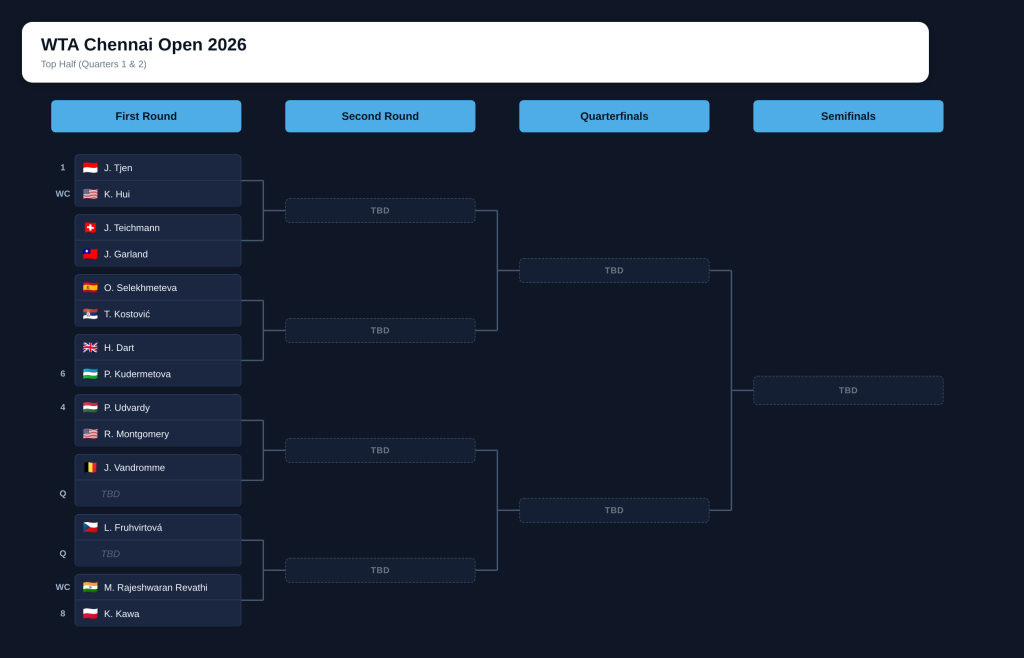
Bottom Half (Quarters 3 & 4)
No. 2 seed Lilli Tagger is the top name in the bottom half of the draw, nestled in Quarter 4 after a stellar run in Guangzhou that saw her lift the runner-up trophy. Other seeded players here include No. 3 Magda Linette, No. 7 Anastasia Zakharova and No. 5 Mananchaya Sawangkaew. The opening round match between Moyuka Uchijima and Rebecca Sramkova is one to watch, as well.
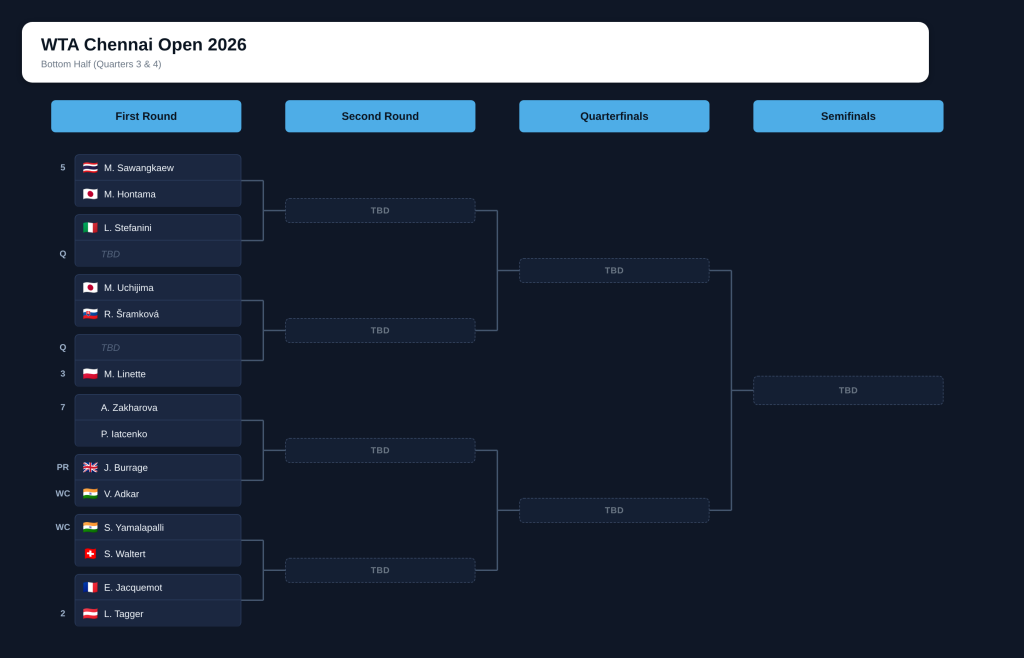
WTA Chennai Open Bracket Analysis
Quarter 1 – Deciding Factors
Janice Tjen’s Title Defense vs. Jil Teichmann’s Quiet Guangzhou Surge
Tjen returns to Chennai as the No. 1 seed and defending champion, the player whose 6-4, 6-3 win over Kimberly Birrell last November was both her maiden WTA singles title and the result that launched her to a career-high ranking of No. 35 this past August. As the top seed with a first-round bye past the qualifying rounds, the data suggests she should be favored to work past Katherine Hui in round one and set up a projected second-round meeting with the winner of Jil Teichmann and Joanna Garland for a spot in this section’s quarterfinal.
Teichmann, meanwhile, is the sleeper this section’s numbers point to. Since returning in April from a seven-month mental-health break that dropped her from a career-high No. 21 down to outside the Top 200, the Swiss left-hander has gone 14-9, a run that includes her ninth career win over a Top 10 opponent — a comeback from 5-1 down in the second set to beat Karolina Muchova at Roland Garros — and, just last week in Guangzhou, a three-set win over No. 64 Zeynep Sonmez that continued her climb back into the Top 170. Tjen’s own recent log cuts the other way: since mid-September she has failed to reach a quarterfinal in five straight tournaments, losing in Guadalajara in a pair of tiebreaks to Sloane Stephens, getting blown out 0-6, 4-6 by Diana Shnaider in Beijing, falling in the Wuhan third round to Ann Li, exiting in the Osaka first round to Ashlyn Krueger, and most recently losing in three sets to Harriet Dart in Guangzhou. If Teichmann gets past Garland, the top seed’s path to a repeat runs through a player who, ranking aside, has looked considerably more dangerous over the past month than Tjen has.
Harriet Dart’s Guangzhou Breakthrough vs. the Workload Behind It
Dart arrives in Chennai on the back of the best week of her career. Entering Guangzhou as a qualifier ranked outside the Top 100, she beat No. 2 seed Janice Tjen in three sets, No. 5 seed Paula Badosa, and Sun Xinran — saving three match points in that semifinal — before closing out her maiden WTA title by coming back from a set down to beat 18-year-old Lilli Tagger 4-6, 6-3, 6-4 in Sunday’s final, a result that lifted her back into the Top 100 for the first time in years. Four main-draw wins over four different styles of opponent, capped by a match-point save and a comeback final, is as complete a week of data as anyone in this section can point to.
The cost of that run, meanwhile, is the obvious counterweight. Dart played through qualifying and five main-draw matches in Guangzhou, several of them three-setters, and now heads straight into the very next tournament on the calendar with no real rest and a brand-new level of expectation attached to her name. A potential quarter path that includes Polina Kudermetova in round one and a projected immediate rematch with Tjen — the player she just needed three sets to beat a week earlier — asks her to back up a career-best week on a short turnaround rather than simply build on it. Whether the title serves as momentum or as a bill that comes due in Chennai is likely to decide how far she carries this run.
Quarter 2 – Deciding Factors
Panna Udvardy’s Thin Hard-Court Résumé vs. Robin Montgomery’s Double-Fault Problem
Udvardy’s game has always been built on raw power — a heavy serve and forehand that can take a match away from an opponent in a hurry — and she’s shown she can fight from the back foot when it’s working, having rallied from 6-1, 3-0 down against Katarzyna Kawa in a past meeting. The problem for a hard-court event like Chennai, meanwhile, is that her 2026 season has been almost entirely a clay story: she’s 6-4 on clay this year, with a runner-up finish at the Copa Colsanitas and a semifinal in Rabat, against just 1-3 on hard courts. Her hard-court numbers haven’t been a blip, either — she carries a 1-12 Grand Slam singles record and has never beaten a Top 10 player, both patterns that track with a power game that gets neutralized on a faster, lower-bouncing surface against opponents who can redirect her pace. The seeding says she should be favored in this section; the surface-specific data says that’s far from guaranteed.
Montgomery is the player in this section whose game is most naturally built for a hard court — her camp describes her left-handed, 5’10” frame as suited to “aggressive baseline tennis and quick movement” on exactly this surface, and her results back it up more than her ranking suggests. Working back from injury in 2026, she qualified into the Rosmalen/Libéma Open in June and won four real matches to reach her first WTA final, including a come-from-behind, three-set win over Daria Kasatkina. Over her last ten matches she’s won six, holding serve at a 66% clip behind a 63% first-serve rate — solid baseline numbers for a player finding her form again. The flip side, meanwhile, shows up in that same data set: a notably high double-fault count, the kind of free-point leakage that can undo an otherwise sound service game against a returner who makes her play an extra ball. If she keeps the unforced errors on serve in check, her surface fit alone makes her a live threat to go further than her ranking indicates.
Linda Fruhvirtova’s Proven Chennai Pedigree vs. Katarzyna Kawa’s Career-Best Form
Fruhvirtova actually won this exact tournament once before, taking the Chennai title in 2022 at 17 to become the first player born in 2005 to win a WTA crown, and her camp’s current scouting report is still a flattering one — her coach points to increased pop on her groundstrokes, a low unforced-error count, and a competitor who “gives 100% every time she steps on a court.” What’s missing in 2026, meanwhile, is recent match volume and results to match that profile: she’s played just a handful of tour-level matches with a 3-4 record, including a second-round finish at the Australian Open and a first-round exit in Miami, and nothing since to suggest she’s built any real rhythm. The scouting notes also flag that she’s “a little less powerful and less aggressive” than her younger sister Brenda and can get rattled into improvised shot-making when pushed off her backhand side. The talent profile that won her this title at 17 is still described as intact; the question is whether a player who has barely competed this season can find her timing against players who’ve been in live matches far more recently.
Kawa is in the best form of her career entering Chennai. She’s already won two titles this season, in Huzhou and Modena, and set a new career-high ranking of No. 106 after qualifying into the Ningbo Open in October and beating fifth-seeded Belinda Bencic — her first win over a Top 20 player — to reach her first WTA 500 quarterfinal. Her backhand has long been described as a genuine weapon, a first-rate two-hander she can lean on in long exchanges, and she’s consistently credited with a fighting spirit that’s produced wins from losing positions. The stylistic gap, meanwhile, shows up on the other side of the ball: her serve has been described as “un-menacing” and her forehand as comparatively “iffy,” meaning she doesn’t have an easy way to end points on her own terms and has to construct them through the backhand and her legs instead. That’s a sustainable formula against players who can’t take the racquet out of her hands, and a much tougher one against someone like Montgomery who can simply out-hit her from the baseline.
Quarter 3 – Deciding Factors
Mananchaya Sawangkaew’s Leaky Service Game vs. Magda Linette’s Elite Return Craft
Sawangkaew’s case for this section starts with the company she’s kept on hard courts specifically — she beat Alycia Parks 7-5, 6-0 at Wimbledon this year (grass, but the same quality of opponent she’d need to handle here), and her best 2026 runs have come at Asian hard-court stops, with quarterfinal finishes at the Mumbai Open and the Jiangxi Open. As the No. 5 seed, that kind of résumé against the right level of competition is exactly what’s needed to be the player who represents this quarter. The service game, meanwhile, keeps undercutting that profile: she’s double-faulting on roughly 11% of her service points, her hold percentage sits at just 55%, and break-point conversion on return has been flagged as a recurring issue in her data. That combination has shown up in the results, too — she’s won only four of her last ten matches, including a first-round exit in Guangzhou just days ago to a player ranked outside the Top 400. The quarterfinal pedigree is real; whether she can hold enough service games to get there again this week is the open question.
Linette’s game is built on a skill set that ages well and travels well: her return of serve is a genuine weapon, capable of taking a backhand down the line or a forehand crosscourt off a big first serve, and she backs it with strong court coverage, doubles-honed net play, and the kind of variety — drop shots, slice backhands — that pulls bigger hitters out of rhythm. That all-court craft produced a win over World No. 2 Iga Świątek in Miami this year, proof the game still holds up against the very best. The tradeoff, meanwhile, is that her own serve has never been a weapon — her first serve averages around 95 mph, which means she rarely gets a free point and has to win most service games the hard way, through rallies rather than through the delivery itself. At 34 and five seasons removed from her 2023 career-high of No. 19, now sitting at No. 74, she remains capable of the kind of return-driven upset that beat Świątek; the question in a 250-level draw is whether a lack of first-strike power lets a bigger hitter dictate points before her return game ever gets involved.
Rebecca Sramkova’s Genuine Power Game vs. the Errors That Come With It
Sramkova plays the most aggressive, first-strike style of anyone in this quarter — a big-hitting baseliner whose forehand has been clocked as the fastest groundstroke in at least one tournament final this year, backed by a net game that won 69% of its points in that same match and the kind of composure that let her serve out a title. Her list of career scalps includes a win over then-top-seed Petra Kvitova, evidence the firepower is real against higher-ranked opponents. The cost of that aggression, meanwhile, shows up directly in her shot charts: her forehand, for all its pace, has produced nearly as many errors as winners in big matches, her backhand runs a clear negative margin, and a long injury history — back, shoulder, abdominal, and leg issues — has interrupted her ability to string results together, leaving her at a pedestrian 26-24 this season and No. 142 in the rankings. When the forehand is landing, she can out-hit anyone in this section; when it isn’t, the same shot that creates her winners is just as likely to hand the match back.
Uchijima’s ceiling in this section is defined by one standout result: a win over Jessica Pegula, then the world No. 3, to reach the quarterfinals of a WTA 1000 event in Madrid, a result that showed she can raise her level against the very best when the occasion calls for it. She’s also shown real competitive stubbornness, once saving seven match points to beat Olga Danilović at the US Open, and she’s collected two WTA 125 singles titles this season, in Antalya and Saint-Malo. The floor beneath that ceiling, meanwhile, is considerably less steady — outside of the Pegula result, she’s just 1-6 for her career against Top 10 opponents, she went nearly four months without a tour-level singles win in 2025, and she has never advanced past the second round of a Grand Slam. That’s the profile of a player capable of one big win in a week rather than four in a row, which is precisely what reaching this section’s quarterfinal would require.
Quarter 4 – Deciding Factors
Lilli Tagger’s Guangzhou Pedigree vs. Elsa Jacquemot’s Downward Trend
Tagger is the name to beat in this section on both size and recent output. At 6’1″ with a one-handed backhand — a rarity at this level — she just ran through a 53rd-ranked entry into the Guangzhou final, beating Venus Williams, Magda Linette, Shi Han, and Kaitlin Quevedo before losing a three-setter to Harriet Dart, and that result came on top of a maiden WTA title in Prague in July and a quarterfinal in Linz where she beat Liudmila Samsonova. The specific number that matters against this opponent: Tagger is 6-0 this season against players ranked outside the Top 100, which is exactly where Jacquemot — at No. 101 — currently sits.
Jacquemot, meanwhile, is a counterpunching mover whose game is built around taking the pace an opponent gives her and redirecting it, a style that produced a triple-tiebreak upset of Marta Kostyuk at this year’s Australian Open and a third-round run at the 2025 French Open. The issue is that her season has trended steadily the wrong way since: her ranking has fallen from a career-high No. 53 in February to No. 101 now, and her 2026 record sat at just 2-9 through the Italian Open. A counterpuncher’s game depends on an opponent supplying enough pace to redirect, and Tagger, fresh off generating her own power against far more experienced players in Guangzhou, is not a player who needs to be handed anything. Unless Jacquemot’s form has turned a corner since that 2-9 stretch, the size and ball-striking gap here favors the player who just made a tour final.
Anastasia Zakharova’s All-Surface Résumé vs. Jodie Burrage’s Grass-Built Game
The data leans toward Zakharova as the player more likely to emerge from this half of this quarter. She plays an explicitly aggressive, first-strike baseline style — by her own description, she has always liked hitting the ball hard and seeks out opponents who play the same way — and in 2026 that approach has produced a career-high ranking of No. 65, wins over Donna Vekić and Dayana Yastremska, and runs to the round of 32 at two WTA 1000 events plus a semifinal at the Istanbul 125. She was still competing as recently as mid-October at the Ningbo Open, evidence of a full season’s worth of reps on the exact hard-court surface Chennai is played on.
Burrage, meanwhile, carries the louder individual weapon — a serve capable of piling up aces in bunches, including a 14-ace day that helped her beat Petra Kvitova at Austin — and a genuinely remarkable comeback story, climbing back to No. 149 this season after wrist surgery and a ruptured ankle ligament had pushed her ranking into four figures. What that serve-built game hasn’t done is travel well to hard courts: her career splits show a 9-9 record on grass against just 4-8 on hard, with no main-draw wins at all on clay, a pattern of a player whose free points come easiest on the surface she’ll face the least this week. Between a baseline grinder who has already proven her game works on hard courts in 2026 and a server whose results are tied to a surface she won’t see in Chennai, the stats point to Zakharova as the more likely of the two to reach this quarter’s final.
Photo Credit: REUTERS