
 Share
Share 


Calling all folks and blokes! A convergence of the best golfers in the world across the PGA TOUR, DP World Tour, and LIV Tour brings us to the final Major of 2025. Royal Portrush is set to host the 153rd running of the Open Championship. Royal Portrush is a very new addition to The Open rota, hosting this event for just the third time. It has not been long since we last saw Royal Portrush, however, as it last hosted in 2019.
Ahead, we’ll get the week kicked off with our usual course preview and look at the British Open odds. Click any British Open odds below to place a wager. For more sportsbook promos, we highly recommend checking out the best sports betting sites.
2025 British Open Odds
The 153rd Open Championship
Traditional Links Golf with a Modern Twist
I love everything about The Open. Links golf is golf in its purest form. It rewards thoughtful, strategic, and creative play with true hazards to penalize a reckless bomb-and-gouge approach. In the case of Royal Portrush, we’ll see strategically placed bunkers, gorse bushes, and minuscule greens defining its identity, sitting heavily exposed on the Northern Atlantic coastline. With constant undulations and scarce flat lies in the fairway, this marks a welcomed respite from the “Trackman golf” wave that has taken over modern golf recently, as the removal of pure distance advantage at The Open Championship gives this event a more accessible feel to the field at large compared to the other three majors on the schedule.
Betting The Open
From a golf betting perspective, The Open presents a challenge as one of the most difficult events of the year to use data predictively. The reasons for that include the randomness of weather and its significant effect on certain waves versus others, the absence of any historical ShotLink/Strokes Gained data to model off of, and the fact that links golf is an entirely different animal. Case in point, we have plenty of players in the field whose last 12 rounds have been played across TPC Deere Run, Detroit Golf Club, and TPC River Highlands. That’s not exactly translatable to what lies in store ahead at Royal Troon, so my betting decisions for this week will be more anecdotally based, using stat modeling directionally to guide those decisions.
I expect this recently modernized version of Royal Portrush to continue to reward the top, in-form players from tee to green yet again. I’m looking to isolate accurate drivers and elite approach players with an extensive history of top performances on proper links courses. With Royal Portrush susceptible to high winds and inclement weather, it will be crucial to monitor the weather forecast throughout the week, as is always the case at any British Open.
Without further ado, let’s run through the key facts and info about Royal Portrush ahead of the 2025 British Open. Scroll to the bottom for complete outright odds and to compare prices across the best sportsbooks in your state. Click on any PGA TOUR odds bet now.
British Open Field At A Glance
The field contains 158 players for the 153rd Open Championship. Four spots remain up for grabs between top qualifying finishers at the previous week’s Scottish Open and ISCO Championship. A majority of the field qualified by way of a top-50 Official World Golf Ranking (OWGR) or by a top-30 ranking from the 2024 DP World Tour season.
Sixteen spots were up for grabs in Final Qualifying, which brought added drama for top players, LIV or otherwise, who were blocked out by their diminishing OWGR rank. Lee Westwood, Dean Burmester, Lucas Herbert, and Harry Hall are notables who were on the outside looking in before punching their tickets to Portrush by way of Open qualifying.
Additional qualifying criteria include recent major champions and top placements in the national open championships across international tours, with the next available OWGR-ranked players rounding out the field. This shapes up as the most top-heavy major this year, as every OWGR top-50 player with the exception of Billy Horschel (recovering from injury) will be teeing it up.
DP World Tour, LIV Players In Action
A major hosted by the R&A means a stark difference in the field composition compared to a usual week on the PGA TOUR. From the DP World Tour, the top-30 players in the 2024 Final Race to Dubai Rankings and the first five players on the 2025 Race to Dubai Ranking not otherwise exempt have gained entry into this week’s field. Frankly, the DP World Tour’s continued path as a feeder Tour for top European talent like Ryan Fox, Rasmus Hojgaard, and Antoine Rozner earning full-time membership on the PGA TOUR in recent years offers little hope for the talent left over to measure up to this field at Royal Troon. The top players from the DP World Tour to watch out for this week, however, include Laurie Canter, Thriston Lawrence, Jordan Smith, Kristoffer Reitan, and Haotong Li.
On the LIV side, a total of 19 players have qualified through past exemptions, highlighted by Jon Rahm, Bryson DeChambeau, Brooks Koepka, Joaquin Niemann, Tyrrell Hatton, and Cam Smith to headline as top contenders.
Xander Schauffele completed a storybook season at Royal Troon last year, picking up his second Major championship win of 2024 at this event. Schauffele will look to hoist the Claret Jug for the second time around this week.
Brian Harman, Cam Smith, Collin Morikawa, Shane Lowry, Francesco Molinari, Jordan Spieth, Henrik Stenson, Zach Johnson, Phil Mickelson, Ernie Els, Darren Clarke, Stewart Cink, Louis Oosthuizen, and Padraig Harrington represent the list of former champions back in Northern Ireland this week.
Introduction To Royal Portrush Golf Club
One of the most “modern” venues on the Open rota, Royal Portrush is a departure from the typical centuries-old courses we’ve seen host this historic event. Established in 1888, it was not until 1929 that Portrush put itself on the map as the most renowned golf course in Ireland. That is when Harry Colt, one of the greatest golf architects of all time, began to design his masterpiece. While Harry Colt is also known for marvels like Wentworth Club, Royal Liverpool, and Hamilton Golf and Country Club, it is his work at Royal Portrush that many credit as his crowning achievement.
Royal Portrush Golf Club sits on the northernmost tip of Northern Ireland in County Antrim, lying heavily exposed to the North Atlantic Ocean coastline. Like the other traditional links venues on the Open rota, unpredictable weather will influence this tournament, as it had in 2019 when the field battled intermittent periods of cold, windy rain and pockets of sunshine. As of Sunday the week prior, the forecast calls for a similar dosage of rain showers to what we saw in 2019, however forecasts on the coast of Northern Ireland can change at a moment’s notice, so it will be best to monitor the weather closely this week if a wave advantage is to emerge.
While Royal Portrush Golf Club may lack the history of better-known Open Championship venues like The Old Course, Carnoustie, or Muirfield, you would never know by looking at this plot of land. Royal Portrush takes all of the traditional elements of links golf, then enhances them with a more modern twist by Harry Colt’s hands. It features undulated humps and hollows throughout the fairways, gorse and fescue to meet any misfire off the tee, internal out-of-bounds to give an even more claustrophobic feel, and severe undulations on the greens that will make players think twice before firing at pins.
Unlike traditional links courses, however, there is far more strategy needed to set up scoring opportunities on this course. The routing is designed to reward players hitting their tee shots towards the most trouble on the course in order to create the best angle for accessible pins on their second shots. In that regard, it is not enough to simply hit the fairway off the tee. In some instances, for example, it may be best to leave yourself right of the fairway than on the left side of the fairway in order to give yourself a chance of holding the green. For this reason, I’ll be looking to hone in on the most precise ball-strikers whose dispersion of misses off the tee is as minuscule as possible. These are qualities that help carry marksmen like Lowry and Fleetwood into the final pairing on Sunday in 2019.
The greens themselves are the other defining feature of Royal Portrush relative to other links venues. While traditional links courses are known for their oversized greens, Royal Portrush flips the script entirely. At just 5,400 average square feet, Royal Portrush’s greens are amongst the smallest in the Open rota. Combine this with its severe undulations, and these become arguably the most difficult greens to hold amongst Open Championship venues.
Exacerbating the difficulty of reaching these greens in regulation are the raised greens complexes and ample blind shots into them. There are not many comfortable shots into these greens, especially when having to account for adjustments to the wind, so players will need to be in complete control of their iron play coming in, while also being comfortable playing flighted down shots where necessary. The raised greens eliminate the prototypical low-flighted runner shots we’ve seen from players on flat links courses like St. Andrews, so experience on proper links courses and making adjustments for high-flighted shots into the wind will be necessary this week.
Breaking Down Royal Portrush
A 7,381-yard par-71, Royal Portrush has nearly an identical makeup to each of the last two Open Championship hosts, Royal Liverpool and Royal Troon. By contrast, however, Royal Portrush places a more heightened importance on accurate iron play, with an opportunity for approach marksmen to separate, particularly when conditions are calm.
Royal Portrush’s routing is unique relative to other classical links courses, as it does not go out from the clubhouse and back, but rather, takes a circuitous route up to and around the coastline. This creates a more scattered influence from the wind, and slightly less likelihood for a severe wave advantage.
Overall, Royal Portrush offers more birdie opportunities than your typical Open Championship venue, and could crown a winner anywhere between 12 to 16-under-par, depending on the severity of the wind. It sets up to be a course where top mid-iron players with control of their driver can truly separate when winds are calm, not unlike what we’ve seen at Pebble Beach.
Signature Holes
“White Rocks”, the 372-yard risk-reward par 4 5th hole, is the one I’m most intrigued by at Royal Portrush. It ceded four eagles and 111 birdies in 2019 and plays dramatically differently depending on the severity and direction of the wind. Players cannot afford to go long on this hole, as out-of-bounds lurks immediately behind the back of this green. That’s an intimidating proposition for players who opt to lay up and have to hit a full wedge into the wind at a number that would land in the Atlantic Ocean on a calm day.
No. 16, “Calamity Corner“, is the one that players will fear most coming down the final stretch. The 236-yard par 3 offers a stunning view of the Atlantic coast, and at the highest elevation on the property, is most prone to the wind. With a treacherous penalty for missing the green, especially to the right, this hole has the potential to unravel a round completely. In 2019, just 41% of tee shots reached this green in regulation – the lowest of any hole.
Event History And Course Comps
It’s been just six years since we last saw Royal Portrush host the British Open. Many of the same contenders from 2019 will return in top form with hopes of hoisting the Claret Jug. Nine of the top-10 finishers from 2019 will tee it up this week: Shane Lowry, Tommy Fleetwood, Tony Finau, Lee Westwood, Brooks Koepka, Rickie Fowler, Tyrrell Hatton, Robert MacIntyre, and Patrick Reed.
British Open History
No two British Open courses are exactly the same, but every venue on the rota shares a British links design. Weather understandably had a different impact each year, but tournament history can still go a long way in predicting the types of players whose games suit this unique style of play.
Fifteen players avoided missing the cut over the last five British Open contests (min. three starts): Jon Rahm, Xander Schauffele, Jordan Spieth, Scottie Scheffler, Cameron Young, Byeong Hun An, Matt Fitzpatrick, Robert MacIntyre, Dean Burmester, Tristan Lawrence, Rickie Fowler, Jason Kokrak, Lee Westwood, Laurie Canter, and Sergio Garcia.
Nineteen players finished in the top 15 multiple times at the British Open in the last five years: Rahm, Schauffele, Spieth, Scheffler, Young, MacIntyre, Brooks Koepka, Dustin Johnson, Francesco Molinari, Tony Finau, Jason Day, Matthew Jordan, Adam Scott, Viktor Hovland, Tyrrell Hatton, Rory McIlroy, Tommy Fleetwood, Brian Harman, and Shane Lowry
Over the last five years, the top 10 players in British Open Event History are: Shane Lowry, Jon Rahm, Xander Schauffele, Jordan Spieth, Tommy Fleetwood, Brian Harman, Scottie Scheffler, Viktor Hovland, Collin Morikawa, and Rory McIlroy. No surprises on this list, but it’s interesting to note that all 10 are past Ryder Cup players with experience playing in a high-pressure European atmosphere.
Course Comps
I usually spend the majority of my research time identifying the best course comps to project recent results within the past year onto the field. In Majors, I tend to de-prioritize the importance of Comp Course History, as the atmosphere of a standard TOUR event is not comparable to that of a Major. In the case of the British Open, it’s typically best to prioritize performance on other links courses, whether it be the Scottish Open, Alfred Dunhill Links Championship, or past British Open venues.
Comparing Royal Portrush To Other Links Venues
The Open is the most challenging event to look back on and measure course suitability simply by referencing a leaderboard. Taking 2019, for example,
All things being equal, Royal Portrush should play most similarly to Royal Liverpool among recent Open venues. Neither course is prohibitively long, and a patient, experienced Links player will manage to separate here by conservatively avoiding trouble. There is a clear path for accurate plodders to follow the Brian Harman blueprint and pound fairways and greens in regulation into submission.
By contrast, however, Royal Portrush’s tiny greens place a heightened importance on precise iron play, both with wedges inside 100 yards and mid-irons from 150-200 yards.
In many ways, we should expect Royal Portrush to play the opposite of The Old Course at St. Andrews, where Cam Smith ultimately prevailed. At Royal Portrush, lag putting is deprioritized, and players who can aim to the middle of these greens and sink enough 20-footers should allow themselves to gain separation. It’s possible that a driver-heavy approach could pay dividends for longer hitters at Royal Portrush, in the same way it could at Oakmont CC, however there is a drastic penalty for wayward misses here that was not the case at St. Andrews.
If weather conditions remain calm, then Royal Liverpool, Royal St. George’s, Royal Troon, Carnoustie, and Muirfield also serve as solid comps to reference from.
Stateside Comps
Leaving the proper links comps behind, the logical first stateside comparison from a profile and leaderboard overlap standpoint would have to be Pebble Beach, particularly in its more challenging routing for the 2019 U.S. Open which preceded this event the last time Royal Portrush hosted. Both courses are not diabolically long and are characterized by smaller, slower greens and exposure to the windy coastline. Brooks Koepka, Jon Rahm, Louis Oosthuizen, Henrik Stenson, and Francesco Molinari finished in the top 20 at both the 2019 Open at Royal Portrush and the 2019 U.S. Open at Pebble Beach.
With its exposure to high gusting winds, premium on approach play, and need for creativity around the greens, TPC Sawgrass may prove to be the top overall comp course to Royal Portrush. Innisbrook Resort, Colonial CC, and Waialae CC also serve as useful stateside comps for their presence of intermittent winds and premium on accuracy over distance.
On a more tertiary basis, I’ve always felt that desert golf offers the best proxy for links conditions for stateside comps. Both share firm and fast conditions and quirky hazards for tee shots that run off the fairway. Tom Kim, Tony Finau, Jon Rahm, and Rickie Fowler highlight a long list of players with overlapping success in desert and links conditions. With that in mind, TPC Scottsdale and TPC Summerlin are worth a reference for firm and fast courses that penalize misses off the tee.
Wrap that all together, and the top 10 players in comp course history are: Scottie Scheffler, Jon Rahm, Xander Schauffele, Tyrrell Hatton, Russell Henley, Tommy Fleetwood, Hideki Matsuyama, Jordan Spieth, Louis Oosthuizen, and Viktor Hovland.
Key Stats To Consider With British Open Odds
- SG: APP / Prox: 150-200
- Bogey Avoidance / Double Bogey Avoidance
- Driving Accuracy / Good Drives Gained
- SG: ARG / Scrambling Gained / Sand Saves
- SG: Putting (Total) / SG: P (Slow Greens) / Approach Putting
- SG: TOT (High Winds)
- Major Championship History (L5 Years)
- Open Championship or Links Course History
- Course & Comp Course History
Given the different types of shots required at an Open Championship links course, it’s not a week to blindly follow the stat model. The shot-making on standard TOUR courses doesn’t necessarily translate. History has shown, however, that players in top form entering the Open tend to leave with the Claret Jug, as few surprise winners have emerged. Since 2012, every winner has fallen inside the OWGR top 40, including 200-1 longshot Brian Harman in 2023.
Windy links courses can deprioritize the importance of SG: APP, with well-struck shots going unrewarded on tight runoffs. At Royal Portrush, however, that trend is combated with its presence of tiny greens and the importance of high greens in regulation to avoid the trouble that lurks around. It is perhaps the single most important venue on The Open rota to have complete control of your irons. With fair conditions expected (at least for now), I’m taking a stance on the importance of elite iron play first and foremost at Royal Portrush. The top 10 in terms of SG: APP coming into this week are: Scottie Scheffler, Viktor Hovland, Sepp Straka, Shane Lowry, Collin Morikawa, Daniel Berger, Lucas Glover, Tom Hoge, Patrick Cantlay, and Akshay Bhatia.
Position off the tee remains crucial at Royal Portrush, as is the case at most proper links courses. Accuracy should trump power on this setup, however, so I’m looking to isolate the best players in the field in terms of Driving Accuracy. The top 10 from that list are: Aaron Rai, Collin Morikawa, Sungjae Im, Kristoffer Reitan, Corey Conners, John Catlin, Henrik Stenson, Zach Johnson, Takumi Kanaya, and Daniel Berger.
Beyond these key measures of precise ball-striking, it will also be crucially important for players to acclimate to these uniquely slow and undulated fescue-based greens. Looking at a combination of SG: P (L36), SG: P (Slow Greens), SG: ARG, and Approach Putting, the top-10 players on and around the greens equipped to handle this course are: Sam Burns, Harry Hall, Rory McIlroy, Jason Day, JT Poston, Matthew Jordan, Tom Kim, Tommy Fleetwood, Brian Harman, and Corey Conners.
Custom Stats
Taking a simple view of those who rank above-average in Driving Accuracy SG: APP, SG: ARG, and Weighted Putting, just 10 players remain: Scottie Scheffler, Patrick Reed, Sam Burns, Harris English, Tommy Fleetwood, Robert MacINtyre, Harry Hall, Russell Henley, Matteo Manassero, and Nick Taylor.
The perfect profile of a player for this week should be above average in both the Driving Accuracy, SG: APP, Comp Links History, and SG: ARG. That’s very specific criteria, but 10 players check each box: Scottie Scheffler, Patrick Reed, Sam Burns, Harris English, Tommy Fleetwood, Robert MacIntyre, Corey Conners, Tom Hoge, Russell Henley, and Nick Taylor.
Player Spotlight: Tyrrell Hatton ()
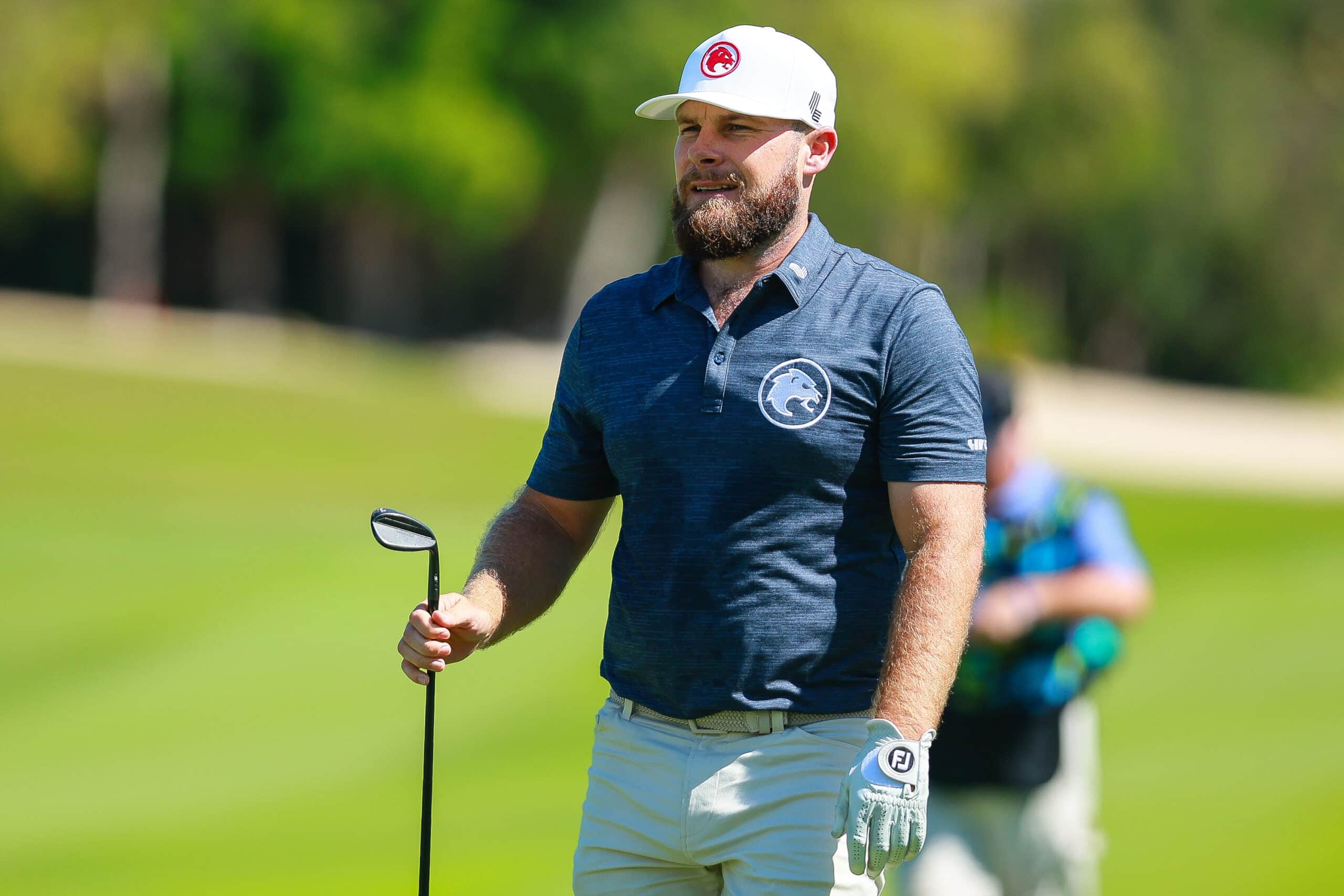
It may be cliche to sing Tyrrell Hatton’s praises on a links golf course, but considering most golf fans have not had a chance to see him play as much since joining LIV, it bears repeating.
Tyrrell Hatton is currently a top-10 talent in the world of golf, and will now take his red-hot form to a golf course tailor-made for his game. Considering how starkly different a links golf course is from the modern parkland golf course, that built-in comfort and familiarity will be an x-factor for Hatton at Portrush.
Links Specialist
Ironically, patience and even temperament are two of the most important intangibles needed to score on a links course, which are two of the last qualities one would associate with Tyrrell Hatton. However, in any case, Hatton has found his zen when the winds are whipping.
He’s added to his impressive links resume by picking up his third career Alfred Dunhill Links Championship at St. Andrews last October. Much like 2019 Open Championship contenders Shane Lowry, Tommy Fleetwood, and Lee Westwood, Tyrrell Hatton’s resume looks dramatically better when playing in front of local supporters in Europe. Eight of Hatton’s 10 career professional wins have come overseas, with Hatton’s sole stateside PGA TOUR victory coming in links-like conditions at a windy 2020 Arnold Palmer Invitational.
Hatton’s form has been spectacular in 2025, finishing T14 at The Masters and T4 at the U.S. Open. A T6 finisher in his last appearance at Portrush in 2019, Hatton will have high expectations in his 2025 return.
2025 British Open Odds: DFS Player Pool
With all the course-fit profiles in mind, I’m leaning early toward the below player pool. Naturally, I’m looking their way in the 2025 British Open odds as well. I’ve broken the list down by projected pricing/odds tier for DraftKings.

Tier 1
- Rory McIlroy
- Scottie Scheffler
- Jon Rahm
Tier 2
- Tommy Fleetwood
- Collin Morikawa
- Viktor Hovland
- Tyrrell Hatton
- Robert MacIntyre
Tier 3
- Russell Henley
- Sepp Straka
- Matt Fitzpatrick
- Sam Burns
- Adam Scott
Tier 4
- Tony Finau
- Patrick Reed
- Victor Perez
- Harris English
Tier 5
- Lee Westwood
- Tom Kim
- Nick Taylor
- Marc Leishman
2025 British Open Odds Model Breakdown
In my model, I’m emphasizing SG: APP, Driving Accuracy, SG: ARG, Weighted Putting (L36, 3-Putt Avoidance, Slow Greens), and Major History (L5 Years) followed by a balanced mix of Bogey or Worse Avoidance, Scrambling Gained, Good Drives Gained, Sand Saves, and SG: TOT (Comp Links Courses).
British Open Odds: Model Favorites
Unsurprisingly, it’s world No. 1 Scottie Scheffler who comes out on top of the model. Ranking No. 1 in SG: T2G, SG: BS, SG: ARG, SG: APP, Bogey Avoidance, and Major History, it’s tough to argue against Scheffler’s chances to pick up his fourth career Major championship, however he has yet to crack the top-5 in his first four Open Championship appearances, so there is hope for the rest of the field. The odds agree with Scheffler as the prohibitive favorite, but with unpredictable conditions looming, I’m less intimidated by Scheffler as I’ve felt most other weeks on the PGA TOUR.
After Scheffler, the rest of my model’s top 10 rounds out with: Russell Henley, Tommy Fleetwood, Tyrrell Hatton, Jon Rahm, Collin Morikawa, Sam Burns, Patrick Cantlay, Sepp Straka, and Corey Conners.
Demonstrating remarkable restraint, I kept patient without a single futures bet placed on British Open odds. I’m hoping to have a clear understanding of any weather-related split advantages in such a weather-impacted event. When the weather outlook is clearer, I’ll look to build my betting card around Tyrrell Hatton, Tommy Fleetwood, and Patrick Reed. Check back in later this week for more updates.
Best of luck navigating 2025 British Open odds!
- Join Lineups.com’s free sports betting Discord channel, where we are talking British Open odds all week. John will also share his betting card in the staff-golf-bets channel.