Online Casino Proponents, Opponents Discuss D.C. Legalization
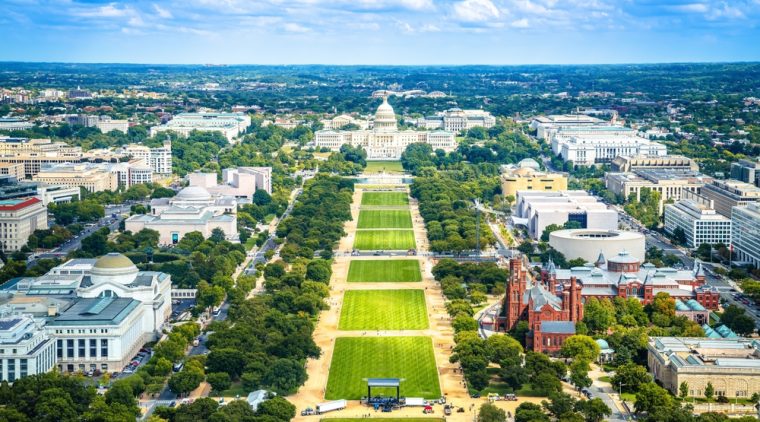
Washington, D.C.’s recently introduced online casino bill took center stage on May 4 when the D.C. Council’s Committee on Human Services held a public hearing that drew a wide range of witnesses.
The District is the third jurisdiction in the DMV area, after Maryland and Virginia, to consider iGaming legislation. If passed, online casino games like poker, roulette, and blackjack would become legal while a ban on sweepstakes gaming would also be enacted.
Chaired by Councilmember Matthew Frumin, the hearing included industry stakeholders, consumer advocates, and residents as witnesses.
Contents
D.C. bill comes after March failures in Maryland and Virginia
In March, Maryland and Virginia both saw their own iGaming legalization efforts fail amid heavy opposition, with some brick-and-mortar casino operators expressing a protective stance towards their foot traffic and retail revenues. The following month, D.C. Councilmember Wendell Felder introduced B26-0656, formally known as the Internet Gaming and Consumer Protection Act of 2026, to “to authorize, regulate, and tax internet gaming.”
Felder addressed the hearing with arguments centered on the proliferation of illegal online casinos and the money spent on unregulated platforms that could instead be kept in D.C.
“Whether we choose to acknowledge it or not, this market already exists,” he said. “The question before us is not whether online gaming happens. It does. The question is whether the District will continue allowing millions of dollars to flow outside of our oversight and outside of our economy, or whether we will regulate it responsibly.”
He noted the District’s illegal gambling market hit around $700 million in bets in 2024: “That is revenue currently leaving our city with little to no consumer protection.”
Key provisions of D.C. online casino bill
Wendell’s bill is designed to update the District’s gaming framework to implement the following measures.
- Authorize online casino-style games to be played on computers or mobile devices
- Establish regulatory oversight by the Office of Lottery and Gaming
- Establish responsible gaming measures and consumer protections
- Prohibit unlicensed sweepstakes gaming and similar dual-currency gaming products
- Require operators to pay a $2 million initial licensing fee for a five-year license and a subsequent $500,000 renewal fee for five additional years
- Impose a 25% tax on an operator’s gross iGaming revenue
Supporters include major operators and industry groups
Leading gaming operator representatives who testified at the hearing included DraftKings, Caesars and BetMGM. Industry groups who participated included the Sports Betting Alliance, represented by Michelle MacGregor, and the iDevelopment and Economic Association, represented by John Pappas.
MacGregor argued that legalizing iGaming is the right public policy to meet consumers where they are citing data from other states that regulated markets successfully migrate gamblers away from illegal offshore sites to legal platforms and provide them with responsible gaming support including identifying “people who are gambling outside their means.” She also testified in support of closing the “loophole for illegal sweepstakes.”
Pappas stressed that illegal iGaming is already widespread, citing 100,000 visits from D.C. to offshore websites every month. He argued the bill proactively establishes guardrails with geolocation and strict age verification.
Opposition cites social costs
Opponents to iGaming at the hearing pointed to the heightened risks of problem gambling that accompany immediate mobile accessibility, echoing the core anti-iGaming arguments raised throughout the region during debates in Virgina and Maryland.
Les Burnal, national director for Stop Predatory Gambling, characterized the legislation as “taxation by exploitation.” He argued that the district’s constituents will lose $400 million over the next five years to government-sponsored gambling and dismissed the claim that legalizing iGaming will reduce the illegal market.
Brianne Doura-Schawohl, testifying on behalf of the Campaign for Fairer Gambling, stated that iGaming is the “Frankenstein’s monster of advertising, access and action,” is 10 times more addictive than its other gambling, and is illegal in most states “for good reason.”
Next steps for online casino bill
No further action has been taken on the bill so far, as the record for all forms of public testimony officially closes on Monday, May 11.
From there, the committee will review the input before potentially marking up the bill and advancing it to the full D.C. Council for a vote. If the bill passes two votes from the full council, it will be sent to the mayor.
Even if the bill survives the mayor’s office, it still must undergo Congressional review, a process that will take a minimum of 30 days. If Congress does nothing during the review period, the measure becomes law.